
The most credible longevity treatment may be the one that makes no promise to reverse aging. With claims often running ahead of research, it’s understandable that compounded peptides for longevity can be difficult to assess. “Peptide” covers many different substances, and a prescription formulation isn’t automatically proven to extend life or slow aging.
What matters is evidence for a specific health outcome, along with a clear understanding of safety and clinical oversight. This article compares approaches with stronger evidence for defined outcomes against treatments whose longevity claims remain uncertain. It also explains what compounded peptides can and can’t currently promise. No peptide is FDA-approved specifically to slow human aging or extend lifespan, and compounded drugs aren’t FDA-approved in the same way as commercially approved medications.
You’ll also learn how individualized evaluation and prescription coordination fit into the process. Independent licensed medical providers assess eligibility and make clinical decisions. Whealth Labs coordinates administrative steps and access to prescribed formulations through licensed compounding pharmacies. The goal is to help you compare options using evidence rather than the promise of a universal anti-aging solution.
Key Takeaways
- Assess a treatment by the health outcome it targets, the quality of human evidence, and its potential risks, not by the strength of its marketing claims.
- Compare established health approaches by their specific benefits. Supporting healthy aging doesn’t necessarily mean reversing or stopping aging.
- Evaluate compounded peptides for longevity without assuming that an individualized preparation proves effectiveness, approval, or suitability.
- Define your goal, weigh the evidence and risks, and understand which clinical decisions belong to an independent licensed provider.
- Individualized evaluation and prescription coordination can support a structured care process, but they don’t guarantee a particular treatment or outcome.
What Does It Mean for an Anti-Aging Treatment to Actually Work?
“Anti-aging” can describe very different goals. It may mean supporting health and function with age, or make a stronger claim that a treatment can reverse, stop, or slow the biological process of aging. These claims aren’t interchangeable. An intervention may help with a specific health measure without being shown to extend life or prevent age-related decline.
Longevity generally concerns how long people live and the factors that influence lifespan. Healthspan describes the years lived in good health, with function and well-being. It isn’t the same as total lifespan. The Longevity overview offers background on the concept and its determinants, but a broad definition can’t establish that a particular treatment works.
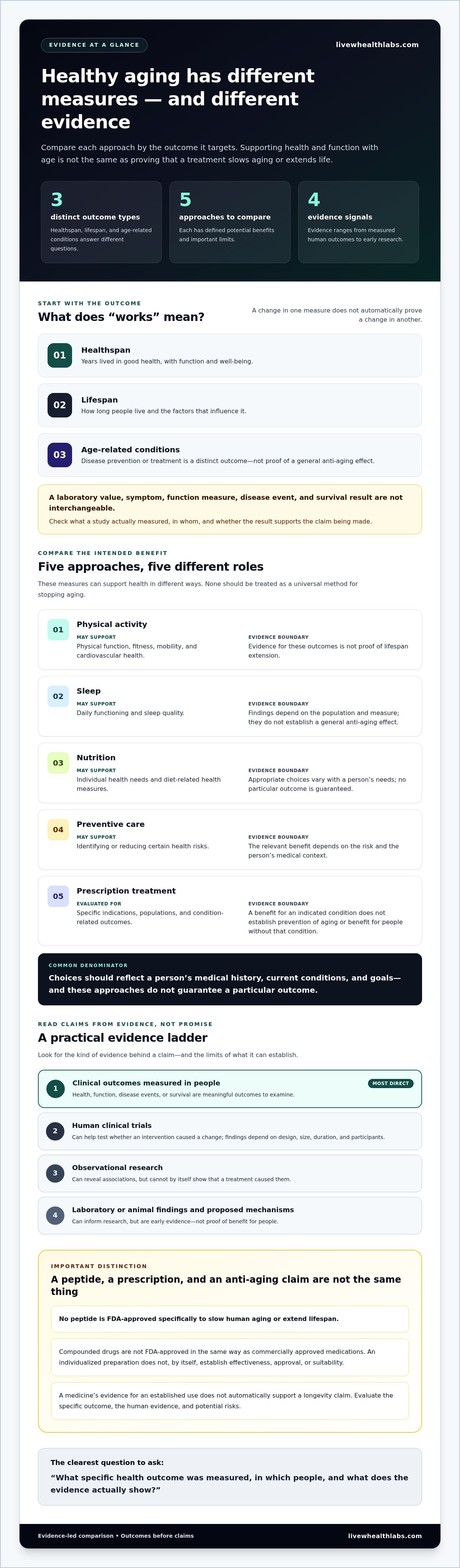
Healthspan, lifespan, and age-related conditions are different outcomes
A study might measure a change in a risk factor, a symptom, physical function, the onset of a disease, or survival. Each result answers a different question. A change in a laboratory value alone doesn’t prove that people live longer, remain healthier for longer, or avoid an age-related condition.
How to read evidence behind longevity claims
A useful evidence hierarchy starts with clinical outcomes measured in people, such as health, function, disease events, or survival. Human clinical trials can help test whether an intervention caused an observed change, but results depend on study design, size, duration, and participants. Observational research can reveal associations, but it can’t by itself show that a treatment caused them. Laboratory or animal findings and proposed biological mechanisms can inform research, but they’re early evidence, not proof of a benefit for people.
Look for published studies and check what they actually measured. Testimonials describe individual experiences. Promotional language may emphasize a plausible mechanism or preliminary finding while leaving uncertainty unclear. Neither substitutes for evidence that an intervention improved a meaningful outcome in an appropriate human population.
A demonstrated clinical benefit is a meaningful improvement in a measured health outcome, supported by appropriate human evidence for the population and use being discussed.
This is the standard applied throughout this evidence-led roundup. A biological explanation may be compelling, but it doesn’t establish that compounded peptides for longevity extend lifespan or improve healthspan. The sections that follow compare approaches by intended outcome, evidence, and safety, without treating anti-aging claims as a promise of longer life.
Which Anti-Aging Approaches Have the Strongest Evidence?
The strongest evidence depends on the outcome being considered. Physical activity, adequate sleep, nutrition, preventive care, and medical treatment can support health in different ways, but none should be treated as a universal method for stopping aging. For patients prioritizing joint preservation and physical mobility, minimally invasive regenerative therapies—such as those outlined at medicakomorkimacierzyste.pl—provide targeted alternatives to surgical procedures. Prescription treatments have evidence for the conditions they were studied and authorized to address, not automatically for extending lifespan in otherwise healthy people.
Foundational measures are practical starting points. Regular movement supports physical function and cardiovascular health; sleep supports daily functioning; nutritious eating helps meet individual health needs; and preventive care can identify or reduce certain health risks. Appropriate choices vary with a person’s medical history, current conditions, and goals. These measures matter, but they don’t guarantee a particular outcome. For a focused discussion of peptide research and precision approaches, read about peptide therapy for longevity.
Medical treatments target defined conditions
Medications are evaluated for specific indications, populations, and outcomes. Evidence that a drug benefits people with an indicated condition doesn’t establish that it prevents aging or benefits people without that condition. The same distinction matters for peptides. As Harvard Health Publishing explains in its overview of what peptides are, the category includes medicines with established uses as well as products marketed for wellness with less certain evidence.
| Approach | Sources and population | Outcomes considered | Key limitation |
|---|---|---|---|
| Physical activity | Public health guidance and human studies in varied adult populations | Fitness, mobility, and health measures | Evidence for these outcomes isn’t proof of lifespan extension. |
| Sleep and nutrition | Clinical guidance and human research, interpreted in the context of individual needs | Sleep quality, daily function, and diet-related health measures | Findings depend on the population and measure; they don’t establish a general anti-aging effect. |
| Prescription treatment | Clinical trials and prescribing information for people with a defined indication | Condition-specific symptoms, risks, or clinical outcomes | Results for an indicated use can’t be assumed to apply to longevity use. |
| Preventive care | Recommendations for eligible groups, such as screening or vaccination guidance | Detection or prevention of specific health problems | Benefits depend on eligibility and the intervention; preventive care isn’t a treatment to reverse aging. |
Use this comparison to ask three specific questions: What outcome was studied? In whom? What were the limitations? This standard is especially relevant to claims about compounded peptides for longevity. Individualized prescription and clinical evaluation are not substitutes for evidence that a treatment improves a meaningful outcome. Readers considering peptide-related care can explore individualized peptide therapy and care coordination as a structured route to provider evaluation.
Where Do Compounded Peptides for Longevity Fit, and What Is Still Uncertain?
Compounding describes how a medication is prepared, not how well it works. A formulation made for an individual prescription isn’t automatically proven to slow aging, appropriate for every patient, or FDA-approved. That distinction is central to evaluating compounded peptides for longevity, where claims can outpace evidence about meaningful outcomes in people.
What compounding does, and does not, mean
A compounding pharmacy prepares a medication for an individual patient under applicable requirements, generally based on a prescription. This differs from mass-market drugs made under an FDA-approved application and from products sold online as “research chemicals.” These categories aren’t interchangeable, and a research-use label isn’t evidence that a product is suitable for human use.
Compounded drugs are not FDA-approved in the same way as FDA-approved drugs. Compounding doesn’t mean the FDA has reviewed and established a formulation’s safety and effectiveness for longevity. Regulatory status varies by substance and can change. As of October 2026, FDA advisory committee recommendations concerning several peptides had not completed the formal process needed to take effect. A recommendation should not be mistaken for current authorization. Check current FDA guidance before drawing conclusions about a particular ingredient.
For additional context on how individualized preparations fit into wellness care, see compounded wellness formulations.
How to assess a peptide longevity claim
Start with evidence for the specific substance and intended use. Preclinical findings, including animal or laboratory research, can suggest a possible biological effect. Early human studies may offer preliminary information, but they don’t necessarily establish a reliable clinical benefit. Stronger evidence requires well-designed human research measuring outcomes relevant to the claim, such as health, function, or disease events. No peptide is FDA-approved specifically to slow human aging or extend lifespan.
A plausible biological mechanism can justify further study, but it does not prove that a peptide extends life or improves healthspan.
Consider uncertainties that promotional summaries may leave out: whether findings apply to people like you, whether effects persist over time, and which adverse effects may occur. For example, BPC-157 has promising preclinical research but very limited human evidence. An individualized provider evaluation can consider a person’s health history and proposed use, but it can’t replace missing clinical evidence or make an uncertain longevity claim an established fact.
Before considering a peptide, separate four questions: What is the intended use? What human outcomes have been studied? What risks and uncertainties are known? What is the substance’s current regulatory status? Keep the answers specific to the peptide rather than assuming that all compounds in this broad category share the same evidence or access status.
How to Compare Anti-Aging Options Without Overlooking Safety
A structured comparison can keep a promising headline from outranking the evidence. Before considering a prescription-based treatment, define the health goal, examine what research actually shows, and include potential risks and clinical oversight in the discussion. No single option is suitable for everyone, and a “longevity” label isn’t a substitute for individualized assessment.
A five-step framework for evaluating a treatment
- Define the outcome. Replace a broad aim such as “reverse aging” with a specific health concern or function you hope to address.
- Check the evidence. Look for relevant human studies and meaningful outcomes. Note whether the research concerns people with the same condition or goal, rather than relying on a proposed mechanism or testimonial.
- Review risks and status. Consider known and uncertain adverse effects, interactions, and the treatment’s current regulatory status. Compounding or personalization doesn’t establish safety or effectiveness.
- Consider individual suitability. An independent licensed medical provider evaluates health history, current medications, and other relevant factors, then decides whether a treatment is appropriate.
- Clarify follow-up. Before proceeding, understand how response and potential adverse effects will be reviewed, and what clinical follow-up is planned. The plan should be specific to the treatment and individual.
Questions that clarify clinical oversight
Good oversight makes responsibilities clear. The independent licensed provider evaluates the patient and makes medical decisions, including whether to prescribe. Administrative coordination is separate: it supports processes such as consent, information handling, and coordination with a compounding pharmacy when a prescription is issued. It doesn’t replace the provider’s judgment.
As you compare compounded peptides for longevity, consider whether the proposed use has relevant human evidence, how its uncertainties will be discussed, and who is responsible for clinical follow-up. A prescription alone doesn’t prove a longevity benefit, and coordination can’t guarantee a particular treatment or result.
For a closer look at how provider evaluation and prescription coordination fit together, read about medically coordinated peptide therapy. To explore an individualized evaluation and coordinated care pathway, review peptide therapy options.
A Responsible Next Step: Individual Evaluation and Coordinated Care
A sound decision about a longevity-related treatment starts with a defined health goal, relevant evidence, and an individualized assessment. No general protocol can determine whether a prescription is appropriate for a particular person. That decision belongs to an independent licensed medical provider, based on the patient’s health history and clinical needs.
What coordinated access can involve
Whealth Labs coordinates the administrative pathway between patients, independent licensed providers, and compounding pharmacies. This can include facilitating consent, coordinating necessary administrative steps, and handling patient information in a HIPAA-compliant manner. The provider evaluates the patient and makes medical decisions. Whealth Labs does not practice medicine or prescribe treatment.
If a provider determines that a prescription is appropriate, pharmacy fulfillment follows that prescription and applicable requirements. Coordination supports the process, but it doesn’t guarantee eligibility, a prescription, or a particular result. It also doesn’t change the evidence for a formulation or establish that it prevents aging.
What to expect from an evidence-led decision
An evaluation may conclude that a proposed therapy isn’t suitable. That can be a responsible outcome, particularly when evidence for a proposed use is limited or a person’s health history raises concerns. Before an evaluation, it may help to organize your goals, relevant medical history, current treatments, and questions about uncertainties, potential risks, and alternatives.
For compounded peptides for longevity, keep the discussion specific: What is the intended use? What evidence supports it? What would follow-up involve? Clear answers can help distinguish a clinical decision from an administrative step, without assuming that access means benefit.
Explore the process at your own pace through medically coordinated wellness care. For more detail about the administrative side, read how coordination fees are explained.
Choose Your Next Step With Evidence in View
The most useful anti-aging decision starts with a specific health goal, not a promise to reverse aging. Compare treatments by the quality of human evidence, the outcomes studied, and the risks relevant to your circumstances. Compounded peptides for longevity may be discussed in individualized care, but compounding alone doesn’t establish a longevity benefit or guarantee that a treatment is appropriate.
Clinical decisions belong to independent licensed providers. Whealth Labs coordinates access to those providers and, when a prescription is issued, facilitates coordination with licensed compounding pharmacies. It also supports HIPAA-compliant handling of patient information. This administrative role helps organize the process without guaranteeing eligibility, a prescription, or a particular outcome.
If you’re considering a next step, explore the care pathway at your own pace. Explore medically coordinated wellness care to learn how individualized evaluation and coordination fit together. A thoughtful choice may involve treatment, further discussion, or deciding that an option isn’t right for you. Each can be a constructive step toward more informed care.
Frequently Asked Questions
Do compounded peptides for longevity actually work?
There isn’t enough strong human evidence to conclude that compounded peptides slow aging, extend lifespan, or reliably improve healthspan. Evidence varies by peptide and intended use. A proposed biological effect or promising preclinical research isn’t the same as a demonstrated clinical benefit in people. A licensed provider can assess whether a particular prescription may be appropriate for an individual, but that evaluation can’t establish benefits that research hasn’t shown.
Are compounded peptides FDA-approved for anti-aging?
No. No peptide is FDA-approved specifically to slow human aging or extend lifespan. Compounded drugs aren’t FDA-approved in the same way as medications reviewed through the FDA’s drug approval process. Compounding may be permitted under applicable requirements for an individual prescription, but it doesn’t mean the FDA has approved a formulation’s safety and effectiveness for anti-aging. Regulatory status can vary by substance, so current guidance matters.
Which anti-aging treatments have the strongest evidence?
Evidence is strongest when a treatment has been studied in people for a defined health outcome, such as managing a diagnosed condition or reducing a specific risk. Physical activity, sleep, nutrition, and preventive care support distinct aspects of health, but none guarantees longer life or reverses aging. Consider prescription treatments in relation to their evaluated indications. Evidence for one condition doesn’t automatically support use for general longevity.
Can a compounded peptide extend lifespan?
No compounded peptide has been established as a way to extend human lifespan. Laboratory or animal findings may help researchers develop questions for further study, but they can’t show that people live longer. Human evidence must measure relevant outcomes and address safety over an appropriate period. Claims about a peptide’s mechanism, individual testimonials, or changes in a surrogate marker aren’t proof of a lifespan benefit.
What is the difference between a compounded peptide and an FDA-approved medication?
An FDA-approved medication has undergone FDA review for safety and effectiveness for specific uses. A compounded medication is prepared by a pharmacy for an individual prescription and isn’t FDA-approved in the same way. Compounding can address an individualized prescription need, but it doesn’t make a drug FDA-approved or establish evidence for an unapproved purpose such as longevity. Products sold as research chemicals are a separate category, not equivalent to prescribed formulations.
Is medical supervision necessary for peptide therapy?
Yes. A licensed medical provider should evaluate health history, current treatments, potential risks, and whether a proposed use is appropriate before prescribing. Eligibility and prescribing decisions belong to the provider, not an administrative coordinator. Supervision also matters because evidence and regulatory status vary among peptides. Don’t self-prescribe, use dosing instructions from marketing materials, or assume that a treatment is suitable simply because it was prescribed to someone else.
How does telehealth coordination for compounded peptides work?
Telehealth coordination connects a patient with an independent licensed provider for individualized evaluation. The provider makes clinical decisions and determines whether a prescription is appropriate. If prescribed, a compounding pharmacy prepares and fulfills the formulation according to the prescription and applicable requirements. Whealth Labs coordinates administrative steps, consent, pharmacy coordination, and HIPAA-compliant handling of patient information. Coordination doesn’t guarantee eligibility, a prescription, or a particular outcome.