
A pharmacy’s credentials and a medication’s FDA approval are not the same thing. The central question is straightforward: are compounded medications FDA approved? No. Compounded preparations aren’t reviewed by the FDA for safety, effectiveness, or quality before they’re marketed. At the same time, compounding follows a distinct regulatory pathway. A prescriber may consider customization when an available medication doesn’t meet a patient’s specific need.
It’s understandable to want an individualized formulation and clear information about oversight. This article explains what the absence of product-specific FDA approval means, how compounded preparations differ from FDA-approved and generic drugs, and why pharmacy registration or licensure doesn’t change a medication’s approval status. You’ll also learn how the 503A and 503B pathways differ, what responsible prescribing and fulfillment coordination should clarify, and where clinical decisions belong. Whealth Labs coordinates access to independent licensed providers and compounding pharmacies; prescribing decisions remain with the provider. Understanding that distinction can make the process clearer without treating coordination or regulatory oversight as proof of FDA approval or a clinical outcome.
Key Takeaways
- Are compounded medications FDA approved? No. Approval applies to specific products, not automatically to an ingredient or pharmacy.
- Traditional compounding and registered outsourcing facilities operate under different pathways. Neither pathway makes a compounded drug FDA-approved.
- Customization may address a patient-specific need, but it doesn’t provide product-specific FDA premarket review. Compounded drugs are also distinct from FDA-approved generics.
- Use a practical framework to clarify the medical rationale, preparation details, directions, dispensing pharmacy, and follow-up for a compounded medication.
- Whealth Labs coordinates communication and fulfillment while independent licensed providers retain responsibility for clinical decisions.
Are compounded medications FDA approved? The direct answer
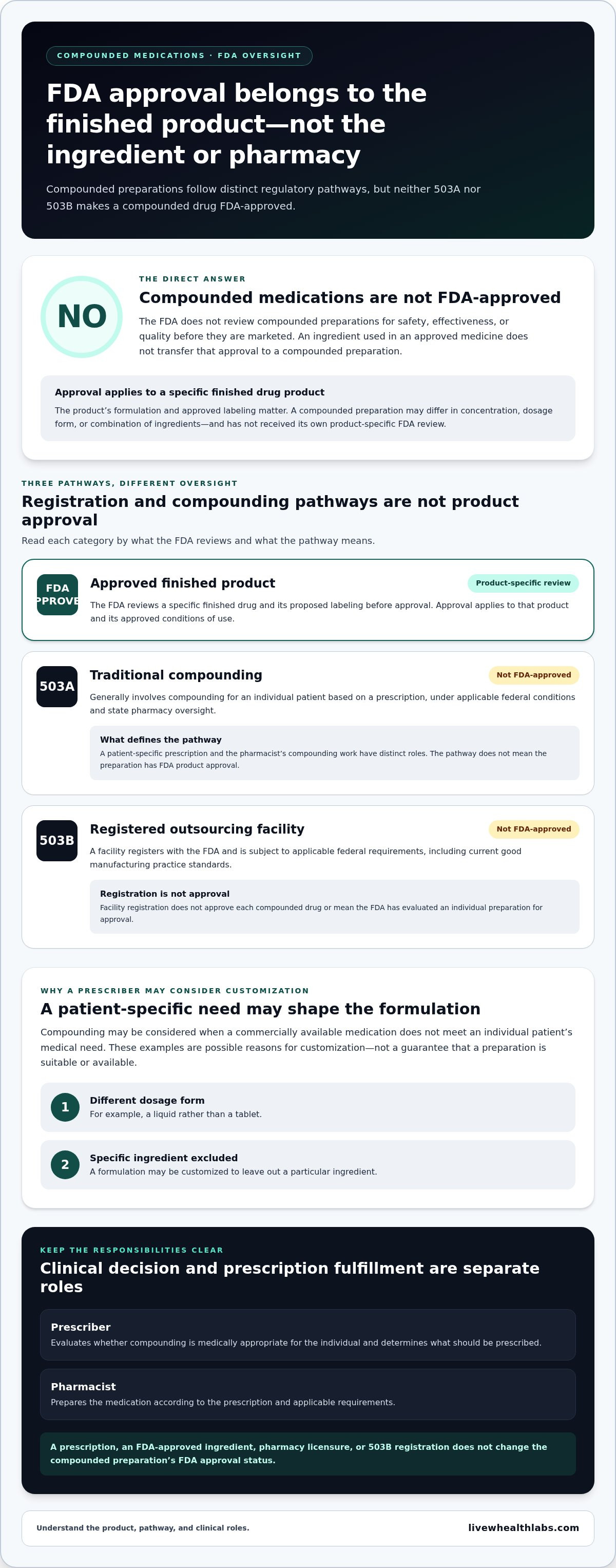
No. Compounded medications themselves are not FDA-approved. That remains true even when a compounded preparation contains an active ingredient used in an FDA-approved medication. Approval applies to a specific finished drug product, not automatically to every preparation made with one of its ingredients.
An FDA-approved ingredient does not make a compounded preparation FDA-approved. Approval belongs to the specific finished product reviewed by the agency. A compounded preparation may differ from an approved medicine in concentration, dosage form, combination of ingredients, or other details. Because of those differences, the preparation as dispensed has not received its own product-specific FDA review for safety, effectiveness, and quality before marketing.
What FDA approval means for a finished medication
FDA approval is tied to a particular drug product and its approved labeling, including how it is made, what it contains, and the conditions and directions for its use. Approval doesn’t automatically transfer to a customized version, even if that version uses an ingredient found in an approved product. Approval also isn’t a promise that a medicine is risk-free; it reflects review of the specific product and evidence submitted for its approved use.
This distinction can be easy to miss. A familiar ingredient name on a prescription or label doesn’t establish that the final compounded preparation was reviewed by the FDA. The dosage form, strength, and formulation may not match the approved product. For general background on the practice and its purposes, see What is pharmaceutical compounding?
Why compounded medications may still be prescribed
Compounding may be considered when a commercially available medication doesn’t meet an individual patient’s medical need. For example, a patient may need a different dosage form, such as a liquid rather than a tablet, or may need a specific ingredient excluded. These are possible reasons for customization, not a guarantee that a particular preparation is suitable or available. Similar considerations also arise in veterinary medicine, where care providers like the Animal Hospital of Sullivan County utilize customized formulations to meet the unique dosage and administration needs of pets.
The decision is clinical, not simply a preference for a customized product. A licensed prescriber evaluates whether compounding is medically appropriate for the individual and determines what should be prescribed. The pharmacist then prepares the medication according to the prescription and applicable requirements. These roles are distinct: the prescriber makes the treatment decision, while the pharmacy fulfills the prescription. Neither an FDA-approved ingredient nor a prescription changes the preparation’s FDA approval status.
For patients, the practical takeaway is to identify the exact product being discussed. An approved commercial drug and a compounded preparation that uses a related ingredient are not interchangeable descriptions. Knowing whether a prescription is for an FDA-approved finished product or a compounded formulation helps set accurate expectations about what the FDA reviewed and what the prescriber is recommending.
How FDA oversight differs for compounded drugs and approved medications
FDA oversight depends on the pathway involved, and the categories aren’t interchangeable. An FDA-approved medication is reviewed as a specific drug product. Compounding operates under federal conditions and state pharmacy oversight, with different requirements for traditional pharmacies and registered outsourcing facilities. The FDA’s perspective on compounded medications explains the distinction between compounding and the drug-approval process.
| Category | What the pathway means | Does it approve each product? |
|---|---|---|
| FDA-approved product | FDA reviews a specific finished drug and its proposed labeling before approval. | Yes, approval applies to that product and its approved conditions of use. |
| Traditional compounding, section 503A | Generally involves compounding for an individual patient based on a prescription, under applicable federal conditions and state pharmacy oversight. | No. The compounded preparation is not FDA-approved. |
| Registered outsourcing facility, section 503B | A facility registers with FDA and is subject to applicable federal requirements, including current good manufacturing practice standards. | No. Registration does not approve each compounded drug. |
Sections 503A and 503B describe different statutory pathways, not grades of FDA approval. They help define how compounding may occur and which oversight requirements apply. Neither designation means the FDA has evaluated an individual compounded preparation for approval. So, if you’re asking, “Are compounded medications FDA approved?” the facility category doesn’t change the answer.
Traditional compounding under section 503A
Under the traditional pathway, a licensed prescriber’s patient-specific prescription and the pharmacist’s compounding work serve distinct roles. The prescriber determines the clinical need and writes the prescription; the pharmacist prepares the prescribed formulation. State boards of pharmacy are central to pharmacy oversight, and federal conditions also apply. Specific practices and oversight can vary, so the 503A label alone doesn’t describe every detail of a pharmacy’s operation.
Outsourcing facilities under section 503B
Section 503B facilities register with the FDA and must follow applicable federal requirements, including current good manufacturing practice standards. The FDA inspects these facilities on a risk-based schedule. Their pathway allows certain compounding at a larger scale, with or without patient-specific prescriptions. These requirements establish a different oversight framework, but they don’t make compounded products FDA-approved drugs.
Facility registration is a status for the establishment, not FDA approval of the medications it compounds. Pharmacy licensure, FDA registration, and FDA product approval refer to separate forms of oversight. Keeping those distinctions clear helps patients understand what a credential does and doesn’t establish about a particular preparation. Whealth Labs supports administrative coordination between patients, independent licensed providers, and compounding pharmacies. That process support is separate from prescribing and FDA approval. Learn about Whealth Labs’ care coordination.
Compounded medications versus FDA-approved drugs: benefits and limitations
Customization can address a specific need, but it doesn’t provide the same kind of product-specific evidence as FDA approval. If you’re asking, “are compounded medications FDA approved,” the answer remains no. That distinction doesn’t, by itself, establish that every compounded preparation is unsafe or that every approved drug is right for every patient. It means the potential benefits and limits should be considered for the particular prescription, rather than assumed from the ingredient or the word “customized.”
In practical terms, the differences include:
- Potential benefit: A compounded medication may be prepared in a different dosage form or with a particular ingredient excluded when a prescriber identifies an individual medical need.
- Key limitation: The specific compounded preparation hasn’t received FDA premarket review as a finished drug product.
- Separate category: A generic is an FDA-approved drug that meets applicable requirements for approval. It isn’t the same as a compounded version of a brand-name or generic medication.
- Safety consideration: Compounding can involve risks such as incorrect potency or dosage, contamination, or labeling errors. The relevance of these risks depends on the preparation and its handling; they aren’t proof that every compounded medication has a problem.
When customization may address a genuine patient need
A tailored preparation may be considered if a commercially available medication doesn’t meet a patient’s needs, such as when the available dosage form is unsuitable or a particular ingredient presents a clinically relevant concern. Customization isn’t automatically preferable, however. A licensed prescriber evaluates the patient’s circumstances and whether compounding is medically appropriate, rather than treating it as a routine substitute when an approved medication meets the need.
What patients give up when a drug is not FDA-approved
The central limitation is specific: the finished compounded preparation hasn’t undergone FDA premarket review for safety, effectiveness, and quality. Patients shouldn’t assume that evidence and approval for a related commercial drug transfer to a formulation that may differ in strength, dosage form, or ingredients. Nor does the absence of approval establish that a particular preparation is defective. It marks a difference in the review pathway, and product-specific claims about effectiveness require product-specific evidence.
Generics offer a useful point of comparison. An FDA-approved generic is approved as a drug product under applicable requirements; a compounded medication is prepared through a separate pathway and isn’t a generic simply because it uses the same active ingredient. The choice isn’t a general contest between “custom” and “approved.” It turns on the prescriber’s medical rationale, the available options, and the specific preparation under consideration.
A practical next step is to understand what is being prescribed: the medication, dosage form, strength, directions, and reason a compounded option is being considered. These details support a clearer conversation with the prescriber and help avoid assuming that customization itself establishes suitability, safety, or equivalence.
What patients should understand before using a compounded medication
A clear process can help you understand what has been prescribed and how to use it as directed. Before starting, organize the conversation around three points: why compounding is being considered, exactly what the preparation contains and how to take it, and what follow-up is appropriate. If you’re asking, “are compounded medications FDA approved?” remember that pharmacy oversight and product approval are separate questions. Understanding both the prescription and its oversight context supports an informed discussion with the prescriber.
- Confirm the medical rationale. Ask what patient-specific need the compounded preparation is intended to address and how that need relates to the available options. The prescriber can explain the clinical reasoning and whether a compounded formulation is appropriate for your circumstances.
- Understand the preparation. Make sure you know the prescribed medication and ingredients, dosage form, strength, directions, and name of the pharmacy responsible for dispensing it. If you have allergies or concerns about an ingredient, raise them with the prescriber before using the medication.
- Clarify use and follow-up. Discuss how to administer the preparation, how it should be stored, what effects or concerns to monitor, and whom to contact if you have a reaction or difficulty following the directions. Don’t guess at a dose or change instructions on your own.
Questions that clarify the prescription and preparation
Useful questions are specific: What need is this formulation meant to address? Which ingredients and dosage form were prescribed? What are the exact directions, including the dose and timing? Which pharmacy will dispense it? Discuss allergies, storage instructions, and possible adverse effects with the prescriber. If the label seems different from what you understood, or administration proves difficult, report the issue promptly rather than improvising.
Keep the label and prescription information accessible, especially if you take other medications or speak with another member of your care team. Precise information helps the prescriber assess questions about use and follow-up; it doesn’t replace that clinician’s judgment. If you experience an unexpected effect, contact your prescriber for guidance about what to do next.
How to interpret pharmacy oversight and quality information
Pharmacy credentials and product approval are separate questions. State pharmacy licensure, FDA registration of an outsourcing facility, FDA inspection, and FDA approval of a drug refer to distinct oversight concepts. A credential or inspection status can provide information about a facility’s regulatory framework, but it doesn’t guarantee an individual preparation’s outcome or make that preparation FDA-approved.
For current details, consult FDA information on drug compounding and the relevant state board of pharmacy’s public resources. The applicable oversight can depend on whether compounding occurs through a traditional pharmacy or a registered outsourcing facility. Read credentials in that context, not as a substitute for understanding the medication, directions, and prescriber’s rationale.
Whealth Labs coordinates communication and fulfillment between patients, independent licensed providers, and compounding pharmacies, while clinical decisions remain with the independent provider. For support with coordinating your care pathway, explore Whealth Labs’ administrative coordination.
How Whealth Labs coordinates access without replacing clinical judgment
Whealth Labs provides administrative coordination between patients, independent licensed providers, and compounding pharmacies. Its role is to support communication and fulfillment across these parts of the process, not to diagnose, prescribe, or practice medicine. The distinction matters: coordination can help organize a care pathway, but it can’t determine whether a treatment is appropriate for an individual.
Where clinical decisions sit in a coordinated process
Independent licensed providers conduct consultations and make clinical decisions, including whether an individual may be eligible for a treatment and whether a prescription is appropriate. Those decisions depend on an assessment of the person’s circumstances. A consultation or coordination process doesn’t guarantee eligibility, a prescription, or a particular treatment plan.
In a coordinated pathway, the responsibilities remain distinct:
- The independent provider assesses clinical information and makes treatment and prescribing decisions.
- The compounding pharmacy handles medication fulfillment when a valid prescription calls for a compounded preparation.
- Whealth Labs supports administrative communication and coordination between the patient, provider, and pharmacy.
This structure clarifies who is responsible for each part of the process. Whealth Labs doesn’t replace the provider’s clinical judgment or the pharmacy’s role in fulfillment. Patients should direct clinical questions, including questions about suitability, dosing, or possible effects, to the independent provider responsible for their care.
What administrative coordination can support
Administrative coordination can connect the parties involved and support the movement of relevant information through the process. Whealth Labs manages patient information through HIPAA-compliant processes. That describes how information is handled; it doesn’t establish that a compounded medication is FDA-approved, guarantee the quality of a particular preparation, or predict a treatment outcome. The question “are compounded medications FDA approved” remains separate from who coordinates communication or how records are managed.
Likewise, coordinating fulfillment with a licensed compounding pharmacy is process support, not product-specific FDA review. FDA approval, pharmacy oversight, and administrative coordination are distinct concepts. Keeping them separate helps patients understand what a platform contributes without mistaking its role for a clinical decision or regulatory determination.
For those exploring peptide-related care, Whealth Labs’ Precision Peptide Therapy pathway connects patients with independent licensed providers while preserving their responsibility for clinical assessment and prescribing decisions. Learn more about the precision peptide therapy online pathway to understand how provider consultation and administrative coordination fit together.
Take the Next Step With Clarity
A question like “are compounded medications FDA approved” is a useful starting point, but informed care also depends on understanding the clinical reasoning behind a treatment and the roles of the people involved. Bring your questions to the next conversation and focus on what matters to your individual circumstances. A thoughtful discussion can help you make sense of your options without confusing administrative coordination with clinical judgment or regulatory review.
Whealth Labs provides a coordinated pathway connecting patients with independent licensed providers and compounding pharmacies, with patient information managed through HIPAA-compliant processes. This support helps organize the process, while clinical decisions remain with the independent provider. Explore how this approach may fit your care journey.
Explore how Whealth Labs coordinates access to precision wellness care, and take your next step with greater clarity.
Frequently Asked Questions
Are compounded medications FDA approved?
No. If you’re asking, “are compounded medications FDA approved?” the answer is no: FDA approval applies to specific drug products, not compounded preparations as a category. If you’re unsure what a prescription refers to, look at the medication name and dosage form on the label, then clarify with the prescriber whether it is a commercially manufactured product or a compounded preparation. That distinction helps you understand which review pathway applies.
Does using an FDA-approved ingredient make a compounded medication FDA approved?
No. An ingredient’s status doesn’t establish approval of the preparation made with it. For example, the compounded product may have a different concentration, dosage form, or combination than a commercially approved medication containing that ingredient. To avoid confusing the two, focus on the exact preparation prescribed, not only the active ingredient name. The prescriber can explain why that formulation was selected and how its directions differ from another product.
Are compounded medications the same as generic drugs?
No. A generic is an FDA-approved drug product that meets applicable requirements; a compounded medication is prepared through a different pathway and isn’t a generic substitute simply because it contains the same active ingredient. A familiar drug name may appear in both contexts, so check the actual product and label. If you’re comparing prescriptions, ask the prescriber whether each is a generic product or a compounded preparation before assuming they can be substituted.
Does an FDA-registered 503B outsourcing facility make its medications FDA approved?
No. FDA registration applies to the outsourcing facility, not to approval of each medication it compounds. A 503B facility is subject to applicable federal requirements and FDA inspection on a risk-based schedule, but those facts don’t mean an individual preparation has received product-specific approval. Keep facility oversight and drug approval separate when interpreting statements about a pharmacy’s status, and rely on the prescriber to explain what was prescribed.
Are compounded medications automatically unsafe because they are not FDA approved?
No. The absence of FDA approval does not, by itself, prove that a particular preparation is unsafe, but it also shouldn’t be treated as evidence that it has been reviewed like an approved drug. If the medication looks different from the label or you have trouble measuring or administering a dose, pause and seek guidance from the prescriber or dispensing pharmacy before making assumptions or changing the directions.
Why would a provider prescribe a compounded medication instead of an FDA-approved drug?
A provider may consider compounding when an available product doesn’t meet a patient-specific medical need, such as an unsuitable dosage form or a clinically relevant ingredient concern. This isn’t a general reason to replace an approved medication. The prescriber weighs the individual circumstances and available options. Ask what need the formulation is intended to address and why the prescribed preparation is appropriate for your situation.
What should I ask about a compounded medication before using it?
Ask what the preparation is intended to address, which ingredients and strength it contains, how to take or administer it, and how to store it. Confirm the dispensing pharmacy and whom to contact about a missed dose, administration difficulty, or unexpected effect. Share allergies and other medications with the prescriber. Keep the label available so you can refer to the exact directions when discussing concerns.