
A peptide’s reputation isn’t a safety profile. If you’re asking, “are peptide therapies safe,” the answer depends on the specific substance, the evidence for its intended use, and the quality of the product. An approved prescription medicine, a compounded preparation, and a product labeled “research use only” don’t carry the same standards or level of evidence.
Some peptide-based medicines are approved for specific conditions and have been studied for those uses. Evidence and oversight may be more limited for other peptides, while products not intended for human use can raise additional concerns about purity and dosing. Possible side effects also vary by substance, so broad claims that peptide therapy is either universally safe or unsafe can be misleading.
This article explains how to distinguish these product categories, evaluate evidence and quality, and understand the role of qualified medical oversight in assessment, prescribing decisions, and follow-up. Whealth Labs coordinates care between users, independent licensed providers, and licensed compounding pharmacies. Clinical decisions remain with the providers. Knowing the difference can help you assess safety more clearly.
Key Takeaways
- Are peptide therapies safe? Assess the specific substance and intended use rather than relying on broad claims about peptides as a group.
- Consider the evidence alongside your health history, other treatments, and a clinician’s plan for follow-up.
- Distinguish an FDA-approved medicine from a compounded preparation or a research-use product; approval applies to a specific product and indication.
- Before treatment, discuss the exact substance, expected benefits, known risks, alternatives, and how concerns or side effects will be monitored.
- Care coordination can organize provider access and pharmacy logistics, while clinical judgment and prescribing remain with independent licensed providers.
Are peptide therapies safe? The answer depends on the specific therapy
There isn’t one safety answer for peptides as a whole. An established medicine containing a peptide, a compounded preparation, and a product marketed for research are not interchangeable. Their evidence, quality controls, intended uses, and risks can differ substantially.
Assess peptide therapy safety substance by substance, for a defined purpose and person, using evidence about the specific product, its quality, and the plan for clinical oversight. Medical supervision can help identify avoidable risks and guide follow-up, but it can’t eliminate uncertainty or guarantee that a treatment will be safe or effective.
What does peptide therapy mean in a medical context?
Peptides are short chains of amino acids with varied biological roles. “Peptide therapy” describes a broad category, not one treatment with a shared safety profile. In a medical context, it means using a particular peptide substance for a specific purpose, with decisions about its use made by a qualified clinician.
That differs from products marketed for research use, which aren’t intended to be medicines for people. “Wellness” marketing also doesn’t establish that a product has been adequately studied or assessed for a particular use. A substance’s presence in the body or in nature doesn’t automatically make it safe as a medicine. The dose, route, formulation, and evidence still matter.
Why one safety answer cannot cover every peptide
Risk depends on several connected factors: the substance, how it’s administered, the dose, the reason for considering it, and the person’s health history. The same reported side effect may have different significance depending on the treatment and the individual. Product quality is a separate concern. Uncertainty about a product’s identity, purity, or strength can complicate any assessment of expected effects and risks.
Evidence must also be specific. Findings about one peptide medicine used for a defined condition can’t automatically support claims about another peptide or a broader category. For less-studied substances, gaps in human evidence can make possible benefits and longer-term risks harder to estimate. The absence of well-established evidence isn’t proof of safety.
A licensed provider can consider the intended use alongside a person’s health circumstances, discuss known risks and uncertainties, and determine whether monitoring is appropriate. That assessment is individual, not a blanket endorsement of peptide therapy. The practical question isn’t simply whether peptides are safe, but whether the evidence and safeguards for this particular substance and situation support considering it.
What determines peptide therapy safety, from evidence to follow-up?
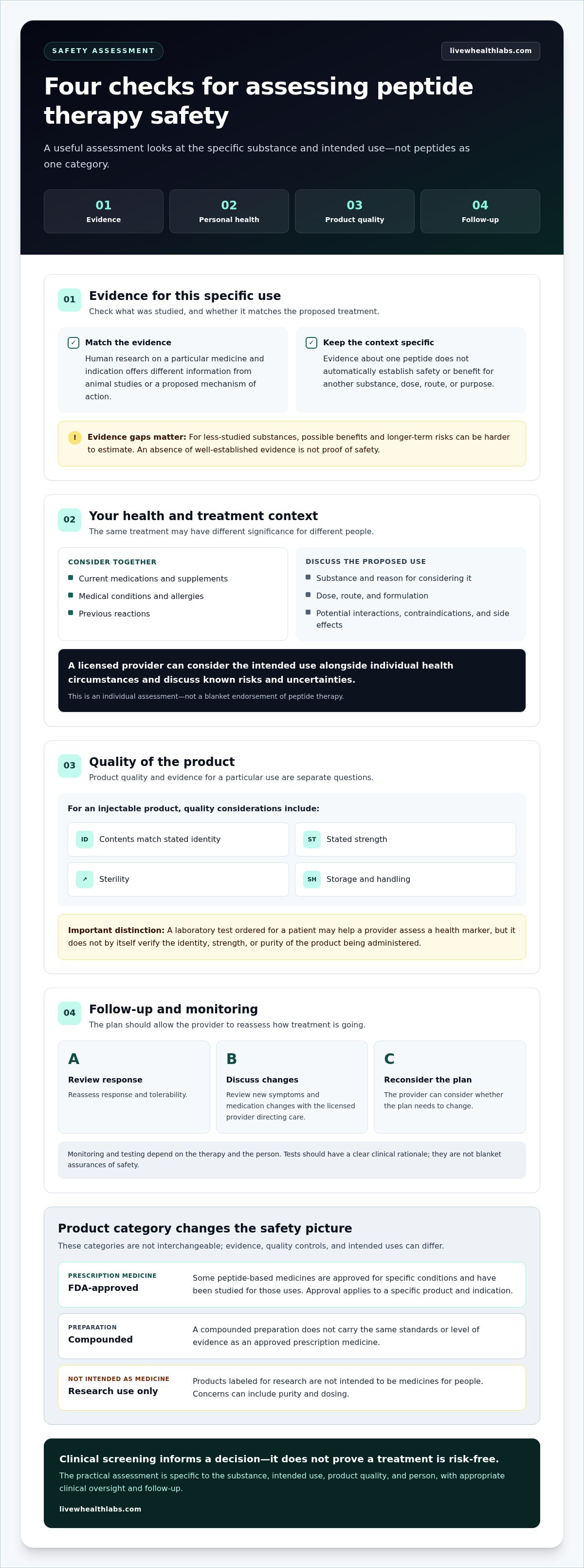
A useful safety assessment goes beyond a single lab result or a general claim about peptides. It brings together four questions: What evidence supports this specific use? How might the person’s health affect the decision? How is product quality addressed? And how will response or concerns be followed over time?
Clinical screening can inform a treatment decision, but it doesn’t prove that a treatment is risk-free. Tests should be selected for a clinical reason, based on the substance, intended use, and individual circumstances. There is no universal panel that certifies every peptide as safe or confirms a product’s identity, strength, or purity.
Evidence, intended use, and individual health factors
Weigh evidence according to what was studied. Human clinical research on a particular medicine and indication offers different information from animal studies or a proposed mechanism of action. A finding in one context doesn’t establish safety or benefit for a different dose, route, or purpose. Harvard Health on peptide safety also discusses evidence gaps and risks associated with unregulated products and trendy peptides.
Personal context matters, too. A provider may consider current medications and supplements, medical conditions, allergies, and previous reactions. These factors can affect potential interactions, contraindications, and whether a proposed therapy is appropriate. Possible side effects depend on the specific substance and how it’s used. Without reliable evidence for that treatment, their likelihood may be difficult to estimate. An individualized clinical assessment is more meaningful than assuming one risk profile fits everyone.
Product quality and monitoring after treatment begins
For an injectable product, relevant quality considerations include whether the contents match their stated identity and strength, as well as sterility, storage, and handling. These are separate questions from whether a substance has evidence for a particular use. A laboratory test ordered for a patient may help a provider assess a health marker, but it doesn’t, by itself, verify the quality of the product being administered.
Follow-up gives the provider an opportunity to reassess response and tolerability, review new symptoms, and consider whether the plan needs to change. Appropriate monitoring depends on the therapy and the person; testing should have a clear clinical rationale, not serve as a blanket assurance. Share new or worsening symptoms and any changes to medications with the licensed provider directing care.
Care coordination can help organize provider consultations and pharmacy logistics, while clinical decisions remain with independent licensed providers. Explore peptide therapy care coordination to learn how the process is organized.
FDA-approved, compounded, and research-use peptides: what is the safety difference?
Product category affects what is known about a peptide and what oversight applies. To assess whether peptide therapies are safe, distinguish an FDA-approved medicine from a compounded preparation and a product labeled for research use. These categories aren’t interchangeable, and none guarantees safety for every person.
| Category | What the category tells you | Important limitation |
|---|---|---|
| FDA-approved medicine | The specific product has been reviewed for its labeled uses, based on evidence submitted for FDA approval. | Approval applies to that medicine and indication, not every peptide or every use. Risks remain, and it may not suit every patient. |
| Compounded preparation | A pharmacy prepares a medication for a particular patient under applicable federal and state requirements. | Compounded drugs aren’t FDA-approved and aren’t reviewed by the FDA for safety, effectiveness, and quality in the same way as approved drugs. |
| Research-use product | The labeling indicates that the product is intended for research, not as a treatment for people. | That label doesn’t establish suitability, quality, or safety for human use. |
What FDA approval does, and doesn’t, tell a patient
Approval relates to a particular medicine, its formulation, and its labeled indication. It doesn’t certify every substance in the same broad category, establish that off-label uses have the same evidence, or remove the possibility of side effects. An approved medicine also may not be appropriate for a particular individual. For any named drug, check its current FDA labeling and safety communications for product-specific information.
How compounded and research-use products differ
Compounding involves a pharmacy preparing a medication rather than dispensing an FDA-approved finished product in its approved form. A compounded preparation may be considered in an appropriate clinical context, but its regulatory status and evidence shouldn’t be described as equivalent to those of an FDA-approved medicine. Whether a particular substance may be compounded can depend on current rules and substance-specific FDA guidance, which can change. Use current guidance rather than relying on older claims or general statements about peptides.
Research-use labeling is different again: it doesn’t mean a product has been evaluated or authorized as a human treatment. A seller’s description or a research label isn’t a substitute for clinical evidence or a medical decision. A licensed provider can assess the intended use and individual circumstances; the category alone can’t determine whether a treatment is appropriate.
How to assess peptide therapy risks before and during treatment
Asking “are peptide therapies safe” is most useful when it leads to specific questions about a proposed treatment. Bring these points to the licensed provider responsible for clinical decisions. Clear answers should help you understand both what is known and what remains uncertain.
Questions to clarify before starting
- What exact substance and formulation are being considered? Clarify the intended route and clinical purpose. If the product’s identity or formulation is unclear, pause until the provider can explain it.
- What evidence supports this specific use? Ask whether evidence comes from human studies of this substance for this purpose, and what important uncertainties remain. Evidence for a different peptide or use may not answer this question.
- What benefits and risks should I weigh? Discuss known or possible side effects, potential interactions, contraindications, and reasonable alternatives, including the option not to proceed.
- Who prescribes and monitors the treatment? Confirm which licensed provider makes clinical decisions, who reviews your progress, and how to report side effects or other concerns.
- What is the follow-up plan? Ask what changes or symptoms should prompt contact, when the provider will reassess your response, and whether any tests are clinically appropriate.
What follow-up and safety communication should cover
Share a complete, current account of your medications and supplements, allergies, health conditions, and prior reactions. These details can affect the provider’s assessment. Monitoring should be tailored to the specific treatment and your circumstances. If laboratory testing is suggested, ask what clinical question it is intended to answer; tests aren’t universal proof that a treatment is safe.
Be cautious if anyone guarantees a result, claims there are no risks, can’t clearly identify the product, or pressures you to decide before your questions are answered. After treatment begins, report new or concerning symptoms to the prescribing provider. Don’t change or stop a prescribed treatment without discussing it with them, unless you’re facing an emergency. Seek prompt medical attention for severe or rapidly worsening symptoms.
Explore independent provider consultations to learn how care coordination separates clinical decisions from administrative support.
How medically coordinated peptide care supports a more informed decision
Understanding a therapy’s evidence, product category, and risks is only part of the decision. A coordinated process can help organize consultations and pharmacy logistics, but it doesn’t determine whether treatment is medically appropriate. If you’re asking, “are peptide therapies safe,” remember that coordination supports the process; it isn’t a safety guarantee.
Where coordination ends and medical decision-making begins
Whealth Labs connects users with independent licensed providers and compounding pharmacies for individually prescribed peptide and wellness therapies. Diagnosis, eligibility, treatment selection, prescribing, and clinical follow-up belong to the independent providers. The platform supports administrative coordination and HIPAA-compliant data management, but doesn’t practice medicine or make clinical decisions.
This distinction matters. Coordination doesn’t make a substance FDA-approved, establish that a product is appropriate for every person, or remove treatment risks. Pharmacy coordination is one part of the process; the provider is responsible for clinical judgment. For a closer look at how the steps fit together, read the precision peptide therapy coordination guide.
A considered next step for readers exploring formulations
A measured decision follows a clear sequence: identify the exact therapy and its intended use, understand its regulatory and product category, discuss evidence and individual risks with a licensed provider, then establish a suitable follow-up plan. If you’re exploring how formulation choices fit into a broader wellness approach, the customized wellness formulations guide offers additional context. For individuals seeking non-invasive care to address root causes of pain alongside their wellness routine, exploring providers like Yuba Sutter Chiropractic & Wellness highlights how targeted therapies can support physical recovery and healing.
Take time to understand each step before deciding whether to proceed. You can explore medically coordinated care to review the coordination process and how it connects users with independent providers and pharmacies. Decisions about eligibility or treatment remain with the licensed provider, and no particular outcome is assured.
Make your next step an informed one
So, are peptide therapies safe? There’s no single answer for every peptide. Safety depends on the specific substance and intended use, the strength of the available evidence, product quality, and your individual health context. FDA approval, compounding, and research-use labeling describe distinct product categories, not interchangeable assurances.
Before considering treatment, clarify what’s being proposed, what is known about its risks and benefits, and how follow-up will work. A licensed provider makes clinical decisions, including whether a therapy is appropriate and how it should be monitored. For individuals weighing emerging therapies for sports injuries or joint recovery, consulting established practices such as orthopedicnewjersey.com can provide guidance on proven clinical pathways. Care coordination can organize access and logistics, but it cannot guarantee safety or replace medical judgment.
Whealth Labs coordinates with independent licensed providers and licensed compounding pharmacies, with HIPAA-compliant data management as part of its coordination service. To learn how that process works, explore medically coordinated peptide care. Take the time you need to understand your options, ask informed questions, and choose your next step with confidence.
Frequently Asked Questions
Are peptide therapies safe for everyone?
There’s no universal answer to whether peptide therapies are safe for everyone. Safety depends on the exact substance, formulation, dose, route, intended use, and person’s health circumstances. An approved medicine may have evidence for a specific indication, but that doesn’t establish safety for other uses or every patient. A licensed provider should review medications, conditions, allergies, and prior reactions before assessing potential benefits and risks.
Are compounded peptides FDA-approved?
No. Compounded drugs aren’t FDA-approved finished medicines and aren’t reviewed by the FDA in the same way for safety, effectiveness, and quality. A pharmacy may prepare a compounded medication under applicable requirements for an individual prescription, but compounding doesn’t make the preparation equivalent to an approved drug. Rules can depend on the substance and may change, so current FDA guidance matters.
Can peptide therapy cause side effects?
Yes. Side effects are possible, and their type and likelihood depend on the specific substance, formulation, dose, and route. Possible effects reported with some peptide therapies include injection-site reactions, nausea, headache, or fatigue, but those examples don’t apply to every peptide. More serious risks may be specific to a treatment or product. Discuss known risks with the prescribing provider and seek prompt medical attention for severe or rapidly worsening symptoms.
How do I know whether a peptide is FDA-approved?
Check the exact medicine name, formulation, and intended indication against current FDA-approved drug information and the product’s FDA labeling. Approval applies to a specific product and its labeled uses, not every product containing a similar ingredient or every use promoted online. If you’re unsure whether the product being discussed matches an FDA-approved medicine, ask the licensed provider to clarify its status and intended use.
Are research peptides safe to use in humans?
A “research use only” label doesn’t establish that a peptide is suitable or safe for human treatment. Such products aren’t presented as medicines for people, and their identity, strength, purity, or sterility may be uncertain. Don’t treat marketing claims or a research label as evidence of clinical safety. Discuss any proposed therapy with a licensed provider, particularly if the product’s source or intended use is unclear.
Does medical supervision make peptide therapy risk-free?
No. Medical supervision can help a provider assess whether a therapy may be appropriate, consider individual risks, and respond to concerns during follow-up, but it can’t eliminate all uncertainty or guarantee safety. Tests should be chosen for a specific clinical reason; they aren’t a universal certificate that a treatment or product is risk-free. Ask what monitoring is planned and how to report side effects or new symptoms.
What should I ask a provider before starting peptide therapy?
Ask for the exact substance and formulation, its intended clinical use, and the evidence supporting that use. Clarify whether it’s an FDA-approved medicine or a compounded preparation, what uncertainties and side effects are known, and what alternatives are available. Share your medications, supplements, health conditions, allergies, and past reactions. Also ask who will prescribe and monitor treatment, what follow-up is planned, and how to report adverse effects.