
A peptide’s reputation isn’t the same as proof that it works. The benefits of peptide therapy depend on the specific peptide, the condition being treated, and the quality of the evidence. A result associated with one treatment shouldn’t be assumed to apply to another.
If you’re wondering what peptide therapy may offer, the answer depends on what the research actually studied. Peptides act as signals in the body, but evidence ranges from established uses for certain FDA-approved medicines to early research or unverified wellness claims. This article explains what peptides do, which benefits have stronger clinical support, and where important questions remain.
Approval status matters: a peptide that may be prepared by a compounding pharmacy isn’t necessarily FDA-approved, and compounding does not establish safety or effectiveness. Individual assessment matters, too. Independent licensed providers make clinical decisions based on a person’s health and treatment needs. Administrative coordination can support access to that assessment, but it can’t guarantee an outcome. The goal is a practical, measured way to evaluate the evidence before considering a peptide treatment.
Key Takeaways
- Peptides are a diverse group of molecules, so their effects depend on the specific treatment and clinical purpose.
- Evaluate a benefit claim by identifying the peptide, indication, formulation, route, and population studied.
- The benefits of peptide therapy should be weighed against treatment-specific risks, contraindications, and gaps in evidence.
- Distinguish evidence for a particular medical use from broader wellness claims before drawing conclusions.
- Independent licensed providers make clinical decisions; Whealth Labs coordinates access and administrative processes.
What Are the Potential Benefits of Peptide Therapy?
Peptide therapy uses particular peptides for specific clinical purposes. The phrase doesn’t describe one standardized treatment: peptides are a diverse class of molecules, and each can interact with the body differently. That means the benefits of peptide therapy can’t be assessed as a single package. A possible effect matters only when it’s tied to a specific peptide, a defined indication, and evidence relevant to that use.
Peptides are short chains of amino acids. In the body, they can take on varied roles, including acting as signals between cells. Some bind to particular receptors and influence processes such as hormone release or other forms of cellular activity. For a foundational overview of peptide structure and biological roles, see Peptide - Wikipedia. These broad biological functions help explain why researchers study peptides, but they don’t establish that a therapy is safe, effective, or beneficial for a particular person.
How do peptides work in the body?
A peptide’s effects depend on its structure and the biological target it interacts with. Binding to a receptor may start or alter a signaling process, but the result depends on where and how that signal operates. A plausible mechanism is a reason to investigate a treatment, not proof of a clinical benefit. Laboratory research, for example, cannot by itself show that a treatment improves a meaningful health outcome in people.
Why is there no single list of peptide therapy benefits?
Peptides differ in their molecular structure, intended use, dose, and route of administration. The same molecule may also be studied in different populations or formulations, and findings don’t necessarily apply across those contexts. Evidence supporting one peptide for a defined medical indication cannot automatically substantiate claims about another peptide or a broader wellness goal.
Peptide-related benefits must be evaluated molecule by molecule and indication by indication. That distinction helps separate a specific, studied treatment from generalized promises about energy, recovery, aging, or overall wellness. Before treating a claim as relevant, identify the outcome measured, who was studied, and which exact treatment was used. A change in a biological marker, for instance, isn’t automatically a meaningful improvement in symptoms or health.
Eligibility varies, too. A treatment’s potential relevance depends on the intended indication and an individual’s clinical circumstances, while its evidence may range from established use to early investigation. Wellness language alone doesn’t establish an outcome. The useful question isn’t whether “peptides” work in general, but whether reliable evidence supports a particular peptide for the specific purpose being considered.
How Peptide Therapy Benefits Differ by Treatment and Indication
The useful question is not whether peptides improve wellness in general. It’s which specific treatment has evidence for which clinical purpose. FDA-approved peptide medicines, for example, are used for defined indications, while claims about other peptides may rely on early research rather than demonstrated patient outcomes.
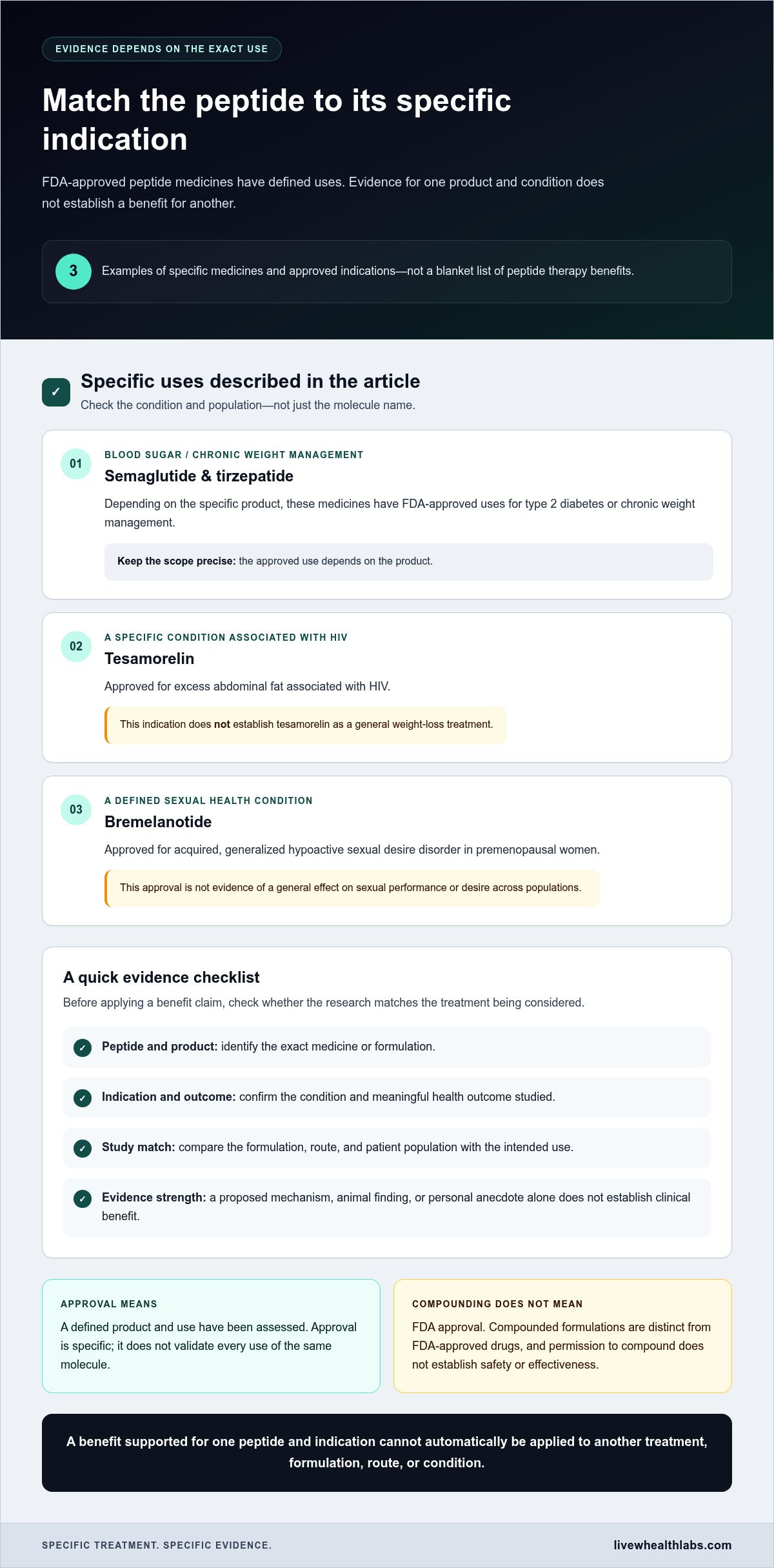
Examples illustrate why the indication matters:
- Blood sugar management or chronic weight management: Depending on the specific product, semaglutide is FDA-approved for type 2 diabetes or chronic weight management. Tirzepatide products also have FDA-approved uses for type 2 diabetes or chronic weight management.
- Excess abdominal fat associated with HIV: Tesamorelin is approved for this specific condition. That indication does not establish it as a general weight-loss treatment.
- Acquired, generalized hypoactive sexual desire disorder: Bremelanotide is approved for this defined condition in premenopausal women. Its approval is not evidence of a general effect on sexual performance or desire across populations.
These examples describe particular medicines and indications, not blanket benefits of peptide therapy. Approval applies to the product and use assessed; it doesn’t automatically extend to a different formulation, route, dose, or condition. Compounded formulations are distinct from FDA-approved drugs, and permission to compound a substance does not make it FDA-approved.
What counts as an established benefit?
Here, “established” means supported by relevant clinical evidence for a defined use, with regulatory status considered alongside the evidence. FDA approval is specific, not universal: it doesn’t validate every use of the same molecule. Human studies should measure meaningful outcomes for the intended population. A proposed mechanism, animal finding, or personal anecdote may prompt further research, but cannot establish a clinical benefit on its own.
Evidence for a peptide in one indication does not establish benefit in another. Check the exact product label and indication, then consider whether the research studied a comparable formulation, route, and patient group. This keeps an established medical use separate from a claim extrapolated beyond the available evidence.
What remains uncertain in wellness and longevity claims?
Claims about longevity, faster recovery, broad immune enhancement, energy, or body composition require evidence for those specific outcomes. Early research may identify a question worth studying, but it isn’t the same as demonstrating a reliable patient benefit or establishing routine clinical use. Evidence for one outcome also can’t stand in for another simply because the same peptide is involved. For broader performance and longevity goals, functional health centers like Emagene Life emphasize evaluating underlying physiological factors and lifestyle baselines rather than relying solely on isolated wellness claims.
For peptides without an FDA-approved indication, including BPC-157, marketed wellness claims should not be mistaken for proven treatment effects. An individualized clinical assessment can help determine whether a specific, evidence-supported option is relevant. Whealth Labs coordinates access to independent licensed providers and compounding pharmacies. Providers make clinical decisions, while Whealth Labs facilitates administrative coordination. Learn about the coordinated peptide therapy process.
How to Evaluate Peptide Therapy Benefit Claims
A compelling claim is only as useful as the evidence behind the exact treatment being discussed. Before judging the promised benefits of peptide therapy, match the claim to the substance, use, and research. Use this framework to separate relevant clinical evidence from broad marketing language.
- Identify the exact treatment. Find the peptide’s precise name, formulation, dose, and route, such as oral or injectable. Evidence for one formulation or route may not apply to another.
- Define the intended indication. Identify the condition or measurable outcome the treatment is meant to address. A study on a diagnosed condition doesn’t establish a benefit for general wellness or a different health goal.
- Check who was studied. Compare the study population with the group named in the claim. Age, health status, diagnosis, and other participant characteristics can affect whether findings are relevant.
- Examine the human evidence. Prioritize well-designed clinical studies and authoritative reviews. Note the number and duration of studies, the outcomes measured, and whether results show a meaningful patient benefit rather than only a biological change.
- Verify regulatory status and safety. Check FDA information for the specific product and indication, and look for current safety statements. If the claim concerns a compounded formulation, assess it as distinct from an FDA-approved drug.
Which evidence should readers look for?
Testimonials describe individual experiences, not whether a treatment reliably works. Mechanistic explanations and animal studies can inform research, but they don’t establish benefits in people. Read beyond a headline: a small study, short follow-up, or outcome such as a lab marker may leave important questions unanswered. Findings are more relevant when the study’s population, dose, route, and measured outcome closely match the claim.
How should readers interpret approval and compounding?
FDA approval applies to a specific product for defined uses; it doesn’t validate every use of a peptide. Check the product label and FDA’s Drugs@FDA database rather than relying on a general statement that a molecule is “approved.” Compounded medications are not FDA-approved drugs, and compounding status should not be presented as proof of FDA-reviewed safety or effectiveness. Guidance and safety information can change, so use current FDA materials when evaluating a claim.
Evidence can inform a question, but it can’t determine whether a treatment is appropriate for you. This educational framework doesn’t establish an individual diagnosis or treatment plan. An independent licensed provider must assess personal health circumstances and make clinical decisions; administrative coordination can support access to that assessment, but it isn’t a substitute for it.
Potential Benefits Must Be Weighed Against Risks and Limits
A possible benefit is only one part of a treatment decision. Peptides can differ in their adverse effects, contraindications, and strength of supporting evidence, so no single safety statement applies to every molecule or use. A treatment discussed in research may also differ from a prescribed product in formulation or route. An individualized assessment by an independent licensed clinician is essential before deciding whether a particular option is appropriate.
Why do safety and suitability vary?
Personal health context matters. Medical history, current medications, known sensitivities, and treatment goals can all affect whether a therapy is suitable and which potential risks deserve attention. These factors are specific to the individual and the treatment, not something a general online claim can resolve.
The product matters, too. Formulation and route can change how a treatment is used and its potential risk profile. Product quality and handling are also relevant considerations. Don’t assume that information about one peptide, preparation, or route applies to another. Check specific adverse effects and safety information against current authoritative sources for the exact treatment; broad estimates can obscure important differences.
A clinician can consider the relevant evidence alongside a person’s circumstances and explain uncertainties. This assessment is not a guarantee of benefit. It helps frame a decision around an intended clinical purpose, potential risks, and available alternatives, rather than a generalized promise.
When should a benefit claim prompt caution?
Pause when marketing promises guaranteed results, presents a peptide as a universal anti-aging solution, or claims broad improvements without identifying the human evidence behind them. Look for the outcome measured and whether the research involved the same peptide, formulation, route, and population. A plausible mechanism or a testimonial cannot establish that other people will experience the same result.
Products marketed as research chemicals, or labeled for research use, are not equivalent to a treatment prescribed for an individual. Their marketing language doesn’t demonstrate that they are appropriate for human use or that a claimed benefit is established. The distinction between prescribed peptides and research chemicals is important when assessing a product’s intended use and the evidence that applies. Don’t self-source or self-administer peptides based on online claims.
The benefits of peptide therapy should be considered alongside uncertainty and treatment-specific risks, not separated from them. Independent licensed providers make clinical decisions. Whealth Labs coordinates access to those providers and to compounding pharmacies for individually prescribed formulations, and facilitates administrative processes. It does not practice medicine. To learn how Whealth Labs coordinates access to peptide therapy, explore its medically coordinated process.
How Whealth Labs Supports a Medically Coordinated Path
Clear information matters, but it doesn’t replace a clinical assessment. Whealth Labs coordinates access to independent licensed providers and compounding pharmacies, and supports the administrative steps involved in a coordinated process. This role helps connect the process; it does not determine whether a peptide is appropriate or establish that it will produce a particular benefit.
Clinical decisions belong to the independent provider. Whealth Labs does not practice medicine or provide in-person clinical exams. Its role includes administrative coordination and HIPAA-compliant data management. Those functions support the process, but they are not clinical care, evidence of treatment effectiveness, or a promise of a prescription.
What happens in an individualized clinical pathway?
An independent provider can review a person’s health context, goals, and relevant eligibility considerations when evaluating a treatment question. The provider determines whether a treatment is appropriate and whether to prescribe it. No prescription or outcome is guaranteed. If a formulation is individually prescribed, Whealth Labs coordinates administrative processes with compounding pharmacies. This coordinated model keeps clinical judgment and logistical support distinct.
For an overview of how provider access and coordination fit together, explore the precision peptide therapy online process.
What should readers take away before considering treatment?
The potential benefits of peptide therapy depend on the specific peptide, indication, evidence, and individual circumstances. A claim that sounds persuasive in general terms may not apply to a particular person or treatment. Education can help clarify what has been studied and where uncertainty remains; an independent licensed provider can assess how that information relates to an individual’s health needs.
A coordinated pathway is a structure for accessing clinical assessment, not proof that a therapy works. It also doesn’t replace the provider’s independent evaluation or turn early research into established benefit. A measured next step is to consider the evidence for the exact proposed use, then leave diagnosis and treatment decisions to the clinician.
If you’re exploring options, learn more about customized wellness formulations through Whealth Labs’ coordinated platform. The process supports access and administration while keeping clinical decisions with independent licensed providers. That distinction offers a practical foundation for considering treatment without relying on generalized promises.
Make Your Next Step an Informed One
Let evidence guide the questions you bring to a clinical discussion. Before considering a treatment, clarify the health goal you’re addressing and what outcome would matter to you. The benefits of peptide therapy are never a substitute for determining whether a specific option fits your circumstances.
A useful next step is an individualized assessment, not a commitment to treatment. Whealth Labs helps coordinate access to independent licensed providers and compounding pharmacies for individually prescribed formulations, with HIPAA-compliant data management supporting the administrative process. Clinical decisions remain with the independent provider. Coordination can support access to an assessment, but it can’t guarantee a prescription or a particular result.
If you’re ready to explore a carefully coordinated next step, Explore Whealth Labs’ medically coordinated wellness process. Move forward with room for evidence, thoughtful questions, and an informed decision.
Frequently Asked Questions
What are the main benefits of peptide therapy?
There isn’t one set of benefits shared by all peptide treatments. Some FDA-approved peptide medicines have defined uses, such as managing type 2 diabetes or chronic weight management, depending on the specific product. Other proposed benefits remain under investigation. To assess a claim, identify the exact peptide and health outcome being discussed, then check whether evidence supports that use. The benefits of peptide therapy aren’t interchangeable across molecules or conditions.
Is peptide therapy scientifically proven?
Some peptide medicines have clinical evidence and FDA approval for specific indications; that doesn’t establish every claimed use of the same molecule or of other peptides. Research results in one patient group, for example, may not apply to people with a different condition. Look for human studies measuring the claimed health outcome, and compare the study’s treatment and participants with the claim. Mechanistic explanations and personal testimonials alone aren’t proof of clinical effectiveness.
Can peptide therapy help with weight loss or metabolism?
Some specific medicines that act on peptide pathways are FDA-approved for chronic weight management or type 2 diabetes, depending on the product. That doesn’t mean peptide therapy as a category is a proven weight-loss or metabolism solution. Start by clarifying whether the goal is weight management, blood sugar control, or another outcome, since evidence and treatment eligibility depend on the indication. For individuals exploring comprehensive medical support for metabolic health and weight loss, specialized centers like Praxis Dr. Tobias Meile offer professional consultation and treatment options. An independent licensed provider can assess individual suitability.
Are peptide therapy benefits different for each person?
Yes. A treatment’s effect and suitability can depend on the condition being treated, overall health, other medications, and the outcome being measured. For instance, someone tracking blood sugar may need different measures of progress than someone receiving treatment for another defined indication. A provider can help establish an appropriate goal and assess progress in context. A result reported by another person doesn’t predict your response or establish that the same treatment is appropriate for you.
Are compounded peptides FDA-approved?
No. Compounded medications are not FDA-approved drugs, even when a particular ingredient may be eligible for compounding under applicable conditions. Compounding status should not be confused with FDA review of a finished product’s safety and effectiveness. Before interpreting an approval claim, check whether it refers to the exact medication and indication or only to an ingredient or compounding category. These distinctions matter when weighing a treatment claim or discussing options with a provider.
How long does it take to notice benefits from peptide therapy?
There isn’t a single timeline for peptide therapy. The time to assess an effect depends on the specific treatment, intended outcome, and how that outcome is measured. A change in a symptom may be assessed differently from a laboratory measure, and neither should be assumed to improve on a fixed schedule. Before treatment, discuss with the independent provider what progress would look like, when it should be reviewed, and what findings would prompt reassessment.
What happens if peptide therapy does not provide the expected benefit?
Tell the prescribing provider rather than increasing, stopping, or changing treatment on your own. The provider can review the original goal, how progress was measured, the treatment plan, and whether new symptoms or other factors affect the assessment. A lack of expected improvement may call for further evaluation, a different approach, or a decision not to continue. Keep a clear record of relevant changes to support a specific follow-up discussion.
Is peptide therapy safe to use without medical supervision?
Using peptide treatments without medical supervision isn’t advisable. A qualified clinician can assess whether a treatment is appropriate, consider health history and current medications, and discuss potential risks for the specific product and route. Products sold as research chemicals aren’t equivalent to individually prescribed treatment. Don’t rely on online claims to select or use a peptide; discuss treatment considerations with an independent licensed provider who can evaluate your circumstances.