
What if the smartest first biohack is a simpler routine, not another device or supplement? If conflicting claims and elaborate protocols make biohacking for beginners feel hard to approach, start with a measured plan: make one manageable change, observe how you feel, and don’t mistake more data for better health.
Biohacking can mean using habits, tools, or other interventions to influence wellbeing and performance. The term covers a wide range, and popular methods don’t all have the same evidence or risks. You don’t need an expensive wearable or complex routine to begin.
This guide explains biohacking in plain language, outlines sensible starting points, and shows how to assess a change without drawing medical conclusions from wellness-device data. You’ll also learn how to spot claims that deserve caution and when to discuss an intervention with a licensed clinician. Medically coordinated therapies are different from everyday habit changes, and independent licensed providers make the clinical decisions. The goal is a thoughtful starting point, not a maximal protocol.
Key Takeaways
- Biohacking for beginners can start with ordinary health habits. Make an intentional change and observe it rather than expecting a quick fix.
- Use feedback to guide decisions, but distinguish a measurable signal from a meaningful health outcome. Wellness-device data isn’t a diagnosis.
- Compare habits, tracking tools, and medical interventions by their effort, oversight needs, and evidence questions, not as a universal ranking.
- Test one change at a time: define your goal, note a baseline, observe a relevant outcome, and decide whether the change is useful.
- Prescription therapies call for individualized clinical assessment. Independent licensed providers make clinical decisions, while Whealth Labs facilitates administrative coordination.
Biohacking for beginners: what it means, and what it does not
The word biohacking can sound technical, as if getting started requires lab equipment or specialist knowledge. Often, the first steps are familiar: adjust your bedtime routine, add regular movement, or notice how meal timing fits into your day. The key is to make an intentional change and pay attention to what follows, rather than assume a method will work for everyone.
Biohacking is the intentional adjustment of behavior or environment, followed by observation of its effects. That definition is broad by design. It covers everyday habits as well as practices involving supplements, devices, or medical care. The label alone doesn’t show that a method is effective or safe.
The term spans distinct approaches, from lifestyle experiments to DIY biology and body modification. A broad overview such as What is Biohacking? can help explain how varied the subject is. For a beginner, the practical distinction matters more than the label: different approaches call for different levels of evidence, caution, and professional oversight.
Everyday habit changes versus advanced interventions
Sleep routines, movement, and meal patterns are lifestyle-level examples. You might keep a steadier wake time, take a short walk after lunch, or notice whether a regular meal schedule suits your day. These are relatively simple changes to observe, though their effects can vary from person to person.
Supplements, tracking devices, and medical interventions raise different questions about evidence, suitability, potential risks, and clinical oversight. A device may record a signal; a supplement may have effects or interactions that aren’t obvious from a testimonial. Popularity and personal stories can suggest questions to explore, but they don’t validate a practice or prove it is right for you.
What a beginner should expect from biohacking
Think of an early experiment as a way to build self-awareness, not as a test of willpower or a route to perfect health. Your notes might show that you felt more alert after changing your evening routine, but that observation alone can’t establish that the change caused it. Sleep, stress, daily schedules, and other factors may have shifted at the same time.
Set modest expectations: notice patterns, consider whether they matter to you, and stay open to uncertainty. You don’t need to track every bodily process or treat each fluctuation as a problem to solve. More data can add context, but it can also distract from the question you started with.
Keep personal observation separate from healthcare decisions. A new or concerning symptom, a change to treatment, or a question about whether an intervention is suitable calls for guidance from a qualified clinician. In biohacking for beginners, restraint is part of a sound approach: curiosity can guide what you learn, while clinical decisions belong in a conversation with a professional.
How biohacking works: biology, behavior, and useful feedback
A useful biohacking experiment follows a simple feedback loop: choose a behavior, observe a relevant outcome, then decide whether to continue, adjust, or stop. For example, you might keep a consistent bedtime and note your wake time and daytime energy. Those notes are feedback, not a verdict. They can help you decide whether the change seems useful in your routine.
Be specific about what you’re observing. A wearable’s estimate of sleep duration is a measurable signal; feeling rested enough to manage your day is a different kind of observation. Neither is a diagnosis or proof of a health benefit. Sleep, energy, and mood can shift with work schedules, stress, illness, activity, and other factors, not just your latest habit change.
What to track, and what the numbers cannot tell you
Keep tracking proportionate to your question. If you’re testing a bedtime routine, note when you went to bed and woke up, then record a simple daytime energy rating. If you’re working on a movement habit, track whether you followed through and how it fit your schedule. A brief written log may be enough; wearable technology is optional.
Wearables can estimate selected measures and present them as trends, but those readings have limits. A number may prompt a useful question, yet it can’t explain on its own why you feel a certain way or whether a medical concern is present. Tracking can reveal patterns across days and routines, but it can’t isolate cause, establish medical causation, or prove clinical benefit.
Why one change at a time matters
Changing several things together makes feedback harder to interpret. If you alter your sleep schedule, add a supplement, and begin a new exercise routine in the same week, a change in energy won’t tell you which factor mattered, if any. A single, low-complexity adjustment gives you a clearer observation, though it still doesn’t replace controlled research.
Consistency matters more than elaborate tracking. Use the same simple notes from day to day, and add context when something unusual could affect the result, such as travel, a demanding workday, or a disrupted night. Review the overall pattern rather than drawing a conclusion from one unusually good or difficult day. If your notes are incomplete or your routine changes substantially, treat your interpretation as uncertain.
For biohacking for beginners, feedback should support a considered decision, not an effort to optimize every number. Continue a habit if it fits your life and seems worthwhile; revise or stop if it isn’t practical or raises concerns. Don’t use a device reading to diagnose yourself, change prescribed treatment, or dismiss new symptoms. Discuss those questions with a qualified clinician. For readers exploring individualized, medically coordinated options, Whealth Labs’ provider coordination supports administrative connection with independent licensed providers. Clinical decisions remain with those providers.
Biohacking methods compared: habits, tracking tools, and medical care
Biohacking approaches differ in purpose, effort, evidence, and oversight. A steady sleep routine is not equivalent to using a wearable, and neither is equivalent to starting a prescription therapy. This comparison isn’t a universal ranking: the right category depends on your question and the potential risks involved. You don’t need advanced tools or therapies to begin.
| Approach | Typical effort | Oversight | Evidence questions |
|---|---|---|---|
| Lifestyle habits | Low to moderate; requires consistency and a routine that fits daily life | Usually self-directed, with clinical guidance if health circumstances call for it | Is the change supported for the intended purpose, and is the observation meaningful? |
| Tracking tools | Varies; includes setup and deciding which readings are relevant | Often self-directed; device readings aren’t a clinical assessment | What does the device estimate, and what can’t its data establish? |
| Supplements or medical interventions | Varies by intervention and may involve additional steps | Individual assessment may be important; prescription decisions belong to independent licensed clinicians | What is known about suitability, evidence, interactions, and potential risks? |
The categories can overlap, but they aren’t interchangeable. A tracking tool may help you observe a routine; it doesn’t make the routine more effective by itself. While advanced options such as genetic testing from preventis.ai can offer insight into individual biology, data from any tool must be paired with appropriate clinical context. The questions in the table are prompts for careful consideration, not proof that a method is beneficial or appropriate.
Lifestyle foundations: the lowest-complexity starting point
Consistent sleep timing, regular movement, and manageable daily routines are approachable areas to consider. Choose a change that fits your schedule and circumstances rather than adopting a rigid protocol designed for someone else. These habits aren’t guaranteed treatments for symptoms or disease; they are practical areas to observe and discuss with care.
For biohacking for beginners, simplicity can make decisions clearer. If your routine is already demanding, a small adjustment you can sustain may be more informative than several new commitments at once. Consider whether the change is feasible, what you hope to observe, and whether personal health concerns make clinical guidance appropriate before you proceed.
When devices, supplements, or therapies change the risk profile
Devices, supplements, and medical interventions raise different questions. Consider what evidence supports the intended use, what the tool can actually measure, and whether an intervention may interact with existing treatment or health conditions. An app, online trend, or testimonial can’t determine whether a prescription is suitable. That decision belongs to an independent licensed clinician who can assess the individual situation.
Prescription-based care is a distinct category, not a default beginner experiment. Whealth Labs facilitates administrative coordination between patients, independent licensed providers, and compounding pharmacies; providers make clinical decisions. For more context on precision peptide therapy online, explore how medically coordinated options differ from everyday habit changes.
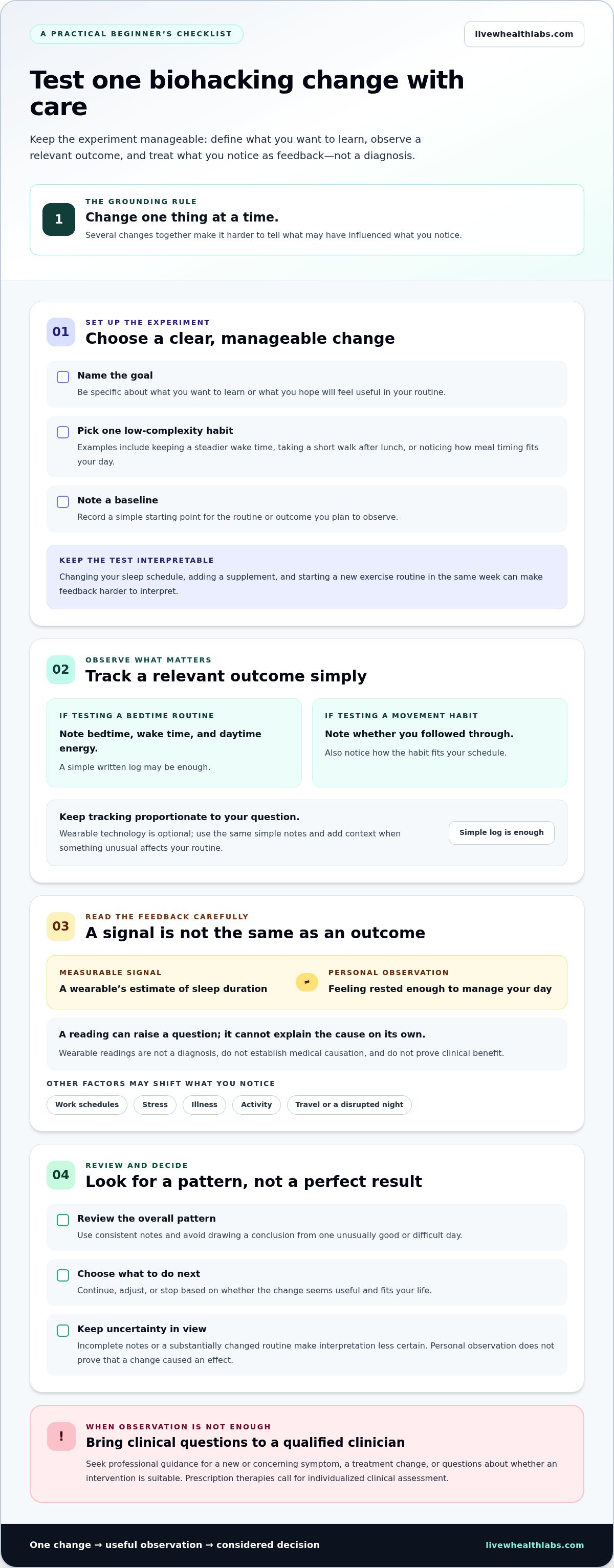
A beginner’s biohacking plan: test one change with care
A useful experiment starts with a question, not a stack of new habits or a target pulled from an app. This five-step process helps you make a manageable change and review what you observe without treating personal notes as clinical evidence. Changing one variable at a time makes your observations easier to interpret because you’re not trying to separate the possible influence of several new habits.
- Choose a focused goal. Turn a broad aim such as “feel better” into a neutral question about one routine. For example: “If I set aside time to wind down before bed, do I notice a difference in how rested I feel in the morning?”
- Record a baseline. Briefly note what the routine and relevant outcome look like before making a change. Keep the record simple, and don’t collect sensitive health information you don’t need for the question.
- Select one low-complexity change. Choose an adjustment that fits your circumstances, such as setting a consistent cue for winding down. Decide in advance what you’ll observe, such as whether you followed the routine or how you felt the next morning. Avoid setting medical targets.
- Observe with context. Make consistent notes while trying the change. Include relevant circumstances, such as travel, a different work schedule, or unusual stress, so you can account for other influences when reviewing the pattern.
- Review and decide. Compare what you observed with your baseline. Consider whether the practice felt manageable and appropriate to continue, adjust, or stop. A pattern in your notes can guide reflection, but it doesn’t prove the change caused it.
Choose a focused question and establish a baseline
Make the question narrow enough to answer with ordinary observations. Instead of asking whether a new routine will improve your health, ask whether you followed it on the days you intended to or noticed a difference in one aspect of your day. Record only what helps answer that question. Your baseline doesn’t need to be a formal measurement; a short description of your usual pattern can provide a useful point of comparison, though those interested in evaluating clinical biomarkers can turn to health checkup and testing packages from Bewell.
Review the result without overclaiming
Personal experience can tell you whether a routine seems practical and worth continuing. It can’t establish cause, confirm a clinical benefit, or show what would happen under different circumstances. Avoid chasing a perfect score. The relevant question is whether the change is sustainable and appropriate for you, not whether every observation improves.
If a change brings on concerning symptoms, stop the experiment and seek appropriate clinical guidance. For a medical condition, medication use, or proposed therapy, discuss decisions with a licensed clinician rather than treating a self-test as a substitute for care. Prescription decisions require individualized clinical assessment.
If you’re considering medically supervised options rather than a routine habit experiment, explore provider-coordinated care options. Independent licensed providers make clinical decisions; Whealth Labs facilitates administrative coordination.
When biohacking calls for medical oversight, and where coordination fits
Some wellness habits can be considered independently; prescription therapies are different. They aren’t routine beginner experiments or substitutes for simple lifestyle adjustments. Medication use, an existing health condition, or interest in a prescription intervention are reasons to involve a licensed provider, who can assess individual circumstances and make clinical decisions.
Recognizing the boundary between wellness habits and medical care
Keep self-observation separate from treatment decisions. A personal routine or wearable reading can’t establish whether a therapy is appropriate, and online trends can’t replace an individualized clinical assessment. Don’t use this guide to select a peptide, change prescribed medication, or determine a dose. If symptoms are new or concerning, seek qualified clinical guidance rather than trying to manage them through a biohacking experiment.
For readers considering how an intervention fits within clinical oversight, biohacking with medical oversight is a distinct topic from testing a daily habit. The central distinction is who evaluates suitability: prescription decisions belong to independent licensed clinicians, not an app, a testimonial, or a self-directed protocol.
How Whealth Labs coordinates access
Whealth Labs is an educational and administrative coordination platform. It connects patients with independent licensed providers and coordinates with compounding pharmacies. The platform supports administrative processes related to access, consent, HIPAA-compliant health-information management, and prescription fulfillment coordination. It does not practice medicine. Independent providers assess patients and make clinical decisions; Whealth Labs facilitates coordination rather than determining treatment.
Readers can explore formulations, learn how the process works, and understand how eligibility is assessed. Exploring information is not the same as receiving a prescription, and it doesn’t mean every person will be eligible. Any decision about a prescription therapy depends on the independent provider’s assessment and guidance.
For biohacking for beginners, the practical boundary is straightforward: begin with manageable habits when appropriate, and bring medical questions to a qualified clinician. If you’re exploring individualized, medically coordinated options, explore Whealth Labs’ coordination platform to learn about the process. This is an informational next step, not a promise of eligibility or a particular result.
Let your next step match the question
Biohacking for beginners doesn’t need to become a project of constant optimization. Let curiosity guide what you explore, and let the level of risk determine when self-directed experimentation should give way to professional input. If your interests move toward prescription-based care, understand the process and the roles involved before making decisions.
Whealth Labs supports that exploration through administrative coordination, including HIPAA-compliant data management and coordination with independent licensed providers and compounding pharmacies. Clinical decisions remain with the providers, and eligibility is assessed individually. Knowing the distinction can help you approach medically coordinated options thoughtfully rather than treating them as another wellness trend.
Explore medically coordinated wellness options to learn about the process. A thoughtful next step doesn’t have to be a dramatic one. Begin with clear questions, stay attentive to your wellbeing, and move forward at a pace that feels informed and appropriate.
Frequently Asked Questions
What is biohacking for beginners?
Biohacking for beginners is a deliberate way to explore how a manageable change in a routine or environment relates to your observations. For example, you might adjust your evening routine and note whether you followed it and how your mornings felt. The term also includes devices and medical interventions, which call for different levels of evidence and oversight. Treat your observations as clues, not proof that a change caused a result.
Is biohacking safe for beginners?
Safety depends on what you try and on your individual circumstances. A small routine adjustment differs from starting a supplement or changing how you use a device. Before trying something that could affect a condition or medication, discuss it with a licensed clinician. Don’t rely on a product’s popularity or online testimonials to establish safety. If a practice causes concerning symptoms, stop and seek appropriate medical guidance.
Can you start biohacking without buying devices?
Yes, you can begin without buying a wearable or specialized equipment. A paper calendar or brief note on your phone can help you record whether you followed a routine, such as taking a walk during a break. Keep the log focused on your question and avoid adding personal health details without a clear reason. These observations may help you reflect, but they can’t diagnose a condition.
How do you know if a biohack is working?
Decide what you’ll observe before you start, then compare your notes with your usual pattern. For instance, if your goal is to make a routine more consistent, record whether you followed it rather than relying on a vague sense of success. Consider whether it remains practical and meaningful. A personal change in mood or energy doesn’t establish medical benefit; discuss clinical measures with a licensed clinician.
Do beginners need supplements for biohacking?
No supplement is a required entry point for biohacking. Before considering one, identify its intended purpose and look beyond testimonials to the quality and limits of available evidence. Supplements can have uncertain benefits or interact with medications. If you take prescription medication, have a health condition, or want to use a supplement for a medical concern, speak with a licensed clinician before starting it.
Is peptide therapy a beginner biohack?
No. Prescription peptide therapy isn’t an over-the-counter product or a casual self-directed experiment. An independent licensed provider must make clinical decisions after an individualized assessment; don’t choose a peptide or determine a dose from online advice. Whealth Labs coordinates administrative access between patients, providers, and compounding pharmacies, but doesn’t practice medicine. Assessment does not guarantee that a person is eligible or that a therapy will produce a particular result.
How long should a beginner test one biohacking change?
There’s no single testing period that suits every routine or observation. Choose a practical window that gives you a chance to follow the behavior consistently, while noting interruptions such as travel, illness, or a changed work schedule. Don’t continue simply to complete a self-imposed experiment if concerning effects arise. If you’re monitoring a medical condition or treatment, ask a licensed clinician what timeframe and measures are appropriate.