
A prescription alone doesn’t settle whether BPC-157 can be legally compounded or used. If you’re searching for how to get BPC-157 legally, that distinction matters: as of October 2026, BPC-157 isn’t FDA-approved, and an advisory committee’s recommendation to add it to the compounding list isn’t final authorization.
Conflicting claims online can make the rules hard to interpret. A clinician’s involvement may sound like a clear route to treatment, while “research use only” products can appear easy to obtain. But clinical evaluation, a prescription, compounding, and FDA approval are separate matters. A research-chemical label doesn’t establish that a product is suitable or lawful for personal use.
This guide explains what BPC-157’s current U.S. status means, what the FDA’s 2026 actions did and didn’t change, and how to distinguish a medically coordinated consultation from direct research-chemical sales. It also outlines questions a responsible process should address, including who makes clinical decisions and what a prescription can and cannot establish. Whealth Labs coordinates patients with independent licensed providers, while providers make their own clinical decisions.
Key Takeaways
- Learn why FDA approval, a clinician’s prescription, and pharmacy compounding are distinct parts of the BPC-157 regulatory picture.
- See how the 503A and 503B frameworks differ, and why neither should be treated as blanket approval of a substance.
- Understand how to get BPC-157 legally by distinguishing a clinically evaluated pathway from products sold for research use only.
- Use practical questions to assess access claims, including whether they involve a genuine provider-patient evaluation rather than a guaranteed prescription.
- Explore a measured next step: prepare for an independent provider consultation while recognizing that it doesn’t guarantee a BPC-157 prescription or dispensing.
How to Get BPC-157 Legally in the U.S.: Start With Its Regulatory Status
As of October 2026, BPC-157 is not an FDA-approved drug product in the United States. That is the starting point for anyone asking how to get BPC-157 legally, but it doesn’t answer every question about prescribing or compounding. Those are separate processes, and the rules can depend on current federal and state requirements. Check current FDA materials rather than relying on a vendor’s description or an older article.
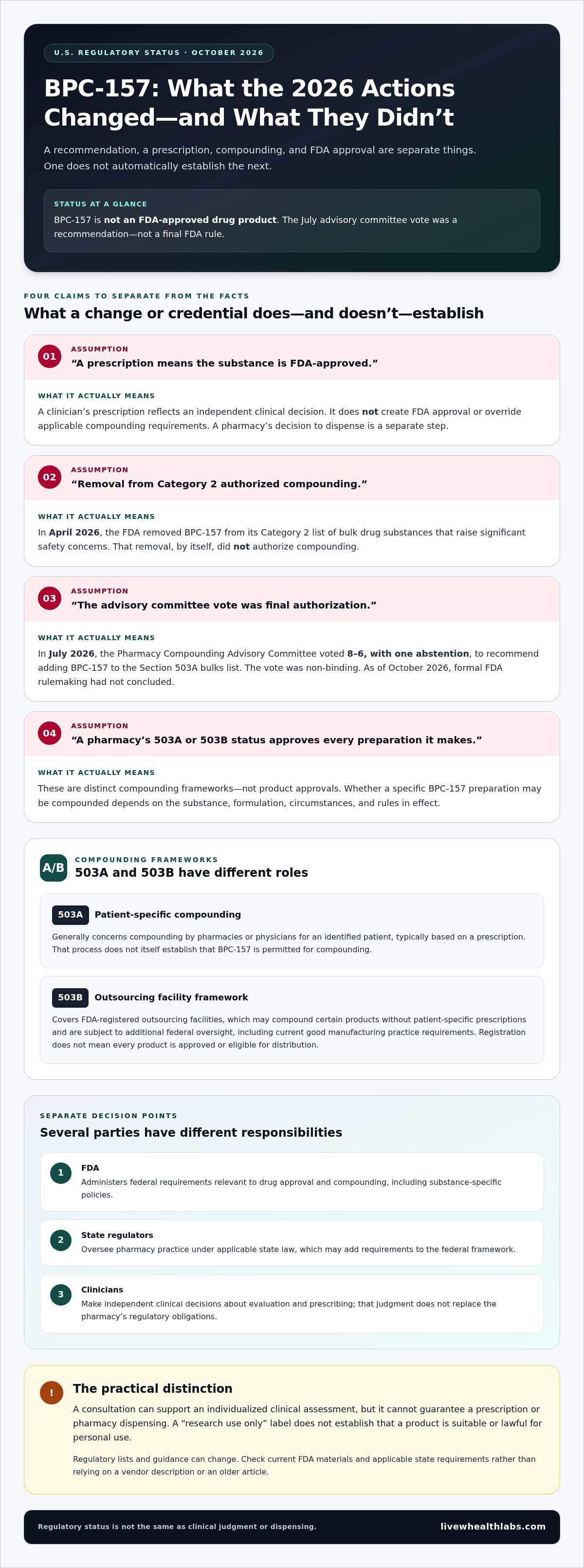
In April 2026, the FDA removed BPC-157 from its Category 2 list of bulk drug substances that raise significant safety concerns. In July, the Pharmacy Compounding Advisory Committee voted 8-6, with one abstention, to recommend adding it to the Section 503A bulks list. That vote was a recommendation, not a final FDA rule. Removal from Category 2 also did not, by itself, authorize compounding.
What does FDA approval mean for BPC-157?
FDA approval applies to a particular drug product and its reviewed conditions of use. It follows an agency evaluation of evidence for that product, including its safety and effectiveness for the intended use. A clinician’s decision to prescribe a substance is not the same as FDA approval, and a pharmacy’s ability to compound a formulation is a separate regulatory question.
Published laboratory or animal research may help explain why BPC-157 attracts scientific interest, but it doesn’t establish an approved human treatment or proven human benefit. The BPC-157 Wikipedia page offers a general overview of the peptide and research context. For regulatory status, consult current FDA materials. Research interest is not evidence of established clinical efficacy.
Does having a prescription automatically make access legal?
No. A clinician’s prescription and a pharmacy’s authority and decision to dispense a compounded preparation are distinct steps. The prescription reflects an independent clinical decision; it doesn’t grant FDA approval or override applicable compounding requirements. A pharmacy’s willingness to dispense doesn’t, on its own, establish that every regulatory condition has been met.
The July advisory committee vote did not settle the question. As of October 2026, the FDA still needed to complete formal rulemaking before BPC-157 could be added to the 503A bulks list. The practical takeaway is clear: a prescription alone doesn’t settle BPC-157’s compounding legality. Check current FDA guidance and applicable state requirements, and distinguish a documented provider-patient evaluation from a sales claim. A consultation can support an individualized clinical assessment, but it cannot guarantee a prescription or pharmacy dispensing.
How U.S. Compounding Rules Affect BPC-157 Access
Compounding is governed by frameworks with different roles and conditions. A pharmacy’s business model or registration, by itself, doesn’t establish that a specific substance or formulation may lawfully be compounded. For BPC-157, substance-specific status is especially important: federal lists and guidance can change, so a general statement about compounding may not reflect the current position.
What do 503A and 503B mean in practice?
Section 503A generally concerns compounding by pharmacies or physicians for an identified patient, typically based on a prescription. Section 503B covers FDA-registered outsourcing facilities, which may compound certain products without patient-specific prescriptions but are subject to additional federal oversight, including current good manufacturing practice requirements. These are distinct pathways, not product approvals.
The distinction matters, but it doesn’t resolve whether a particular BPC-157 preparation meets applicable requirements. A 503A pharmacy’s patient-specific prescription process doesn’t establish that the substance is permitted for compounding. A 503B registration likewise doesn’t mean every product made by that facility is approved or legally eligible for distribution. The substance, formulation, prescription circumstances, and rules in effect all matter.
Responsibility is distributed across several decision points:
- FDA: Sets and administers federal requirements relevant to drug approval and compounding, including substance-specific policies.
- State regulators: Oversee pharmacy practice under applicable state law, which may add requirements to the federal framework.
- Clinicians: Make independent clinical decisions about evaluation and prescribing. That judgment doesn’t replace the pharmacy’s regulatory obligations.
Why can BPC-157 compounding status be difficult to summarize?
Federal policies can shift, and an advisory committee recommendation is not the same as a final rule. As of October 2026, the FDA had removed BPC-157 from Category 2 in April, and its Pharmacy Compounding Advisory Committee voted in July to recommend adding it to the Section 503A bulks list. The vote was non-binding, and formal rulemaking had not concluded.
Check that timeline against current FDA records before relying on it. In particular, verify the agency’s current Category 2 information, the 503A bulks list, and any final rule or updated guidance. Don’t treat removal from one list as automatic permission to compound, or a committee vote as a completed regulatory change. State requirements may also affect how federal rules apply to a specific pharmacy and preparation.
For readers asking how to get BPC-157 legally, the useful question isn’t simply whether a pharmacy is “503A” or “503B.” It’s whether the specific substance and preparation fit current requirements, alongside an appropriate clinical evaluation. A coordinated consultation process can organize provider and administrative steps without replacing clinical judgment. Independent provider consultations offer a structured way to explore care.
Research-Only BPC-157 Versus a Clinically Evaluated Prescription Pathway
A product listing and a clinical pathway can both use medical-sounding language, but they are not equivalent. The key differences are intended use, individualized review, prescription status, and whether dispensing complies with current requirements. The comparison below focuses on those distinctions, not on ranking sellers.
Research-only sale
Intended for laboratory research, not human treatment. Typically involves no provider-patient evaluation and no prescription for the product. The label does not establish authorization for personal use, pharmaceutical quality, or suitability for people.
Clinical evaluation
An independent licensed provider reviews a person’s health history and circumstances, then makes an individual clinical decision. The evaluation itself is not a prescription, FDA approval, or assurance that a pharmacy can dispense a particular preparation.
Pharmacy dispensing
A pharmacy assesses whether it can prepare and dispense a specific formulation under applicable requirements. A prescription or pharmacy category alone does not demonstrate that every substance, formulation, or dispensing arrangement is permitted.
What does a research-use-only label actually tell you?
It signals that the product is represented as being for research, not as a human medicine. While laboratory investigators often turn to specialized distributors such as buyironpeptides.com to source high-purity peptide compounds for scientific study, a disclaimer doesn’t transform a research product into an approved treatment. Be cautious if a seller pairs “not for human consumption” with consumer-facing instructions or claims that appear to encourage human use. A certificate of analysis may describe testing of a sample or batch, but it doesn’t prove FDA approval, clinical safety, or lawful eligibility for human use. Testing claims are not a substitute for clinical oversight.
What distinguishes a clinical pathway from direct online purchasing?
A clinical pathway begins with assessment, not product selection. An independent licensed provider may review medical history, current concerns, and relevant factors before deciding whether any treatment is appropriate. That decision belongs to the provider. Administrative coordination can organize communication and information handling, while pharmacy fulfillment is a separate step governed by the pharmacy’s obligations and current rules.
Direct online purchasing from a research-use listing generally bypasses individualized provider review. It also leaves the buyer to infer product quality and intended use from seller materials, which cannot establish that a substance is appropriate for treatment. Neither a professional-sounding website nor a certificate alone makes the purchase equivalent to a medically evaluated pathway.
For readers exploring how to get BPC-157 legally, keep the roles distinct: provider evaluation, administrative coordination, and pharmacy dispensing each answer a different question. A broader overview of precision peptide therapy online explains how care coordination can support a structured process without replacing independent clinical judgment or guaranteeing a specific prescription.
How to Assess a BPC-157 Access Claim Without Confusing It for Legal Advice
Marketing can make a complicated access pathway sound simple: book a visit, receive a prescription, and expect a product. A careful assessment separates what can be verified from what is promised. A checklist can help you understand a process, but it cannot make an unapproved product FDA-approved or determine whether a particular preparation may be compounded under current requirements.
Use these questions to examine an access claim:
- Is there a genuine provider-patient evaluation? Look for an individualized review, not an automatic approval process presented as a consultation.
- Who makes the clinical decision? The independent licensed provider should assess the case and determine what, if any, care is appropriate.
- Is a prescription being guaranteed? A responsible evaluation doesn’t promise a specific prescription or outcome before the review takes place.
- What does the testing document establish? A certificate of analysis (COA) may report testing details, but it doesn’t establish FDA approval or settle legal eligibility for human use.
- Are the claims consistent? Treat “research use only” as meaningful. Consumer-facing directions or treatment promises alongside that disclaimer deserve careful scrutiny, not workarounds.
Which claims deserve careful scrutiny?
Be cautious of claims that guarantee eligibility, results, or FDA approval without substantiation. A consultation is an opportunity for clinical assessment, not a commitment to prescribe BPC-157. Likewise, a COA, laboratory testing claim, prescription, or pharmacy’s willingness to dispense is not, by itself, a complete answer about legal status. If a product is labeled for research use, don’t interpret that wording as permission for personal treatment.
What should a responsible clinical review include?
An independent provider should consider relevant health history, potential risks, and whether a proposed approach is clinically appropriate. The provider makes medical decisions; an administrative coordination platform can support communication and process management, but it doesn’t replace that judgment. Discuss the evidence and uncertainty plainly, including alternatives. If the review feels like a formality designed to deliver a predetermined prescription, it may not provide the individualized assessment you’re seeking.
For anyone researching how to get BPC-157 legally, remember that no checklist can certify access or substitute for current regulatory guidance. Verify status through official FDA materials, and keep clinical evaluation distinct from pharmacy dispensing. Coordination can help organize a consultation, but it cannot guarantee a prescription or determine whether a particular formulation may be dispensed.
To explore a structured consultation process with independent providers, learn about independent provider consultations.
A Medically Coordinated Next Step for Exploring Peptide Care
A careful next step begins with information, not an assumption that a prescription or product will follow. If you’re exploring peptide care, use a sequence that keeps regulatory facts, clinical judgment, and administrative coordination distinct. BPC-157’s status can change, so review current FDA materials before relying on an access claim or making decisions about treatment.
- Review the current status. Confirm what FDA materials say about approval and compounding, and note the date you checked. A provider’s willingness to discuss a substance isn’t proof that a specific formulation can be dispensed.
- Prepare for an individualized discussion. Gather relevant health information and questions so the provider can assess your circumstances rather than relying on a generic product description.
- Consult an independent provider. The provider evaluates your history, concerns, and treatment goals, then makes an independent clinical decision.
- Review the next steps separately. If a provider recommends a course of care, clarify what further clinical and pharmacy review may be required. A consultation doesn’t guarantee a BPC-157 prescription or pharmacy dispensing.
What information should readers prepare for a consultation?
Organize your current medications, relevant medical history, health concerns, and treatment goals. A concise list can help you explain what you hope to address and what care you’ve already considered. Prepare questions about the quality of evidence, known uncertainties, potential risks, alternatives, and current regulatory status. The independent provider determines eligibility and clinical appropriateness; preparation supports that discussion but doesn’t predetermine its outcome.
How does care coordination fit into the process?
Care coordination supports the administrative connection between a patient, an independent licensed provider, and pharmacy workflows when relevant. It is distinct from medical practice: the provider makes clinical decisions, while coordination helps organize the process and patient information. HIPAA-compliant handling of patient data supports responsible coordination, but it doesn’t establish that a treatment is appropriate or guarantee a prescription, compounding, or dispensing.
Individualized care also means considering broader health goals rather than treating one peptide as the default answer. For individuals researching experimental compounds for joint or connective tissue issues, reviewing established orthopaedic treatments—such as procedures detailed on londonhipknee.co.uk—provides helpful context on proven clinical alternatives. The overview of customized wellness formulations provides broader context on how personal health considerations can inform a care discussion.
For readers asking how to get BPC-157 legally, the responsible path is to verify current status, prepare for an honest clinical conversation, and assess proposed next steps on their own terms. Whealth Labs coordinates patients with independent licensed providers and compounding pharmacies, and does not practice medicine. Explore a medically coordinated consultation pathway to begin discussing peptide care.
Make Your Next Step an Informed Conversation
The most useful next step may not be finding a faster route to a particular peptide. It may be clarifying what you want care to address, what remains uncertain, and which questions deserve a clinician’s attention. With BPC-157, asking how to get BPC-157 legally should begin with a careful conversation, not an assumption that a prescription or product will follow.
Whealth Labs helps coordinate access to independent licensed providers and related pharmacy workflows, with HIPAA-compliant administrative coordination. The provider remains responsible for medical decisions, and any next step depends on the individual evaluation and applicable requirements. This distinction supports a considered process without promising a specific treatment or outcome.
If you’re ready to explore peptide care through a structured, medically coordinated process, explore medically coordinated peptide care. Bring your questions, take time to understand the answers, and move forward at a pace that respects both your health and the limits of current evidence.
Frequently Asked Questions
Is BPC-157 legal to buy in the United States?
There isn’t a single answer that applies to every purchase; the legal analysis can depend on intended use, product claims, and applicable federal and state rules. BPC-157 is not FDA-approved, and products labeled for research use aren’t approved medicines for personal treatment. A seller’s disclaimer alone doesn’t resolve how a product is being marketed or used. Check current FDA guidance, and consult a licensed clinician or qualified legal professional about your specific circumstances.
Can a doctor prescribe BPC-157 legally?
A clinician may evaluate a patient and make an independent prescribing decision, but that is separate from FDA approval and from a pharmacy’s authority to compound or dispense a product. A prescription doesn’t by itself establish that a particular BPC-157 formulation complies with current requirements. Rules and professional obligations may vary by jurisdiction. Review current official FDA guidance and discuss clinical and regulatory questions with the provider.
Is compounded BPC-157 FDA-approved?
No. Compounded drugs aren’t FDA-approved in the same manner as finished drug products approved by the agency. Compounding remains subject to applicable requirements, and those requirements don’t automatically make every substance or formulation permissible. A pharmacy’s license or registration isn’t FDA approval of a specific compounded preparation. Because BPC-157-specific policies may change, verify current FDA materials before drawing conclusions about a formulation or relying on an availability claim.
Does a research-use-only BPC-157 product mean it is safe for people?
No. A research-use label doesn’t establish human safety, effectiveness, or authorization for personal use. For example, a certificate of analysis may report test results for a sample or batch, but those results don’t show that the product is suitable for a patient or has been evaluated as a medicine. Don’t treat vendor testing claims as clinical evidence. Discuss health concerns and possible options with a licensed clinician who can consider your circumstances.
Can an online clinic guarantee a BPC-157 prescription?
No responsible clinical pathway should promise a prescription before an individualized evaluation. An independent licensed provider considers a person’s health history and circumstances, and may decide that a proposed treatment isn’t appropriate. Administrative coordination can help organize communication and related steps, but it doesn’t make medical decisions. A consultation also can’t promise that a pharmacy will dispense a particular preparation or that treatment will produce a specific outcome.
Does a certificate of analysis prove that BPC-157 is legal for human use?
No. A certificate of analysis can document testing information for a particular sample or batch, but it doesn’t establish FDA approval, legal authorization for human use, or clinical effectiveness. Product-quality documentation and regulatory status answer different questions. Don’t treat a testing document as a substitute for a medical evaluation or current FDA guidance. If a claim relies on a COA as proof of lawful human use, that claim goes beyond what the document establishes.
Is BPC-157 prohibited in competitive sports?
Athletes should check the current World Anti-Doping Agency Prohibited List and the rules of their sport’s governing body before using any substance. BPC-157 has been listed by WADA under category S0, Non-Approved Substances, but athletes should verify the current list and applicable sport-specific rules. A prescription doesn’t automatically determine anti-doping status or provide an exemption. For guidance on a particular sport or competition, consult a team physician or anti-doping organization.