
What’s the best answer to how to reduce inflammation in the body? It often starts with understanding what may be driving it, rather than reaching for a supplement or a strict diet. Inflammation is part of the body’s normal response to injury or infection. It can be more concerning when it persists, and its signs aren’t always obvious.
Online claims about anti-inflammatory foods and supplements can be hard to evaluate. A short-term inflammatory response is different from ongoing inflammation, and general wellness habits can support overall health without guaranteeing a specific result or replacing medical care.
This guide explains acute and chronic inflammation in plain language, then outlines practical habits around food, movement, sleep, and stress. You’ll also learn why symptoms and inflammation tests need clinical context, which persistent or concerning changes deserve medical attention, and how a clinician can determine appropriate next steps for your situation.
Key Takeaways
- Inflammation is an immune response, not a diagnosis. Ongoing or unexplained symptoms need context rather than assumptions.
- Learn how to reduce inflammation in the body by focusing on sustainable habits that support overall health, not quick fixes or cure claims.
- Balanced eating patterns, regular movement, restorative sleep, and thoughtful choices around smoking and alcohol can help build a practical wellness routine.
- Inflammation markers such as C-reactive protein are only one part of an assessment and should be interpreted alongside symptoms and health history.
- Persistent, recurring, severe, or unexplained symptoms warrant medical guidance. Clinicians can determine whether tests or other next steps are appropriate.
What Inflammation Is, and When It Becomes a Concern
Online advice about inflammation can make it difficult to separate useful guidance from cure claims. Start with this distinction: inflammation is a biological response, not a diagnosis or another name for every ache, bout of fatigue, or change in how you feel. Understanding that helps put questions such as how to reduce inflammation in the body into a more practical context.
Inflammation is the immune system’s coordinated response to a threat or injury, involving signals and changes in affected tissues that help the body respond. The underlying condition or trigger is separate. Inflammation may occur with an infection or injury, for example, but it doesn’t identify which one is present. The overview of Inflammation describes its biological role and common signs, including redness, warmth, swelling, and pain. These signs can be absent or vary, and none identifies the cause by itself.
What happens during an inflammatory response?
When tissue is injured or the body detects an infection, immune signals help coordinate a local response. Blood flow and immune activity in the affected area can increase as the body responds to the problem. A minor cut may become red, warm, or swollen for a time as it heals. The details depend on what is happening, where it is happening, and the person’s health. Visible symptoms alone can’t confirm inflammation or identify its source.
How is acute inflammation different from chronic inflammation?
Acute inflammation is generally a short-term response linked to a recent trigger. It can be a normal part of healing after an injury or during an infection. As the trigger resolves, the response may settle too.
Chronic inflammation describes inflammation that continues or recurs over time. It can occur in different contexts and have varied possible causes, so it isn’t something to determine from a symptom checklist. Duration matters, but persistent symptoms don’t automatically mean a person has chronic inflammation.
Fatigue, soreness, and other nonspecific changes can have many explanations. Treating them as proof of inflammation may cause unnecessary worry or distract from the underlying issue. If symptoms persist, recur, feel severe, or have no clear explanation, a clinician can consider your health history, assess the pattern, and decide whether further evaluation is appropriate. That’s more informative than relying on a single symptom or an online promise to “fix” inflammation.
How Inflammation Is Assessed: Symptoms, Causes, and Clinical Context
Assessment begins with the person, not a lab number. Infections, injuries, immune conditions, and other health factors can contribute to inflammation, while similar symptoms may have different explanations. The National Institute of Environmental Health Sciences explains what inflammation is; identifying what may be causing a person’s symptoms, however, requires clinical context.
Which signs may deserve a clinician’s attention?
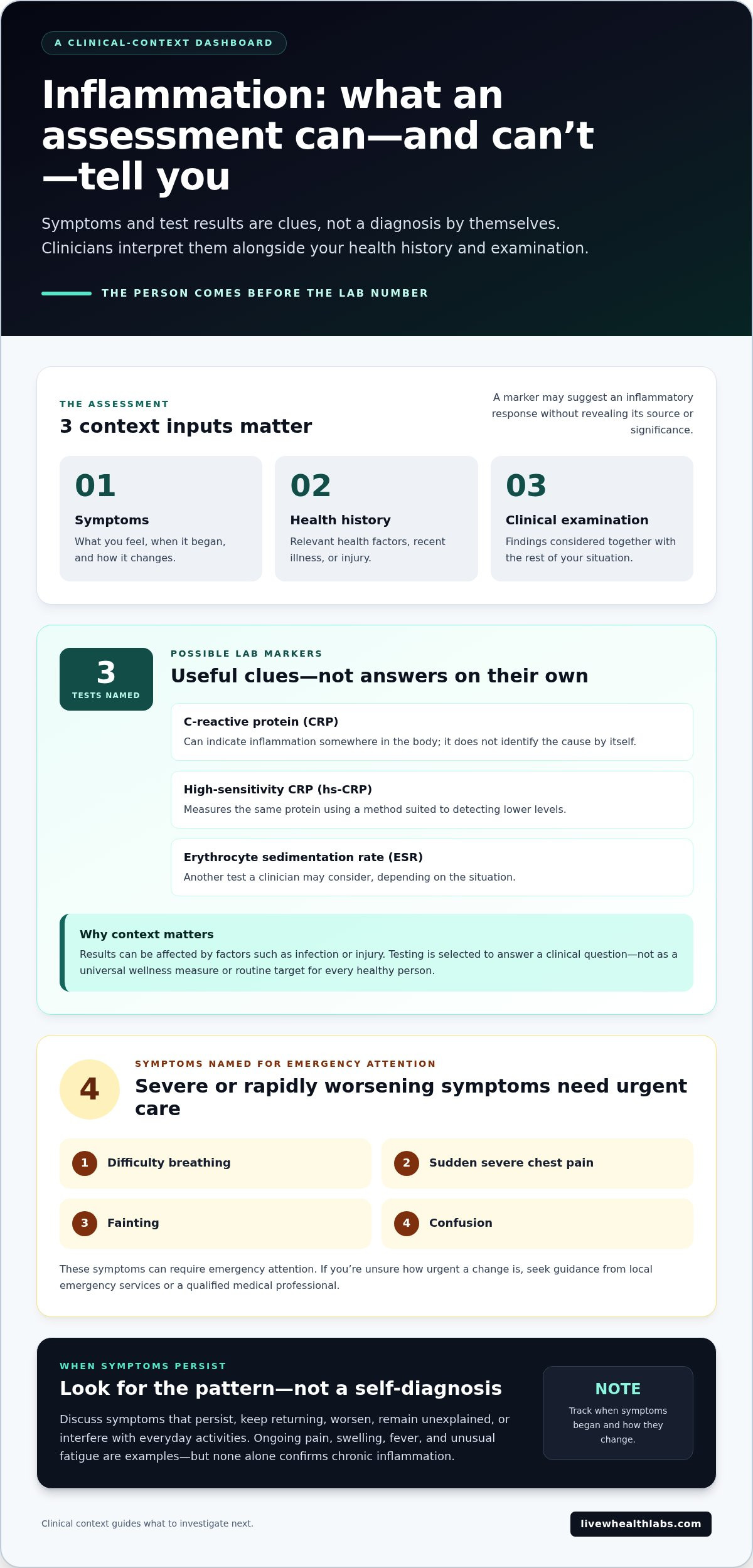
Discuss symptoms with a clinician if they persist, keep returning, worsen, or remain unexplained, especially if they interfere with everyday activities. Examples might include ongoing pain, swelling, fever, or unusual fatigue, but none of these alone confirms chronic inflammation. Before an appointment, note when symptoms began, how they change, and any recent illness or injury. Those details can help guide an assessment without turning a symptom list into a self-diagnosis tool.
Seek urgent medical care for severe or rapidly worsening symptoms. Difficulty breathing, sudden severe chest pain, fainting, or confusion can require emergency attention. If you’re unsure how urgent a change is, contact local emergency services or a qualified medical professional for guidance rather than relying on an online inflammation checklist.
What can inflammation tests tell you?
A clinician may consider blood tests such as C-reactive protein (CRP), which can indicate inflammation somewhere in the body. A high-sensitivity CRP test measures the same protein using a method suited to detecting lower levels. Neither test identifies the cause on its own. Results may be affected by factors such as infection or injury, so a number needs interpretation rather than an isolated “good” or “bad” label.
Inflammation test results must be interpreted alongside a person’s symptoms, medical history, and clinical examination because a marker can indicate an inflammatory response without identifying its source or significance. Depending on the situation, a clinician may consider other tests, such as the erythrocyte sedimentation rate (ESR), or investigate a suspected cause. Testing is selected to answer a clinical question; it isn’t a universal measure of wellness or a routine target for every healthy person.
If you’re researching how to reduce inflammation in the body, understanding the reason for symptoms can help put general wellness advice in perspective. For those exploring clinician-guided wellness care, Whealth Labs’ care coordination connects patients with independent licensed providers. Clinical decisions and prescriptions belong to those providers, not the coordination platform.
Which Anti-Inflammatory Claims Are Supported, and Which Need Caution?
Claims that a single ingredient can “switch off” inflammation oversimplify a complex process. A more grounded approach is to consider overall dietary patterns and health habits as support for general well-being, while treating claims of cures or guaranteed biomarker changes with caution.
| More reasonable to consider | Claims that need caution |
|---|---|
| Eating a varied pattern that includes vegetables, fruits, legumes, whole grains, and unsaturated fats. | A single food, restrictive plan, or supplement will cure inflammation or treat an underlying disease. |
| Choosing sustainable habits that fit your needs and support overall health. | A product can reliably lower inflammation for everyone, regardless of cause, health status, or medication use. |
| Discussing persistent symptoms and treatment questions with a qualified clinician. | Wellness products, including peptides or compounded formulations, are established anti-inflammatory treatments without condition-specific evidence and provider assessment. |
Can an anti-inflammatory diet reduce inflammation?
It’s generally more useful to consider the pattern of meals than to label one food a cure. A balanced approach can include a range of vegetables and fruits, beans and other legumes, whole grains, nuts, seeds, and sources of unsaturated fats. Harvard Health Publishing’s overview of Foods that fight inflammation also emphasizes dietary choices within a broader eating pattern, rather than relying on one “superfood.”
For a practical starting point, look at the variety in your usual meals: include vegetables or fruit, and choose among options such as legumes, whole grains, nuts, seeds, and unsaturated fats according to your preferences and needs. Food choices can support overall health, but they don’t replace assessment or care for a medical condition. There’s no need to assume that everyone should follow the same restrictive plan; individual needs, preferences, and health circumstances matter.
No single food or supplement reliably treats every cause of inflammation.
Do supplements or wellness products solve the problem?
Evidence and safety can vary by ingredient and dose, and a supplement may interact with medication or be unsuitable for particular health circumstances. “Natural” doesn’t automatically mean safe or effective. Before starting a supplement, discuss it with a qualified clinician, especially if you take medication, have a health condition, or are considering using it instead of prescribed care.
The same care applies to wellness products and formulations. A product’s availability or wellness positioning doesn’t establish that it treats inflammation. Peptides and compounded formulations shouldn’t be assumed to be proven anti-inflammatory treatments. Decisions about an individually prescribed therapy belong with an independent licensed provider, who can consider the person’s health history and the evidence relevant to the specific situation.
How to Support Overall Health With Practical, Sustainable Habits
Which daily habits are a reasonable place to start?
Make healthy choices easier to repeat by tying them to routines you already have. Consider a consistent sleep and wake schedule, and meals that include a variety of nourishing foods. A small adjustment, such as adding a serving of vegetables or choosing a walk you enjoy, may fit daily life more naturally than a strict short-term plan.
It may also help to review smoking and alcohol use without judgment. If you smoke and want to stop, a clinician can discuss cessation support. If you drink alcohol, consider how it fits your health circumstances and ask for individualized guidance if you’re uncertain. There’s no single routine that works for everyone.
How can you track progress without overinterpreting symptoms?
A simple record can make a clinical conversation more specific. Note when symptoms occur, along with sleep, activity, and relevant changes in routine or health. Focus on patterns over time, not on assigning a diagnosis to each difficult day. Bring your notes to an appointment if symptoms persist or change.
Frequent testing or interpreting one biomarker result in isolation can create confusion. Inflammation markers vary and need clinical context; a single result doesn’t necessarily explain how you feel or show whether a lifestyle change is working. Progress may also be reflected in broader measures of well-being, such as whether daily activities feel more manageable, rather than in one inflammation number.
Sustainable habits can support overall health, but they cannot replace diagnosis or treatment when a medical condition needs care. If you’re exploring clinician-guided wellness options, learn about coordinated wellness care. Whealth Labs coordinates access to independent licensed providers; clinical decisions and prescriptions remain with those providers.
When to Seek Medical Guidance, and Where Coordinated Wellness Fits
General health habits can support well-being, but they can’t explain every symptom. Seek professional assessment if symptoms are persistent, recurring, severe, worsening, or unexplained. A clinician can consider the pattern alongside your health history and examination, then decide whether tests or other next steps are appropriate. The goal isn’t to label every symptom as inflammation; it’s to understand what may be causing it.
What should you prepare for a clinical conversation?
A few notes can make an appointment more focused. Record when symptoms started, how they’ve changed, and what seems to affect them. Bring relevant medical history, a list of medications and supplements, and any prior test results you have. Consider asking what possible causes are being considered, which evaluation may be appropriate, and when to follow up. Severe or urgent symptoms need timely medical attention, not advice from a wellness article.
If symptoms include difficulty breathing, sudden severe chest pain, fainting, or confusion, seek emergency medical care. Don’t wait to see whether a lifestyle change or wellness product helps.
How does responsible wellness coordination work?
Whealth Labs provides administrative coordination that connects patients with independent licensed providers and supports access to individually prescribed wellness formulations. It does not diagnose or practice medicine. Independent providers decide whether evaluation, treatment, or a prescription is appropriate for an individual, based on their clinical judgment. A topic such as precision peptide therapy online should not be understood as a treatment for inflammation; suitability and clinical decisions are individualized.
If you’re exploring how to reduce inflammation in the body, keep the distinction clear: everyday habits may support overall health, while symptoms that persist or concern you deserve individualized medical assessment. A wellness coordination platform can facilitate access to independent providers, but it doesn’t replace clinical care or determine what treatment is right for you.
For a calm introduction to coordinated wellness care, explore Whealth Labs.
Take the Next Step With Clarity
Understanding how to reduce inflammation in the body starts with recognizing that inflammation is a response, not a diagnosis. Sustainable habits, including balanced meals, regular movement, and consistent sleep, can support overall health, but they aren’t guaranteed treatments. Persistent, recurring, severe, or unexplained symptoms deserve individualized medical assessment.
Test results and symptoms make the most sense in context. A clinician can consider your history, examine relevant concerns, and determine whether further evaluation or treatment is appropriate. That measured approach is more useful than relying on a universal “anti-inflammatory” fix.
For those exploring clinician-guided wellness care, Whealth Labs provides HIPAA-compliant administrative coordination, connecting patients with independent licensed providers and coordinating prescribed formulations with compounding pharmacies. Providers make clinical decisions and determine whether a therapy is appropriate for an individual.
Explore coordinated wellness care with Whealth Labs to learn how the service connects patients with independent providers and supports coordination for prescribed wellness formulations.
Frequently Asked Questions
What is the fastest way to reduce inflammation in the body?
There isn’t one fastest method that works for every cause of inflammation. If symptoms follow an injury or infection, the appropriate response depends on what’s causing them; severe, persistent, or worsening symptoms warrant medical guidance. For general health, consistent habits such as balanced meals, regular movement, and adequate sleep are more sensible than extreme short-term protocols. A clinician can advise whether evaluation or treatment is needed for your specific situation.
Can drinking water reduce inflammation?
Drinking enough water supports normal body functions, but extra water isn’t a proven treatment for inflammation and won’t address its underlying cause. Hydration needs vary with activity, health, and other individual factors. Drinking to thirst and following any fluid guidance from your clinician is a reasonable approach. If you’re considering water as a way to manage ongoing symptoms, discuss those symptoms with a healthcare professional rather than relying on increased fluid intake alone.
What foods may support a healthy inflammatory response?
A varied eating pattern that includes vegetables, fruits, legumes, whole grains, nuts, seeds, and unsaturated fats can support overall health. Think about the balance of meals over time rather than expecting one ingredient to act as a cure. Individual needs and preferences differ, so a highly restrictive diet isn’t necessary for everyone. Food choices may complement appropriate medical care, but they don’t replace evaluation or treatment for an underlying condition.
How do you know if inflammation is chronic?
You can’t reliably determine that from symptoms alone. Fatigue, soreness, or recurring discomfort can have many possible explanations, and ongoing symptoms don’t automatically mean chronic inflammation. A clinician considers the pattern, health history, examination, and any relevant tests. Inflammation markers such as C-reactive protein may provide information, but they can’t identify a cause by themselves. Seek assessment if symptoms persist, recur, worsen, or remain unexplained.
Can stress and poor sleep contribute to inflammation?
Stress and disrupted sleep can affect health and may influence immune and inflammatory processes, but they don’t prove that someone has chronic inflammation or explain symptoms on their own. A steady sleep routine and practical stress-management approaches may support overall well-being. Start with changes that feel manageable, rather than expecting a quick fix. If sleep problems or stress are persistent or affecting daily life, discuss them with a qualified healthcare professional.
When should I see a doctor about possible inflammation?
Arrange a clinical assessment for symptoms that are persistent, recurring, severe, worsening, or unexplained. A clinician can consider your history and examination findings before deciding whether tests or follow-up are appropriate. Seek urgent medical attention for severe or rapidly worsening symptoms, such as difficulty breathing, sudden severe chest pain, fainting, or confusion. Don’t delay urgent care to try a supplement or wait for a lifestyle change to work.
Do supplements or peptides reduce inflammation?
Evidence and safety vary by supplement, ingredient, dose, medications, and health status. Some products can interact with medicines or may not suit particular circumstances, so discuss them with a qualified clinician before use, especially if you take medication. Peptides and compounded formulations shouldn’t be assumed to treat inflammation; their suitability and any prescription decision require assessment by an independent licensed provider. No product should replace evaluation of persistent or concerning symptoms.