
What if the peptide itself isn’t the deciding factor in whether your plan pays? If you’re asking, “is peptide therapy covered by insurance,” the answer depends on the medication, why it’s prescribed, and your plan’s rules. A prescription alone doesn’t guarantee coverage, and coverage for a medication doesn’t necessarily include related consultations or coordination fees.
That uncertainty can make it difficult to estimate what you’ll owe. The key distinction is between a medication benefit and the services involved in coordinating care. Some plans may consider FDA-approved peptide medications prescribed for approved indications, while compounded peptides are typically not covered. Your individual benefits and requirements still matter.
This guide explains what insurers may consider and how to verify coverage for a specific prescription, including what to ask about prior authorization, copays, and exclusions. It also covers how to compare insurance with self-pay and eligible account payment options without assuming reimbursement. Whealth Labs coordinates with independent licensed providers and compounding pharmacies. That coordination is separate from an insurer’s coverage decision, so consider medication costs and administrative fees separately.
Key Takeaways
- The answer to “is peptide therapy covered by insurance” depends on the prescribed product, its intended use, and your plan’s benefit rules.
- Check the plan formulary for coverage conditions, exclusions, and requirements such as prior authorization before estimating your out-of-pocket costs.
- Compare private insurance, Medicare benefits, and compounded prescriptions carefully. Coverage rules can differ by product and plan.
- When verifying benefits, give the insurer the exact medication, prescribed indication, prescriber details, and plan information, then record the response.
- Review medication, consultation, pharmacy fulfillment, and administrative coordination charges separately when comparing self-pay with potential reimbursement.
Is peptide therapy covered by insurance? Start with the short answer
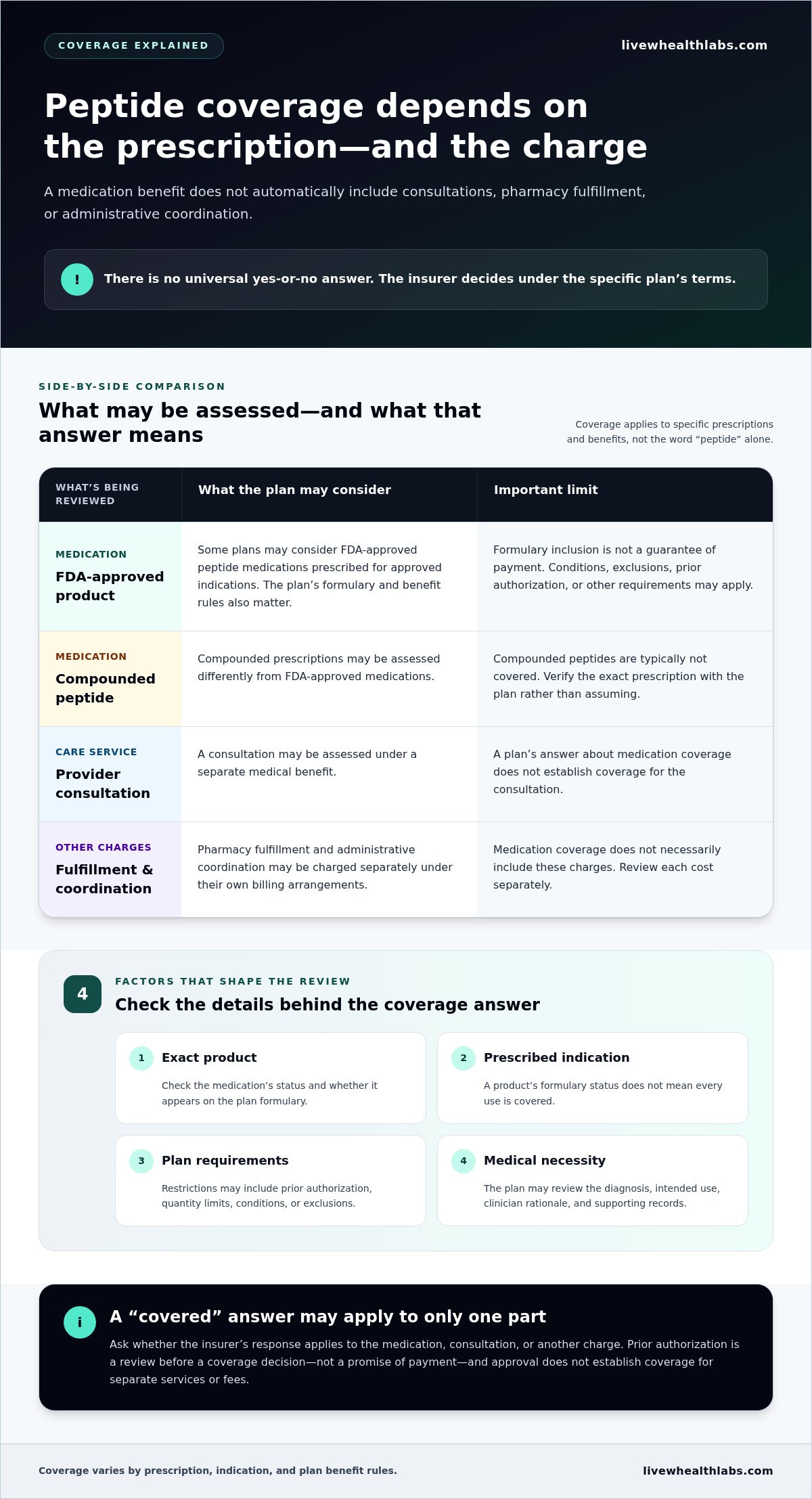
Sometimes, but there’s no universal answer. Whether is peptide therapy covered by insurance applies to a particular prescription depends on the product, the condition it’s prescribed for, your plan’s benefits, and any coverage requirements. A prescription isn’t a promise of payment. The insurer makes its decision under your plan’s terms.
It’s also important to separate the charges. Medication, a provider consultation, pharmacy fulfillment, and administrative coordination may be billed by different parties and assessed under different rules. Even if a plan considers a medication for coverage, that doesn’t establish coverage for related services or fees.
Coverage follows the specific prescription and plan rules, not the word “peptide” on its own.
What does insurance coverage for peptide therapy actually mean?
Insurance coverage can refer to several different benefits, so clarify which charge you’re asking about. Prescription-drug coverage concerns whether a medication is included under your plan’s pharmacy benefit. A provider consultation may be assessed under a separate medical benefit. Pharmacy fulfillment and administrative coordination may also be charged separately, under their own billing arrangements.
These three terms can help you interpret an insurer’s answer:
- Formulary: The plan’s list of medications it covers, often with conditions or restrictions.
- Medical necessity: The plan’s assessment of whether the treatment is appropriate for the documented health condition under its coverage criteria.
- Prior authorization: A review the insurer may require before deciding whether to cover a medication. Approval isn’t automatic, and authorization alone doesn’t establish that separate services or charges are covered.
Ask whether the response applies to the medication, the consultation, or another part of the process. A general “covered” answer may not address every charge.
Why does coverage vary between peptide prescriptions?
Insurers may assess a medication’s status, its prescribed indication, and the plan’s benefit rules. A product’s inclusion in a formulary doesn’t necessarily mean it’s covered for every use. Plans can set conditions, require documentation, or exclude particular products or uses. Compounded prescriptions may be assessed differently from FDA-approved medications. Verify coverage for the exact prescription rather than assuming the answer.
The reason for treatment matters, too. A wellness goal alone doesn’t establish that a plan’s medical-necessity criteria are met. The insurer may consider the diagnosis and whether the prescription aligns with the plan’s coverage terms. That’s why two people discussing peptide therapy could receive different answers, even if the medication names sound similar.
For a broader explanation of individualized, medically coordinated care, explore this precision peptide therapy guide. Whealth Labs coordinates with independent licensed providers and compounding pharmacies. It facilitates administrative coordination, rather than making clinical or insurer coverage decisions.
How insurers assess a peptide prescription and its medical necessity
Insurers generally evaluate a prescription in context, not as a category-wide yes or no. The product’s regulatory status, the condition it’s prescribed to treat, and the plan’s coverage criteria can all affect the review. A clinician’s decision to prescribe a medication doesn’t by itself establish that the insurer’s definition of medical necessity is met.
Insurers may review the product, prescribed indication, plan formulary, and supporting documentation, but these factors don’t guarantee a coverage decision.
Approval status, prescribed use, and formulary placement
An FDA-approved medication prescribed for an indication included in its approved labeling presents a different coverage question from a medication prescribed for another use or a compounded preparation. These distinctions can matter, but they don’t determine the outcome on their own. Check current FDA sources for product-specific FDA status and labeling, since details can change.
Each plan maintains its own formulary, or covered-drug list. A medication may be placed on a tier that affects the member’s share of the cost, subject to plan terms. It may also have utilization conditions, such as prior authorization or quantity limits. A plan may exclude a product or a particular use. Formulary placement is a starting point for understanding benefits, not a guarantee that a specific prescription will be paid.
Medical necessity and prior authorization
To assess medical necessity, a plan may request information about the diagnosis, intended use, and clinician’s rationale for prescribing the medication. The insurer may also specify which records or forms it needs. Requirements vary, so use the plan’s written criteria rather than assuming one insurer’s process applies to another.
Prior authorization is a review that may happen before the plan decides whether a medication qualifies for coverage. It isn’t a promise of payment. A request can be approved, denied, or returned for more information, and the final decision remains subject to the plan’s terms. If a decision is unclear, ask the insurer which criterion it applied and whether there’s a review or appeal process.
Before contacting the insurer, gather the relevant details:
- Product: Exact medication name and, where applicable, whether it’s an FDA-approved product or compounded preparation.
- Indication: The condition the prescription is intended to address.
- Plan requirement: Formulary status, restrictions, and any prior-authorization criteria.
- Documentation: Information the plan requires from the prescribing clinician.
These details make an insurer inquiry specific without presuming clinical eligibility. Whealth Labs coordinates with independent licensed providers and compounding pharmacies, while the insurer makes coverage decisions. To understand how coordination fits into a personalized process, explore Whealth Labs’ precision peptide therapy.
Private insurance, Medicare, and compounded peptide coverage compared
The answer to is peptide therapy covered by insurance depends partly on which coverage pathway applies. Private plans, Medicare benefits, and pharmacy claims for compounded prescriptions aren’t interchangeable. This table is a starting point, not a coverage determination. The specific product, prescribed use, and plan terms determine the individual answer.
| Coverage pathway | What to understand | What to verify |
|---|---|---|
| Private insurance | Coverage depends on the plan’s formulary, benefit design, and restrictions for the drug and indication. | Whether the exact medication and prescribed use are covered, and whether authorization or other conditions apply. |
| Medicare Part D | May cover certain FDA-approved prescription drugs for approved indications, subject to Medicare and plan rules. | Whether the drug and use qualify under the current Part D benefit and the enrollee’s plan requirements. |
| Medicare Part B | Uses a different benefit pathway from Part D. Coverage depends on applicable Medicare rules and circumstances. | Which benefit, if any, applies to the specific medication and how it is provided. |
| Compounded prescription | May be treated differently from an FDA-approved product. Compounding status alone doesn’t establish a universal outcome. | Whether the plan considers the prescription under its terms and whether the dispensing pharmacy can process it through that benefit. |
Private plans and Medicare require separate checks
A private insurer’s formulary and restrictions apply to that plan. Medicare has its own benefit categories and current rules. Part B and Part D aren’t general labels for peptide therapy. The applicable pathway depends on the medication and circumstances, so check current CMS guidance and the member’s plan documents rather than assuming Medicare covers or excludes all peptide prescriptions.
As of October 2026, the Medicare GLP-1 Bridge program is a limited, time-bound pathway for certain weight-loss GLP-1 drugs. CMS states that the program began July 1, 2026, and is scheduled to run through December 31, 2027, with a $50 monthly copay for eligible Part D enrollees. This program doesn’t establish coverage for other peptide products or uses. Eligibility and terms still matter.
Compounded prescriptions need their own review
A compounded medication isn’t automatically treated like an FDA-approved drug with a similar ingredient or purpose. Plans may apply different coverage rules, and the dispensing pharmacy and benefit arrangement can affect how a claim is handled. Don’t assume every compounded prescription is covered or that every one is excluded. Confirm the exact formulation and pharmacy with the plan before estimating payment.
Individualized formulations also involve considerations beyond a benefit category. Whealth Labs coordinates with independent providers and compounding pharmacies, while insurers make coverage decisions. This guide to customized wellness formulations explains how individualized formulations fit into a coordinated approach.
How to check coverage before starting peptide therapy
A precise coverage check starts with the prescription details, not a general question about peptides. If you’re asking, “is peptide therapy covered by insurance,” give your plan enough information to assess the specific medication and use. A phone estimate or online formulary entry can help, but neither should be treated as a guarantee of payment.
- Gather the prescription details. Note the exact medication name, whether it’s an FDA-approved or compounded product, the prescribed indication, dosage form, and intended dispensing pharmacy. If the prescription is still being considered, ask the prescribing provider what details the insurer will need.
- Identify the prescriber and benefit pathway. Have the provider’s details and your plan information ready. If you have Medicare, clarify whether the inquiry concerns Part B or Part D. For private coverage, identify the relevant medical or pharmacy benefit.
- Review your plan documents. Search the current formulary and benefit materials for the exact product. Check for exclusions, tier placement, prior authorization, step requirements, quantity limits, and pharmacy network rules.
- Contact member services or the pharmacy benefit manager. Ask about the exact product and indication, and whether the prescriber and pharmacy meet plan requirements. Request an estimate of your patient responsibility, including any applicable deductible, copay, or coinsurance.
- Document the response. Record the date, representative’s name or reference number, and the precise question asked. Request written benefit information when available, and keep any forms or authorization instructions.
Questions to ask your health plan
Keep your questions specific: Is this exact medication on the current formulary for the stated diagnosis? Is prior authorization required, and what documentation must the prescriber submit? Are there restrictions on the dispensing pharmacy? What portion of the medication cost may be your responsibility under current benefits? Ask whether the answer is a benefit estimate or a formal coverage decision, then save the response.
What to do when coverage is denied or unclear
Read the denial notice and identify the reason, such as a formulary exclusion, missing documentation, or an unmet plan criterion. Follow the reconsideration or appeal instructions and deadlines in the plan materials. You can discuss relevant clinical documentation with the prescribing provider, who can clarify the diagnosis and rationale where appropriate. An appeal invites another review, but it doesn’t ensure the decision will change.
Keep medication benefits separate from charges for provider consultations, pharmacy fulfillment, or administrative coordination. These may follow different billing arrangements and aren’t necessarily included in a medication decision. Understanding administrative medical coordination fees can help you distinguish those charges when reviewing expected expenses. Whealth Labs facilitates administrative coordination with independent providers and compounding pharmacies. Insurers make coverage decisions.
For a coordinated approach to peptide therapy, explore Whealth Labs’ precision peptide therapy.
If insurance does not cover peptide therapy: understand the payment pathway
If your plan won’t cover a prescribed medication, compare self-pay with any reimbursement options available under your plan. This direct-pay model is already common across regenerative health; for instance, concierge practices such as REVĪV provide in-home care for spine and joint pain under self-pay structures when insurance does not apply. Paying directly doesn’t establish that an insurer will reimburse you later, so treat these as separate pathways and request a clear breakdown of each charge before committing.
A peptide-related care process may involve several distinct expenses:
- Provider consultation: A charge for professional time and clinical services, handled under the provider’s billing arrangements.
- Prescribed medication: The cost of the specific prescription, which may be separate from the consultation.
- Pharmacy fulfillment: Charges associated with dispensing and fulfilling the prescription.
- Administrative coordination: Fees for administrative support, which aren’t automatically part of a medication benefit.
Ask for an itemized explanation before deciding how to pay. If you plan to submit a claim yourself, check whether your plan accepts that type of expense and what documentation it requires. An invoice or receipt can support a claim, but it doesn’t guarantee reimbursement or establish that a service is covered.
HSA and FSA funds: eligibility is not automatic
Whether an HSA or FSA can be used for an expense depends on current tax rules, the nature of the expense, and plan administration. Don’t assume peptide treatment, a consultation, pharmacy fulfillment, or administrative coordination qualifies. Before using account funds, verify the specific expense with your plan administrator and review current IRS guidance. Eligibility for one charge doesn’t necessarily extend to the others.
How Whealth Labs fits into a coordinated care process
Whealth Labs facilitates administrative coordination among patients, independent licensed providers, and compounding pharmacies. It doesn’t practice medicine: independent providers make clinical decisions, and insurers determine coverage under their own plan rules. Coordination and medication fulfillment are distinct from a provider’s clinical services, so review the charges separately as you assess payment options.
Understanding administrative medical coordination fees can help clarify which charges relate to coordination rather than medication benefits. To learn more about a coordinated approach, explore Whealth Labs.
Make your next step an informed one
Before beginning a peptide therapy pathway, make your decision with clear information rather than assumptions about benefits or out-of-pocket costs. The question “is peptide therapy covered by insurance” is a useful starting point, but your plan’s specific response and a clear understanding of each charge can help you decide what to do next.
Whealth Labs supports the administrative side by coordinating with independent licensed medical providers and compounding pharmacies. Its coordination includes HIPAA-compliant data management. Clinical decisions remain with providers, and coverage decisions remain with insurers. This distinction helps keep the process transparent without promising a particular clinical or financial outcome.
To understand how administrative support fits into the broader care pathway, explore the Whealth Labs coordination process.
Frequently Asked Questions
Is peptide therapy usually covered by health insurance?
Coverage isn’t uniform, so “is peptide therapy covered by insurance” has to be answered for a specific prescription and plan. A drug appearing on a formulary, for example, doesn’t necessarily qualify for coverage when prescribed for a different use. Compare the medication benefit with charges for provider services and administrative support. Ask the plan what its response applies to, and keep a record.
Does insurance cover compounded peptide therapy?
It depends on the plan and the specific compounded prescription. A prescription alone doesn’t establish that the plan will pay, and coverage for an FDA-approved product shouldn’t be assumed to apply to a compounded formulation. Give the insurer the formulation and dispensing pharmacy details, then ask which benefit rules apply. If you receive an estimate, confirm whether it covers the medication alone or also addresses pharmacy and provider charges.
Does Medicare cover peptide therapy?
Medicare coverage depends on the prescription and applicable program rules, so a general answer about peptides can be misleading. Part B and Part D have different roles, and the relevant benefit may depend on the medication and circumstances. Check current CMS guidance and the member’s plan materials. Have the product name and intended indication ready so the response addresses the specific prescription.
Can prior authorization guarantee insurance coverage for peptide therapy?
No. Prior authorization is a review of a request, not a guarantee that the insurer will pay every related charge. Check the written decision for the exact product, indication, pharmacy, and any stated coverage period or conditions. Also ask how the plan applies your deductible or cost-sharing. Authorization for a medication may still be separate from coverage for consultations, fulfillment, or administrative services.
Can I use HSA or FSA funds for peptide therapy?
Possibly, but eligibility depends on current tax rules, the particular expense, and account administration. Don’t assume that a prescription makes every associated charge eligible. Medication, provider services, and administrative fees may need to be considered separately. Before paying with account funds, ask your administrator about the specific expense and consult current IRS guidance. Account eligibility is distinct from insurance coverage or reimbursement.
What happens if my insurance denies peptide therapy?
Start with the denial notice, which should identify the reason and explain any review options and deadlines under your plan. If the insurer cites missing records, ask what information it needs. The prescribing provider can discuss relevant clinical documentation. Keep copies of the notice and any submission. While the plan reviews its decision, request an itemized breakdown of expected charges so you can distinguish medication expenses from other services.
Will insurance reimburse Whealth Labs coordination or fulfillment fees?
Don’t assume reimbursement. Whealth Labs facilitates administrative coordination and medication fulfillment with independent licensed providers and compounding pharmacies. Ask your plan whether it considers each specific expense eligible and what documentation it requires. A receipt or invoice may help document a payment, but it doesn’t establish reimbursement. Any decision depends on the plan’s terms and applicable rules.