
Could fatigue, lower libido, or changes in strength in your 30s signal low testosterone, or might sleep, stress, or another health factor be involved? If you’re searching for symptoms of low testosterone in 30s, a clear checklist may seem helpful. But these changes can have several causes, and symptoms alone can’t confirm a hormone deficiency.
Patterns matter more than age or any single symptom. Persistent changes, especially when several occur together, may be worth discussing with a clinician. An assessment typically considers your symptoms and health history alongside appropriately timed blood tests. Results need clinical interpretation rather than a quick comparison with an online range.
This guide explains which signs may warrant attention, what can contribute to low testosterone, and why fatigue or reduced libido isn’t diagnostic on its own. You’ll also learn what a clinical evaluation may involve, so you can take an informed next step instead of drawing conclusions from a checklist.
Key Takeaways
- Sexual, reproductive, physical, sleep, and emotional changes may form a pattern worth discussing with a clinician.
- The symptoms of low testosterone in 30s can overlap with sleep disruption, stress, medication effects, and other health concerns.
- Track when symptoms began, how often they occur, and how they affect daily life to support a focused clinical conversation.
- Clinicians interpret test results alongside symptoms, medical history, and other relevant context.
- Avoid starting testosterone or online products based on symptoms alone. Appropriate next steps depend on an individual evaluation.
Symptoms of low testosterone in your 30s: what changes may matter?
A change in sexual desire, energy, or strength can raise a reasonable question about testosterone. Still, symptoms alone can’t establish testosterone deficiency. The symptoms of low testosterone in 30s overlap with other health concerns, and one isolated test result may not tell the full story.
Testosterone is a hormone involved in sexual function, sperm production, muscle and bone health, and other processes. “Low testosterone” generally refers to testosterone levels below the expected range in a person with relevant symptoms or signs. Hypogonadism describes a condition in which the body doesn’t produce enough sex hormones, including testosterone. Hypogonadism, also known as low testosterone, can have different causes and may affect sexual and reproductive function.
A single laboratory result is not, by itself, a complete diagnosis. Testosterone levels can vary, and clinicians interpret results in light of symptoms, health history, and other relevant factors. Symptoms raise a question; clinical assessment determines whether testosterone deficiency is present.
Which changes are commonly associated with low testosterone?
Possible signs include reduced sexual desire, erectile changes, or fewer spontaneous erections, such as morning erections. Some people notice lower energy, reduced muscle strength, or changes in body composition, including increased body fat or difficulty maintaining muscle. Mood changes, irritability, or difficulty concentrating may also occur.
There’s no single pattern everyone experiences. One person may notice a persistent change in sexual desire, while another has changes across several areas. Fatigue or difficulty concentrating on its own is especially nonspecific. These experiences can also occur with sleep disruption, stress, mood concerns, medication effects, or other health conditions, so they don’t identify the cause.
Does testosterone normally decline in your 30s?
Testosterone levels tend to decrease gradually with age, but the pace and extent vary between individuals. A Utah Health article cites an approximate decline of 1% per year beginning around age 30. That figure describes a population-level trend; it doesn’t predict how much any one person’s level will change or whether they’ll develop a deficiency.
Age-related averages aren’t a personal diagnosis. Someone in their 30s may have levels that differ from the average, and age alone can’t establish whether those levels are clinically low. An age-based estimate or isolated test result shouldn’t replace assessment of symptoms and medical circumstances.
Instead, consider the pattern: when a change began, whether it persists, and whether other changes appeared alongside it. A combination of concerns may help guide a clinical conversation, but it still needs appropriate evaluation. This distinction is useful when online symptom lists make ordinary fluctuations seem conclusive.
How low testosterone can affect sexual health, energy, and fertility
Testosterone can influence several aspects of health, so possible signs may appear in more than one area. A change in sexual function may feel more specific than general tiredness, but neither confirms a hormone disorder. The symptoms of low testosterone in 30s are best treated as a pattern to discuss, not a checklist that predicts a diagnosis or its severity.
Sexual and reproductive changes to note
Some people notice lower interest in sex, erectile changes, or fewer spontaneous erections. These experiences can be personal and difficult to raise, but describing them plainly helps a clinician understand what changed, when it began, and whether it is persistent.
Fertility is related, but it isn’t interchangeable with libido or erectile function. Testosterone plays a role in reproductive health, and hormonal factors may be considered when someone is having difficulty conceiving. Fertility concerns can have many causes, however, so they warrant an individual clinical discussion rather than an assumption that testosterone is responsible. If having children is a current or future goal, mention it during that conversation.
Energy, strength, sleep, and mood changes
Possible physical changes include persistent fatigue, reduced strength, or shifts in body composition. Sleep disruption may occur alongside hormonal concerns, but poor sleep can also affect energy and mood in its own right. Difficulty concentrating, low motivation, or irritability are similarly broad experiences. They can have several explanations and don’t establish low testosterone.
Consider how the changes relate to one another. Lower sexual desire together with a sustained change in spontaneous erections may be useful context to share, while fatigue alone offers less specific information. Even a cluster of symptoms can’t establish the cause or severity of a hormone problem. Possible symptoms can guide questions, but only clinical assessment can determine whether hypogonadism is present.
A brief record can make the pattern easier to explain. Note:
- When each change began and whether it is ongoing or intermittent.
- Which areas it affects, such as sexual function, sleep, energy, strength, or mood.
- How it affects daily life, relationships, or fertility goals.
Share this context in a clinical discussion, including changes that seem unrelated. A clinician can consider your symptoms alongside your medical history and appropriate evaluation rather than treating one complaint as decisive. The goal is not to self-diagnose, but to describe what has changed clearly enough to support a measured assessment.
For a broader overview of medically coordinated wellness access, learn about wellness coordination.
Low testosterone or something else? Understand overlapping symptoms
Fatigue, reduced sexual interest, and changes in body composition can appear in discussions of low testosterone, but none points to one cause by itself. The symptoms of low testosterone in 30s can overlap with sleep disruption, ongoing stress, mood concerns, medication effects, and other health issues. An online checklist can help you name a concern, but it can’t distinguish among these possibilities or replace a clinical evaluation.
Use the comparison below as a guide for what to discuss, not as a tool for self-diagnosis. The other explanations are possibilities a clinician may consider, not conclusions about what’s causing your symptoms.
| Symptom | Possible testosterone connection | Other explanations to discuss clinically |
|---|---|---|
| Fatigue or low energy | Can occur alongside low testosterone, particularly when other changes are present. | Sleep disruption, stress, medication effects, or other health concerns. |
| Lower libido or erectile changes | May be associated with reduced testosterone. | Mood, relationship or situational factors, medications, and other health issues. |
| Low mood or difficulty concentrating | May occur as part of a broader symptom pattern. | Stress, sleep problems, mental health concerns, or other conditions. |
| Changes in strength or body composition | May be relevant when considered with other symptoms. | Changes in activity, nutrition, health, or medications. |
Why fatigue and low mood are not specific to low T
Sleep problems can leave you tired or less focused; stress and mental health concerns can affect energy, motivation, and mood. Other health conditions or nutritional shortfalls may also contribute, and clinics such as Ready Health highlight how issues like vitamin deficiencies frequently explain ongoing fatigue. Some medications can also influence how you feel or function. These possibilities don’t rule out low testosterone, just as fatigue or low mood doesn’t prove it. Describe the timing and context, including whether symptoms followed a change in sleep, stress, health, or medication and whether they persist despite changes in routine.
When sexual or body-composition changes need context
Record what you’ve observed without assigning a cause. Note when sexual changes began, whether they’re consistent, and whether strength or body composition changed around the same time. A clinician may consider your health history and medications alongside your symptoms. Share relevant health changes and fertility goals as well; these details can help shape the discussion and can be raised confidentially.
Persistent, changing, or disruptive symptoms merit attention whatever their cause. Seek an assessment if they affect daily life, relationships, or wellbeing, rather than waiting for an online checklist to provide certainty. A clear account of what has changed gives a clinician a useful starting point for deciding what evaluation, if any, is appropriate.
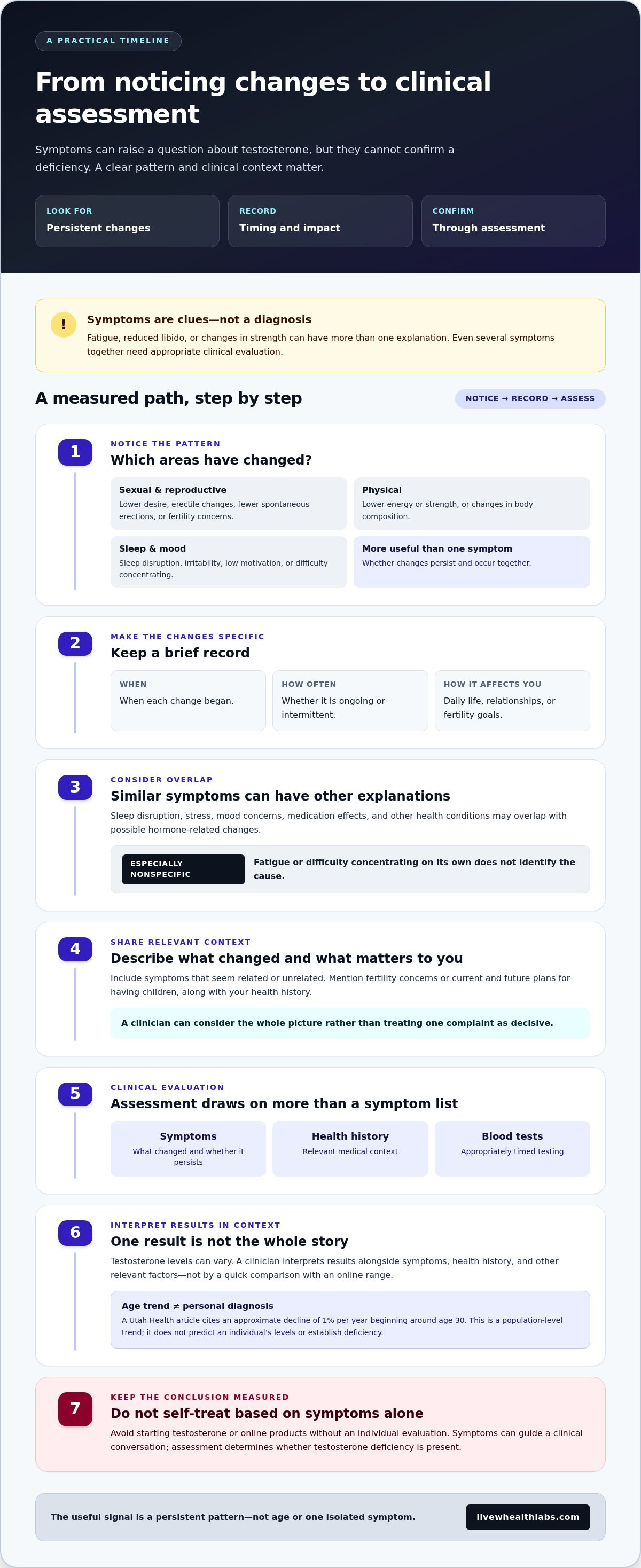
What to Do for Low Testosterone Symptoms in Your 30s
If you’re concerned about possible symptoms of low testosterone in 30s, a clear sequence can help turn uncertainty into a focused clinical conversation. The goal isn’t to confirm a diagnosis yourself. It’s to describe what’s changed and support an evaluation that considers your symptoms, test results, and health history together.
- Document the changes. Note when each symptom began, how often it occurs, whether it’s changing, and how it affects daily functioning, relationships, sleep, or exercise. Record relevant context, such as a recent change in health or routine.
- Arrange a clinical discussion. Bring your notes and explain what concerns you most. Mention sexual symptoms directly, even if the conversation feels uncomfortable. A clear description is more useful than trying to label the cause in advance.
- Complete the indicated evaluation. A clinician may recommend blood testing or other steps based on your symptoms and medical context. Follow the specific instructions provided for your evaluation rather than relying on a self-ordered test or general online testing schedule.
- Review the findings. Discuss what the results mean in context, whether further evaluation is appropriate, and what potential causes or next steps the clinician is considering.
How to prepare for a clinical conversation
Before the appointment, make a current list of prescription medications, over-the-counter products, and supplements, including recent changes. Add relevant medical history and any fertility goals, whether you’re trying to conceive now or may want children in the future. This information helps the clinician consider the full picture. Don’t stop or change a medication on your own; ask how it may relate to your concerns.
Write down a few questions, such as which symptoms matter most to the evaluation and what the proposed tests can clarify. You don’t need to arrive with a suspected diagnosis. Be specific about what you’ve noticed and let the clinician assess its significance.
What testing can and cannot tell you
Blood testing can measure testosterone, but a result isn’t self-interpreting. Clinicians consider laboratory findings alongside symptoms, medical history, and other relevant factors. Appropriate timing, whether testing should be repeated, and how results are interpreted depend on clinical guidance and the individual situation. Follow the instructions given for your evaluation; don’t use a single result or online threshold to decide that you have a hormone disorder.
Clinical diagnosis requires interpreted evidence, not a self-scored symptom checklist. A symptom list can organize your concerns, and a test can provide useful information, but neither is the entire assessment. If symptoms persist or affect your life, a clinical discussion can help determine what evaluation is appropriate.
Whealth Labs coordinates access to independent licensed providers, who conduct medical consultations and determine care. Explore medically coordinated wellness access to understand how provider access and administrative coordination work.
After evaluation: understand the care pathway without self-treating
An evaluation is a starting point for informed decisions, not an automatic path to a particular treatment. What happens next depends on the clinical findings, suspected cause, medical history, and personal goals, including whether you hope to have children. The symptoms of low testosterone in 30s can prompt a conversation, but they don’t determine which care, if any, is appropriate.
Why treatment decisions require individualized medical oversight
If testosterone deficiency is being considered, a licensed clinician can discuss potential benefits and risks of available approaches in light of your circumstances. Fertility goals matter: hormone-related decisions may affect reproductive planning, so raise those goals before considering an intervention. This is individualized medical care, distinct from general education. Don’t start testosterone, hormones, or other medication based only on symptoms, an online checklist, or marketing claims.
Online products marketed for “low T” may not provide the assessment needed to understand what is causing symptoms or whether a product is suitable for you. Avoid self-treating with hormones or supplements based on an advertised promise or a test result viewed without clinical interpretation. If you’re already taking a product, tell the clinician what it is rather than stopping or changing prescribed medication without medical guidance.
Where coordinated wellness access fits, and where it does not
Whealth Labs is an administrative coordination platform that connects patients with independent providers. It doesn’t diagnose or treat testosterone deficiency; independent providers conduct medical consultations and determine care. Coordination supports access and administration, while clinical evaluation and medical decisions remain with the provider.
Whealth Labs’ peptide and wellness offerings aren’t presented as treatment for low testosterone. This educational overview of precision peptide therapy coordination explains the broader coordination context, not treatment for testosterone deficiency. Keep the questions distinct: a clinician assesses your health concerns, while wellness coordination describes an administrative process.
For your next clinical conversation, focus on what you want clarified: what the findings mean, whether further evaluation is appropriate, and how your health history and goals shape the discussion. You don’t need to arrive with a treatment decision. Take time to understand the clinical reasoning before considering an intervention, and avoid products that promise a diagnosis or result without appropriate medical oversight.
Whealth Labs provides administrative coordination for medically coordinated wellness access. This is separate from diagnosis or treatment for low testosterone; clinical decisions belong with an independent licensed provider.
Take the next step with clarity
If the symptoms of low testosterone in 30s are affecting your wellbeing, you don’t need to decide what they mean on your own. Use your concerns as a reason to seek a thoughtful clinical discussion, and take time to understand the findings before considering care.
Medical decisions belong to independent licensed providers, who conduct consultations and determine care. Whealth Labs supports administrative coordination, including HIPAA-compliant data management; it doesn’t diagnose or treat testosterone deficiency. Keeping those roles distinct helps clarify where education ends and individualized medical care begins.
To learn how Whealth Labs coordinates access to independent providers, explore the coordination process. Informed questions and appropriate clinical guidance can help you move forward with greater confidence.
Frequently Asked Questions
Can you have low testosterone in your 30s?
Yes, low testosterone can occur in your 30s, but age alone doesn’t establish a deficiency. Hormone levels and experiences differ, and symptoms such as reduced energy or sexual changes can have other explanations. If you’re concerned, note what has changed and how it affects you. A clinician can decide whether testing is appropriate and interpret results in context rather than relying on an online checklist.
What is usually the first sign of low testosterone?
There isn’t one first sign that applies to everyone. Some people notice a change in sexual desire or erections; others first observe lower energy, reduced strength, or mood changes. Pay attention to changes from your own usual pattern, not comparisons with someone else. Note whether a change is persistent or appears only during a period of disrupted sleep, illness, or unusual stress.
Is fatigue a sign of low testosterone in your 30s?
Fatigue can occur alongside low testosterone, but fatigue alone doesn’t establish a hormone problem. Sleep disruption, stress, medications, and other health conditions can also affect energy. If tiredness is persistent or interferes with work, exercise, or daily responsibilities, discuss it with a clinician. Mention whether it coincides with changes in sexual function, strength, sleep, or mood, and whether anything changed around the time it began.
How is low testosterone diagnosed in men in their 30s?
Diagnosis requires clinical assessment, not simply matching symptoms to a list. A clinician may review your health history and symptoms and use blood testing to assess testosterone. The appropriate timing, need for further testing, and interpretation depend on your circumstances and current clinical guidance. If you already have a result, bring the report and explain when and why it was obtained. Don’t treat a number viewed without professional interpretation as a diagnosis.
Can low testosterone affect fertility in your 30s?
Testosterone-related conditions may be relevant to fertility, but difficulty conceiving can have many causes. If you’re trying to conceive or expect to in the future, raise this early in a medical discussion. Discuss fertility goals before considering hormone products, since decisions about hormones can affect reproductive planning. Avoid assuming testosterone is the cause or starting a product without guidance from a licensed clinician.
What else can cause symptoms that look like low testosterone?
Several factors can overlap with symptoms associated with low testosterone, including disrupted sleep, ongoing stress, mental health concerns, medication effects, lifestyle changes, and other health conditions. The pattern alone may not distinguish among them. Before a clinical conversation, consider whether symptoms began after a change in medication, sleep, or health, and bring a current medication and supplement list. A clinician can determine whether further assessment is appropriate.
Should you take testosterone if you have symptoms of low T?
No, don’t start testosterone based only on symptoms, online advice, or a test result you haven’t reviewed with a clinician. Decisions require medical oversight and discussion of possible causes, potential risks, and personal goals, including fertility. Whealth Labs is a coordination platform, not a medical practice. Independent licensed providers conduct medical consultations and determine care; Whealth Labs doesn’t diagnose or prescribe treatment for low testosterone.