
What does PCAB accreditation tell you about a compounding pharmacy, and what does it leave unanswered? PCAB accredited compounding pharmacies have undergone an accreditation process that assesses practices against applicable compounding standards. That matters, but it is not the same as state licensure, FDA approval of compounded medications, or a guarantee of safety.
When a compounded medication is part of your care, clear credentials can help you evaluate a pharmacy. The important step is to understand what each credential establishes instead of treating one accreditation claim as proof of everything. This guide explains what PCAB accreditation assesses, how it differs from state licensure, and how to interpret its scope. It also clarifies the separate roles of the pharmacy, prescriber, and care-coordination platform.
Whealth Labs coordinates administrative processes between patients, independent licensed providers, and compounding pharmacies. That coordination does not replace a prescriber’s clinical judgment or a pharmacy’s responsibilities. Understanding those boundaries helps you assess each credential and role more clearly.
Key Takeaways
- PCAB accreditation, administered by ACHC, assesses a pharmacy against defined compounding standards. It does not approve a medication.
- Compare accreditation with state licensure, FDA oversight, and USP standards to understand what each credential or framework addresses.
- For PCAB accredited compounding pharmacies, verify the current listing and check whether the accredited scope covers sterile compounding, nonsterile compounding, or both.
- Use a simple sequence: identify the claim, find its source, confirm its scope, and keep credential checks separate from treatment decisions.
- Know each role in the process: patients explore information, independent providers make clinical decisions, pharmacies handle prescription fulfillment, and Whealth Labs facilitates administrative coordination.
What Does PCAB Accreditation Mean for a Compounding Pharmacy?
PCAB accreditation is a voluntary assessment of a compounding pharmacy’s practices against defined standards for pharmaceutical compounding. The Pharmacy Compounding Accreditation Board (PCAB) program is administered by the Accreditation Commission for Health Care (ACHC), which offers PCAB as an accreditation service. PCAB is not a federal regulator or state licensing board. Its accreditation provides information about a pharmacy’s practices within the assessed scope; it does not approve a particular medication.
For patients comparing PCAB accredited compounding pharmacies, this distinction is important. A pharmacy credential concerns the pharmacy’s operations. A prescriber’s clinical decision concerns whether a treatment is appropriate for an individual patient. Accreditation can inform your evaluation of a pharmacy, but it does not determine whether a prescription should be written, whether a compounded preparation is right for you, or what outcome to expect.
PCAB’s standards have been updated to incorporate revised United States Pharmacopeia (USP) General Chapters <795> and <797>, addressing nonsterile and sterile compounding. The updated PCAB standards took effect on June 1, 2024. Consider accreditation in light of the standards and scope that apply, rather than as a blanket endorsement of every preparation or service a pharmacy may provide.
What does the PCAB acronym refer to?
PCAB stands for Pharmacy Compounding Accreditation Board. It is a program of ACHC, an accrediting organization, rather than an agency that grants pharmacy licenses or regulates medications at the federal level. The distinction is practical: an accrediting organization assesses an entity against its standards, while government authorities handle licensing and regulatory responsibilities.
Why do patients search for accredited compounders?
Compounding credentials give patients and prescribers a defined point of comparison when evaluating pharmacy practices. But a credential answers an operational question, not every question about a person’s care. Consider accreditation alongside applicable licensure, oversight, the pharmacy’s stated scope, and the prescriber’s assessment. No single credential should decide the whole evaluation.
Accreditation is a limited operational credential, not medication approval, a safety guarantee, or a substitute for clinical judgment.
That limit is central to interpreting the term accurately. A pharmacy may hold accreditation within a particular scope, but the prescriber remains responsible for clinical decisions. The pharmacy’s credential does not establish that a specific compounded medication is FDA-approved. Accreditation is one consideration in a broader framework of pharmacy oversight and patient-specific prescribing. Next, distinguish what accreditation evaluates from what state licensure, FDA oversight, and USP standards address.
How Accreditation, State Licensure, FDA Oversight, and USP Standards Differ
These terms describe different parts of compounding oversight. They are not interchangeable seals of approval. A pharmacy may be subject to licensing and regulatory requirements, follow applicable compounding standards, and hold voluntary accreditation at the same time. Each addresses a different question, so comparing PCAB accredited compounding pharmacies means looking beyond the credential name to understand its scope.
| Framework | What it addresses | What it doesn’t establish |
|---|---|---|
| PCAB accreditation | A voluntary assessment of pharmacy practices against accreditation standards within a defined scope. | FDA approval of a compounded drug, required state licensure, or suitability for an individual patient. |
| State pharmacy licensure | Authorization and oversight by state boards of pharmacy under applicable state requirements, including requirements relevant to pharmacy operations and jurisdiction. | Accreditation or FDA approval of a compounded medication. |
| FDA oversight | Federal oversight of drugs and compounding, with requirements that differ according to the facility’s legal category and activities. | Identical inspection or regulatory pathways for every compounding pharmacy. |
| USP standards | Technical standards for compounding practices, including relevant chapters for nonsterile, sterile, and hazardous-drug handling. | Approval of a particular drug or a clinical decision about whether it’s appropriate. |
Accreditation is not the same as a pharmacy license
State boards of pharmacy oversee pharmacy licensing within their jurisdictions. A license is a legal authorization subject to applicable state rules; it is not the same as a voluntary accreditation assessment. Accreditation has its own standards and scope, and it does not replace any license required for the pharmacy’s operations. For a pharmacy serving patients across state lines, relevant licensing requirements can depend on the states involved.
Where FDA and USP requirements fit
FDA oversight varies by compounding category and activity. For example, traditional 503A pharmacies generally compound for individual patients pursuant to prescriptions, while 503B outsourcing facilities operate under a separate federal framework and are subject to current good manufacturing practice requirements. The distinction matters because it would be inaccurate to assume every pharmacy is inspected or regulated in exactly the same way. Compounded drugs are also not FDA-approved in the same manner as FDA-approved drugs.
USP General Chapters <795>, <797>, and <800> address nonsterile compounding, sterile compounding, and hazardous-drug handling, respectively, where applicable. The USP Compounded Medicines resource explains USP’s role and compounding standards. Accreditation may assess practices against relevant standards, but applicable requirements depend on the work performed.
Facility standards address how compounding is conducted; drug approval concerns whether a drug has undergone FDA approval. Neither accreditation nor adherence to a standard determines whether a specific preparation is clinically suitable for you. That assessment belongs with the prescriber, who considers your circumstances and treatment needs. Whealth Labs facilitates administrative coordination between patients, independent providers, and pharmacies, helping clarify each role in prescription-based care.
What to Compare When a Pharmacy Claims PCAB Accreditation
A credential name is only a starting point. To evaluate an accreditation claim, compare the pharmacy’s current listing, the scope shown there, and the services it says it provides. This is especially useful when a pharmacy advertises both sterile and nonsterile compounding. A claim about one type should not automatically be read as covering every activity.
PCAB accreditation is administered by ACHC. ACHC provides a publicly searchable accreditation directory, which can help you distinguish an independently verifiable listing from language on a pharmacy’s own website. Use the directory to verify the credential, then consider licensure and the pharmacy’s stated services as separate information.
Check the credential’s scope and current status
Search the ACHC directory using the pharmacy’s legal name and location. Compare those details with the name and address in the pharmacy’s accreditation claim. A similar name alone may not establish that the listing belongs to the same operation. Review the status and scope in the official record, then match that scope to the service you’re evaluating.
Be precise about the type of compounding involved. Sterile and nonsterile compounding involve different practices and applicable standards. If a pharmacy’s materials describe one type but its accreditation listing identifies another scope, do not assume they are interchangeable. Use the listed scope to understand what the accreditation covers instead of interpreting a general “PCAB accredited” statement as covering every preparation.
Read the credential alongside other pharmacy information
Accreditation does not replace checking whether a pharmacy has the applicable state license. Use the relevant state board of pharmacy’s public records, where available, to review licensure status and disciplinary information. Requirements and available records can vary by jurisdiction, so focus on the pharmacy and locations involved.
A credential also does not tell you everything about a specific preparation. By itself, it does not establish the quality or source of a particular ingredient, approve a prescription, or show that a medication is appropriate for an individual patient. Those are separate questions requiring relevant pharmacy information and, for treatment decisions, the prescriber’s clinical judgment.
- Identity: Does the official listing match the pharmacy’s legal name and location?
- Status: Does the directory show a current accreditation listing?
- Scope: Does the listed accreditation align with the sterile or nonsterile service being discussed?
- Context: Have you considered applicable licensure and public board records separately?
This approach helps you compare PCAB accredited compounding pharmacies without treating accreditation as a ranking or guarantee. For more context on how specialized pharmacy access differs from generic retail options, explore specialized compounding pharmacy access. A verified credential is one useful data point, not a complete assessment of a pharmacy or treatment.
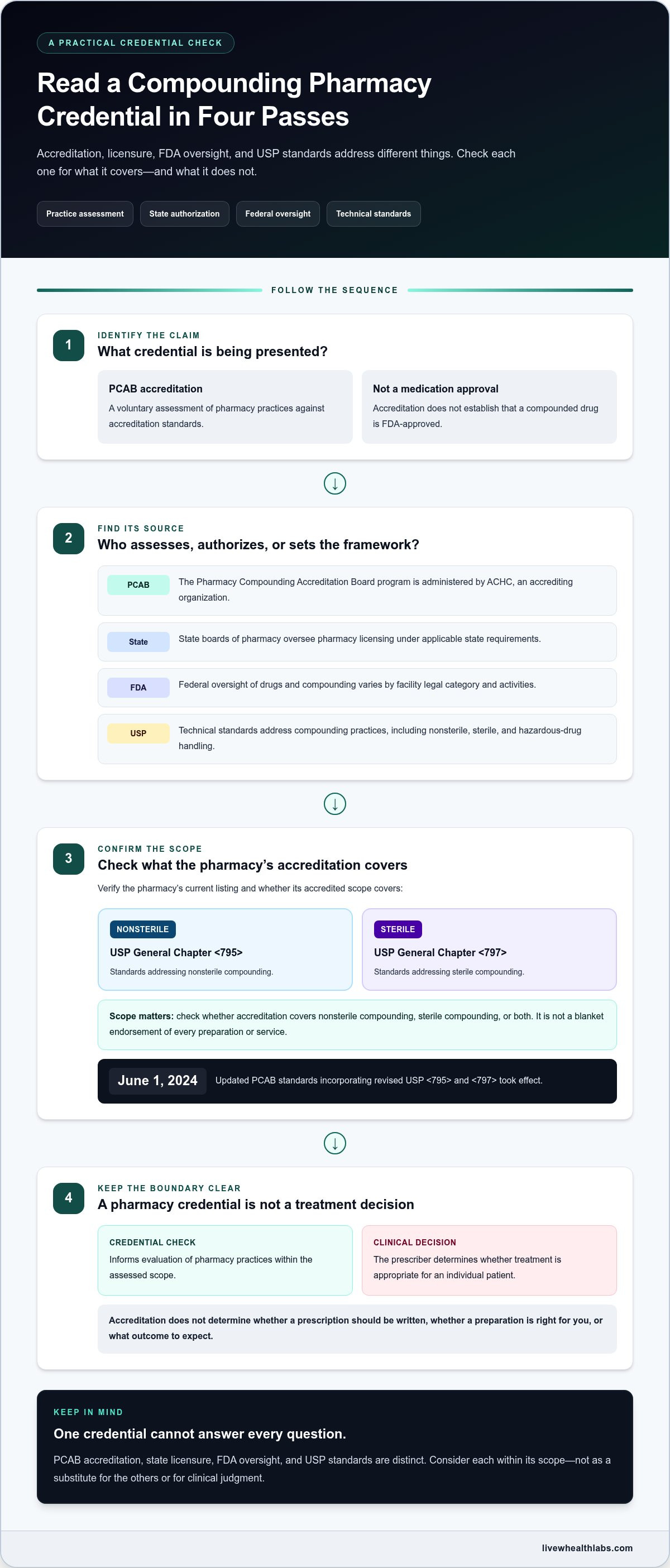
A Patient’s Practical Checklist for Interpreting Accreditation
A pharmacy credential is useful when you know what was assessed and who conducted the assessment. Use this sequence to evaluate a PCAB claim without confusing operational verification with a decision about your treatment.
- Identify the exact claim. Note the accreditor named and the pharmacy’s legal name and location. Broad wording such as “accredited” or “PCAB compliant” is not the same as a verified accreditation listing. Treat the claim as a starting point, not a conclusion.
- Locate the claim’s source. Search the Accreditation Commission for Health Care (ACHC) public directory, which lists PCAB-accredited pharmacies. Compare the directory entry with the pharmacy’s information. If the names or locations do not align, do not assume the listing refers to the same operation.
- Check status and scope. Review the current listing and the activities it covers. If you’re assessing a sterile preparation, for example, confirm that the listed scope applies to sterile compounding rather than assuming a general accreditation claim covers every type. Keep advertised services distinct from the scope recorded by the accreditor.
- Compare the roles. Consider pharmacy accreditation alongside applicable state licensure and publicly available board records. Then separate those checks from the clinical question: an independent licensed provider evaluates the patient and determines whether a treatment may be appropriate. Pharmacy accreditation does not establish patient eligibility or replace that evaluation.
Verify the claim without treating it as a guarantee
Use the accreditor’s current verification tool where available. As you compare records, keep the pharmacy’s exact name, location, and stated service in view. If a pharmacy operates or dispenses across state lines, requirements can depend on the states involved. Do not draw a legal conclusion from accreditation alone. Review relevant state board information for the jurisdiction at issue.
A credential can establish that a pharmacy is listed as accredited within a stated scope; it cannot establish that a specific prescription is appropriate for you.
Keep the clinical decision with the licensed provider
A credential answers an operational question, not a personal medical one. The independent provider considers the patient’s circumstances and makes clinical decisions, including whether treatment is appropriate. The pharmacy has a separate role in handling a prescription under applicable requirements. For context on how these responsibilities fit into medically coordinated peptide therapy, keep provider evaluation separate from pharmacy credential checks.
Whealth Labs facilitates administrative and educational coordination among patients, independent licensed providers, and compounding pharmacies. It does not make clinical decisions or accredit pharmacies. To explore this coordination approach, learn about coordinated peptide therapy.
How Pharmacy Credentials Fit Into Whealth Labs’ Coordination Process
A pharmacy credential is one part of prescription-based care, not the whole process. Patients can begin by exploring information about a therapy. An independent licensed provider then evaluates the patient and makes clinical decisions, including whether a prescription is appropriate. If the provider prescribes, a compounding pharmacy has a separate role in handling the prescription and fulfillment under applicable requirements.
The provider, pharmacy, and coordination platform have different roles
Each participant has a distinct responsibility. The independent provider evaluates the patient and determines clinical care. The compounding pharmacy handles pharmacy functions associated with a prescription, including preparing or dispensing a compounded formulation as applicable. Accreditation relates to a pharmacy’s assessed practices and scope; it does not transfer clinical authority to the pharmacy or a coordination platform.
Whealth Labs is an administrative and educational coordination platform connecting patients with independent licensed providers and compounding pharmacies. It facilitates coordination and HIPAA-compliant data management, but it does not practice medicine, conduct in-person clinical examinations, or operate as a compounding pharmacy. This separation clarifies where questions belong: treatment decisions to the provider, pharmacy operations to the pharmacy, and administrative coordination to the platform.
In practice, a patient may review information, take part in an independent provider’s evaluation, and receive a prescription only if that provider determines one is appropriate. Pharmacy fulfillment is a later, separate step, subject to applicable prescription and regulatory processes. The sequence does not guarantee that a prescription will be written or filled.
What the accreditation question can, and cannot, answer
Checking whether a pharmacy appears among PCAB accredited compounding pharmacies can contribute to a credential comparison. It can help you understand whether the pharmacy has an accreditation listing and what scope is stated. It cannot determine whether treatment fits your health needs, whether you’re eligible, whether a provider will approve or issue a prescription, or what clinical outcome may follow.
Learning about customized wellness formulations can provide context about prescription-based approaches, but educational information is not a personal treatment recommendation. Discuss treatment questions with the independent provider responsible for evaluating your care. Keep pharmacy credential checks focused on the pharmacy’s identity, current status, and scope.
The practical takeaway is measured: accreditation can inform how you assess a pharmacy, while the provider’s clinical evaluation guides decisions about your care. Whealth Labs supports administrative coordination between the people and organizations involved, without replacing clinical judgment or pharmacy responsibilities. To understand how coordinated, prescription-based care is organized, explore Whealth Labs’ coordination approach.
Make Your Next Care Decision With Clarity
Use a pharmacy credential as a starting point for informed questions, not as a shortcut to a treatment decision. If you’re considering PCAB accredited compounding pharmacies, first understand what the credential covers. Then discuss treatment suitability with the independent licensed provider responsible for your care.
Whealth Labs connects patients with independent licensed providers and compounding pharmacies through administrative coordination and HIPAA-compliant data management. This structure supports clearer communication across the process while leaving clinical decisions with the provider and pharmacy functions with the pharmacy.
Explore how prescription-based wellness care is coordinated and take your next step with a clearer understanding of who is responsible for each part: Explore coordinated prescription-based wellness care.
Thoughtful questions and clearly defined roles can make a complex process easier to understand. Move forward at your own pace, with clarity guiding the conversation.
Frequently Asked Questions
Can a compounding pharmacy be legitimate without PCAB accreditation?
Yes. PCAB accreditation is not a universal synonym for legal operation, and its absence alone does not establish that a pharmacy is operating unlawfully. Pharmacy licensure and other requirements depend on jurisdiction and activity; additional conditions may apply in some contexts. Check the relevant state board’s current rules and records, and consider accreditation separately from licensing and the clinical appropriateness of a compounded prescription. No single credential answers all three questions.
Does PCAB accreditation cover sterile and nonsterile compounding?
Not necessarily. Scope may depend on the accreditation program, the pharmacy, and the activities assessed. Do not assume a listing for one location or type of compounding applies to every service. For example, a claim related to nonsterile work does not by itself show that sterile compounding is included. Check current PCAB or accreditor records and describe the scope shown there precisely. A scope match is useful, but it does not verify an individual preparation.
How often does a pharmacy need to renew PCAB accreditation?
Renewal timing and reassessment requirements depend on the current accreditation program. Rather than relying on a general statement or an undated logo, use the accreditor’s official listing to review the pharmacy’s displayed status and any dates or scope information. Program requirements can change, so consult the accreditor’s current published materials for renewal details. A current listing can help verify the credential, but it does not address whether a particular treatment is appropriate.
Can a PCAB-accredited pharmacy fill any compounded prescription?
No. Accreditation does not establish that a pharmacy can or should fill every prescription. The prescription, the pharmacy’s scope and capabilities, applicable requirements, and the provider’s clinical decision all matter. A credential also does not guarantee that a preparation is available or appropriate for a particular patient. Discuss treatment questions with the prescribing provider; accreditation is not a substitute for individualized clinical judgment.
Can a PCAB-accredited pharmacy ship prescriptions across state lines?
There is not a single answer for every pharmacy or prescription. Dispensing and shipping across state lines can involve licensing and other requirements that depend on the states and circumstances. Review current information from the relevant state boards and the pharmacy’s applicable licensure status. Accreditation alone does not establish authorization to dispense or ship into a particular state. This is general information, not a legal determination about a specific pharmacy or shipment.
Does PCAB accreditation mean a compounded medication is FDA-approved?
No. PCAB accreditation concerns a pharmacy’s practices within a defined accreditation scope; it is not FDA approval of a compounded medication. Compounded drugs are not FDA-approved in the same manner as FDA-approved drugs. Accreditation does not replace applicable regulatory oversight or standards, and it does not determine whether a medication is suitable for an individual. That treatment question belongs with the licensed provider evaluating the patient’s circumstances.