
Could a peptide address persistent fatigue, or distract from a cause that still needs to be identified? When fatigue disrupts work, daily activities, or quality of life, it’s understandable to look for new options. But peptide therapy for chronic fatigue is not an established treatment, and online claims can outpace the evidence. A careful medical evaluation is essential before considering treatment.
Chronic fatigue describes a symptom; ME/CFS is a diagnosed condition with its own clinical criteria. The distinction matters because fatigue can have many possible contributors, and the next step depends on a person’s history and clinical assessment. This article explains what is and isn’t known about peptides for fatigue, what safety questions to discuss with a licensed clinician, and why treatment decisions belong to independent medical providers. It also clarifies the difference between clinical care and administrative coordination: Whealth Labs helps coordinate access and related processes, but doesn’t diagnose or prescribe. The goal is to help you have an informed discussion, not promise a particular outcome.
Key Takeaways
- Distinguish persistent fatigue as a symptom from ME/CFS as a diagnosis; the terms aren’t interchangeable.
- Assess peptide therapy for chronic fatigue by looking for relevant human research, not anecdotes or findings from unrelated conditions.
- Understand how clinician-led evaluation and prescribed treatment consideration differ from sourcing peptides yourself.
- Prepare for a clinical discussion by noting your symptoms, timeline, daily impact, and current medicines, then asking about possible causes and alternatives.
- Whealth Labs coordinates administrative processes with independent licensed providers and compounding pharmacies; clinicians retain responsibility for assessment and prescribing decisions.
Chronic fatigue and peptide therapy: what the terms actually mean
Persistent fatigue can make ordinary demands, from completing a workday to managing household tasks, feel difficult. That experience deserves attention, but it doesn’t identify the cause. “Chronic fatigue” describes ongoing tiredness or low energy; it isn’t a diagnosis by itself. Because possible contributors vary, an individualized clinical assessment is a more reliable starting point than choosing a treatment based on the symptom alone.
That distinction matters when considering peptide therapy for chronic fatigue. Interest in a treatment, a plausible explanation for how it might work, or positive anecdotes don’t establish that it effectively treats fatigue. Evidence needs to relate to both the condition and the specific treatment being considered.
Is chronic fatigue the same as ME/CFS?
No. ME/CFS is a distinct clinical condition, not another name for feeling tired. Diagnosis involves clinical assessment and established criteria; it can’t be confirmed by matching a brief online symptom list. Post-exertional malaise, a worsening of symptoms after exertion, is an important feature discussed in this Myalgic encephalomyelitis/chronic fatigue syndrome overview. A clinician can assess whether the criteria fit and consider other explanations.
What are peptides, and why are they discussed in wellness care?
Peptides are short chains of amino acids. Some act as signals in the body, but peptides differ in structure, function, evidence, and medical use. The term doesn’t describe one uniform treatment. Some peptide-based medicines have established uses for particular conditions, while other proposed wellness applications remain investigational or have limited evidence. Approval or evidence for one use doesn’t establish benefit for another.
A biological mechanism alone does not prove clinical benefit. A substance may affect a pathway in laboratory research without demonstrating that it improves symptoms or outcomes in people with chronic fatigue or ME/CFS. The relevant questions are whether the treatment has been studied for the condition, how strong that evidence is, and what uncertainties remain.
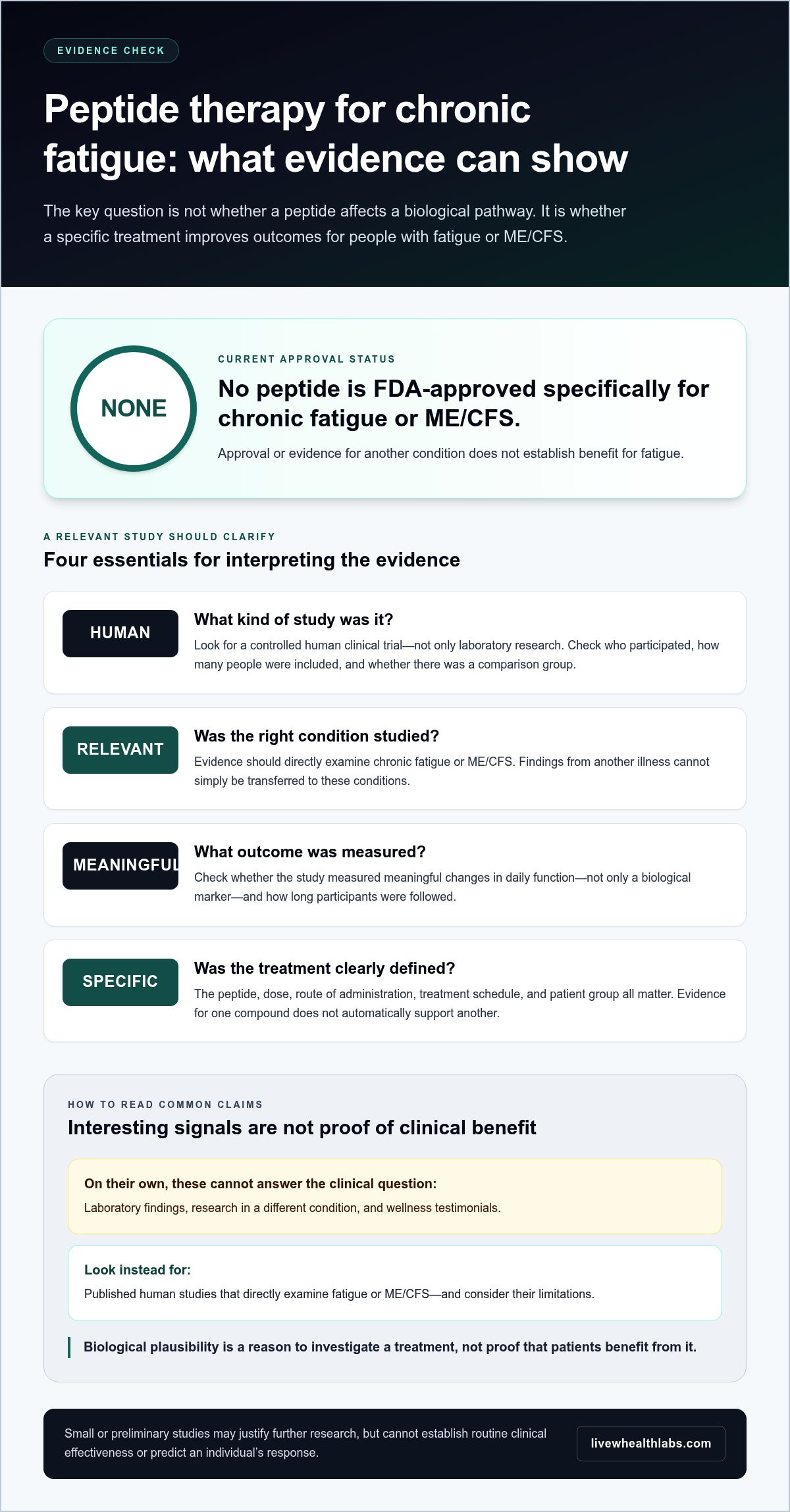
No peptide is FDA-approved specifically to treat ME/CFS or chronic fatigue. That makes careful interpretation especially important: evidence from another condition, early-stage research, and personal reports shouldn’t be presented as proof of effectiveness. A licensed clinician can assess fatigue in context and discuss evidence and treatment considerations without assuming a peptide is appropriate.
What does the evidence say about peptide therapy for chronic fatigue?
The central question isn’t whether a peptide can affect a biological pathway. It’s whether a specific peptide, given in a defined way, has been shown to improve outcomes for people with chronic fatigue or ME/CFS. Evidence from another condition, a laboratory experiment, or a wellness testimonial may raise a research question, but it can’t answer that clinical question on its own.
Peptide therapy for chronic fatigue shouldn’t be described as an established treatment. No peptide is FDA-approved specifically for chronic fatigue or ME/CFS. Approval for another indication, where it exists, doesn’t establish effectiveness for fatigue. The FDA’s Drugs@FDA database can help readers check approved drug indications; it doesn’t replace a review of clinical evidence for a proposed use.
How to judge peptide research without overreading it
Start with the study design. Was it a controlled human clinical trial, or laboratory research? Who participated, how many people were included, and was there a comparison group? Check what the researchers measured, how long they followed participants, and whether the outcome reflects meaningful changes in daily function rather than only a biological marker. Small or preliminary studies may justify further research, but they can’t establish routine clinical effectiveness or predict an individual’s response.
Biological plausibility is a reason to investigate a treatment, not proof that patients benefit from it. A mechanism observed in cells or animals does not show that the treatment safely and reliably improves fatigue in people.
Why evidence for one condition may not apply to fatigue
Clinical findings are specific to the population and treatment studied. Results in a different illness can’t simply be transferred to ME/CFS or persistent fatigue. Evidence for one compound also can’t automatically support another: the peptide, dose, route of administration, treatment schedule, and patient group all matter. Each combination needs evidence relevant to the proposed use.
Promotional claims can blur these distinctions by combining early research, patient anecdotes, and findings from unrelated conditions. Look for published human studies that directly examine fatigue or ME/CFS, and consider whether their limitations leave important questions unanswered. Without direct evidence, claims of proven benefit, symptom reversal, or predictable results go beyond what can responsibly be concluded.
A licensed clinician can help interpret what is known in the context of an individual’s health and discuss uncertainties without presenting a peptide as a proven solution. Whealth Labs coordinates access to independent licensed providers and supports related administrative processes; clinical assessment and prescribing decisions remain with those providers. Read more about clinician-coordinated peptide care.
Peptide therapy, standard evaluation, and self-treatment compared
| Approach | What it involves | Key distinction |
|---|---|---|
| Clinician-led evaluation | A licensed clinician reviews health history, symptoms, medicines, and any relevant examination or testing. | Helps assess possible causes and determine appropriate next steps. |
| Prescribed treatment consideration | An independent licensed provider weighs potential benefits, risks, evidence, and alternatives, then decides whether a prescription is appropriate. | The prescription decision belongs to the provider, not an administrative coordination platform. |
| Self-sourcing | Products may be sold outside clinician-led care, including with “research use” labeling. | Product identity, quality, intended use, and oversight may differ; self-sourcing isn’t a substitute for clinical assessment or prescribed care. |
What a clinician-led fatigue evaluation can clarify
Why self-sourced or research-use peptides are not equivalent to prescribed care
A label or online claim can’t establish that a product is suitable for human use, accurately identified, or made to appropriate quality standards. Avoid using unprescribed products, and don’t rely on a seller’s claims as a substitute for medical guidance. For a focused explanation, read about prescribed peptides versus research chemicals.
Compounding is distinct from FDA approval. The FDA explains that compounded drugs aren’t FDA-approved, which means the agency doesn’t review them for safety, effectiveness, and quality before marketing in the same way it reviews approved drugs. A prescription alone doesn’t make a compounded preparation FDA-approved or establish that it treats chronic fatigue. Details can depend on the specific drug and pharmacy; the provider and pharmacy have separate roles in clinical decision-making and preparation. See the FDA’s information on drug compounding.
For people exploring peptide therapy for chronic fatigue, Whealth Labs coordinates administrative processes involving independent licensed providers and compounding pharmacies. Clinical evaluation and prescription decisions remain with the provider. Learn more about clinician-coordinated peptide care.
Questions to discuss before considering peptide therapy for fatigue
A prepared conversation can help a clinician understand how fatigue affects you and clarify what is known, uncertain, or worth evaluating further. Use these steps to organize your questions, not to diagnose yourself or decide whether a treatment is appropriate.
How to prepare for a conversation about persistent fatigue
- Record the pattern. Note when fatigue began, how it changes, and any patterns you’ve observed. Include whether activity affects symptoms and how long any change lasts. These notes provide context, not diagnostic proof.
- Describe the functional impact. Write down how fatigue affects work, self-care, sleep, concentration, and other daily activities. Concrete examples can make the impact easier to discuss.
- Bring an up-to-date medication and supplement list. Include what you take, how often, and any recent changes. Don’t stop or alter prescribed treatment based on this checklist.
- Ask about possible causes and uncertainty. What factors could be contributing to fatigue? What has the evaluation established, and what remains unclear? Would further assessment be relevant in your circumstances?
- Discuss evidence and alternatives. What human evidence supports the proposed treatment for fatigue or ME/CFS specifically? How does its strength compare with other options, and what are the limits of what’s known?
- Clarify oversight before making a decision. Ask what monitoring or follow-up the clinician considers appropriate, which adverse effects to watch for, and what circumstances should prompt pausing treatment or seeking medical advice.
What medical oversight should mean in practice
Oversight isn’t a generic protocol applied to everyone. An independent licensed provider assesses the person’s history and clinical context, discusses potential benefits and risks, and decides whether a prescription is appropriate. If treatment is considered, that provider is responsible for explaining the intended plan and any follow-up needed. Monitoring needs vary, so they shouldn’t be assumed or promised in advance.
For broader context, read about medically supervised peptide protocols. This checklist can support a clinician discussion; it can’t establish eligibility or recommend peptide therapy for chronic fatigue.
Whealth Labs coordinates access to independent licensed providers and supports related administrative processes. Read about clinician-coordinated peptide care to understand how the coordination pathway works.
How Whealth Labs coordinates access to clinician-led peptide care
Exploring peptide therapy for chronic fatigue involves more than identifying a compound. It calls for clinical judgment, clear communication, and careful coordination among the patient, an independent licensed provider, and, where relevant, a compounding pharmacy. Whealth Labs supports the administrative pathway while keeping those roles distinct.
What coordination does, and what it does not do
Whealth Labs facilitates administrative steps between patients, independent licensed providers, and compounding pharmacies. This includes supporting consent and related processes, coordinating information, and handling patient data through HIPAA-compliant processes. These functions help organize the pathway; they are not a medical evaluation.
The independent provider assesses the patient’s circumstances and decides whether a prescription is appropriate. Whealth Labs doesn’t diagnose, prescribe, or replace that clinician. A compounded formulation should not be assumed to be FDA-approved or suitable for every patient. The clinician’s assessment and any prescription decision remain separate from administrative coordination.
Coordination can support communication and process, but it can’t establish the cause of fatigue, confirm a diagnosis, or demonstrate that a proposed treatment will help. Clinical decisions belong to the provider, while pharmacy processes are handled separately.
A considered next step for people exploring peptide therapy
Before pursuing a treatment, prioritize a clinical evaluation and an evidence-informed discussion of potential benefits, risks, alternatives, and uncertainties. Understanding how coordination works can help clarify the process, but it doesn’t promise eligibility or a particular health outcome.
For a fuller overview, read the precision peptide therapy online guide. It explains the medically coordinated pathway and the distinction between administrative support and independent clinical decisions.
You can also explore Whealth Labs’ coordination process at your own pace.
Make your next step an informed one
Persistent fatigue deserves thoughtful evaluation, not assumptions about its cause. Chronic fatigue is a symptom, while ME/CFS is a distinct diagnosis. Any interest in peptide therapy for chronic fatigue should be weighed against direct evidence for the condition, the limits of what’s known, and an individual clinician’s assessment.
Before discussing treatment, organize your symptom history and questions. Ask about possible contributing factors, alternatives, evidence quality, potential risks, and what follow-up could involve. A licensed provider makes clinical decisions, including whether a prescription is appropriate. Coordination can support the process, but it doesn’t replace medical judgment.
Whealth Labs coordinates access to independent licensed providers and supports administrative facilitation involving compounding pharmacies. Patient information is managed through HIPAA-compliant processes. These administrative functions are distinct from diagnosis and prescribing.
To learn how the pathway works, explore Whealth Labs’ coordinated care process. Start with an informed conversation with a licensed clinician about your fatigue and possible next steps.
Frequently Asked Questions
Can peptide therapy treat chronic fatigue?
It hasn’t been established as an effective treatment for chronic fatigue. Research on a peptide’s biological effects, or reports of personal improvement, doesn’t show that it reliably reduces fatigue in patients. Evidence needs to apply to the specific peptide and to people with chronic fatigue or ME/CFS. Discuss the quality and limits of any cited evidence with a licensed clinician before weighing a treatment.
Is peptide therapy an established treatment for ME/CFS?
No. Peptide therapy isn’t an established treatment for ME/CFS, and no peptide is FDA-approved specifically for this condition. Evidence from other illnesses or early-stage studies can’t establish that a peptide treats ME/CFS. A clinician can discuss how a proposed use fits the available evidence, its uncertainties, and other options. Be cautious of claims that promise symptom reversal or a predictable result.
What is the difference between chronic fatigue and ME/CFS?
Chronic fatigue describes persistent tiredness or low energy; it isn’t a diagnosis by itself. ME/CFS is a distinct clinical condition diagnosed through assessment using established criteria. Ongoing fatigue can have different possible contributors, so a clinician considers the person’s history and symptoms rather than assuming ME/CFS or another cause. An online symptom list can’t confirm a diagnosis or replace an individual evaluation.
Can a telehealth provider evaluate persistent fatigue?
Yes, an independent licensed provider may begin an evaluation through telehealth by reviewing symptoms, health history, and current medicines. The clinician determines whether that information is sufficient or whether further assessment, testing, or an in-person examination is needed. Telehealth doesn’t guarantee a diagnosis or prescription. Whealth Labs coordinates access to independent providers, but it doesn’t practice medicine or make clinical decisions.
Are compounded peptides FDA-approved to treat chronic fatigue?
No. Compounded drugs aren’t FDA-approved, and no peptide is FDA-approved specifically to treat chronic fatigue or ME/CFS. Compounding and FDA approval are distinct, and a prescription doesn’t establish that a preparation is approved or effective for fatigue. Ask the licensed provider to explain the proposed use, the evidence supporting it, and any relevant uncertainties before making a decision.
What should I ask a clinician before considering peptide therapy?
Ask what might be contributing to your fatigue and what remains uncertain. If a peptide is proposed, ask whether human studies examined that treatment for chronic fatigue or ME/CFS, what the evidence can and can’t show, and what alternatives exist. Discuss possible adverse effects, monitoring, follow-up, and what circumstances should prompt stopping treatment or seeking advice. Bring a symptom timeline and current medication and supplement list.
Is it safe to use peptides purchased for research purposes?
Products labeled for research purposes aren’t equivalent to clinician-prescribed treatment, and their identity, quality, intended use, or suitability for people may be uncertain. Don’t use them to self-treat fatigue. An online seller’s claims can’t replace clinical assessment or establish safety. Discuss any product you’ve taken or are considering with a licensed clinician, including the packaging or product information if available.