
What if the most important question isn’t which peptide to try, but what’s causing the inflammation in the first place? Interest in peptide therapy for inflammation is understandable, especially when online claims promise clear answers. But inflammation can describe a short-term response, a persistent symptom, a lab finding, or part of a diagnosed condition. Each calls for a different kind of assessment.
Peptides are discussed with varying levels of confidence. For many marketed uses, the evidence remains preliminary, with much of it coming from preclinical research or small human studies. A compounded peptide isn’t the same as an FDA-approved drug, and a product sold online without appropriate medical oversight can carry avoidable risks. That distinction matters when weighing potential benefits against uncertainty.
This article separates acute from chronic inflammation, explains what current evidence can and can’t tell us about peptide therapy, and outlines practical, evidence-informed steps that may support overall health. You’ll also learn which symptoms warrant clinical assessment and how to discuss treatment options with a licensed clinician without delaying care for an underlying condition.
Key Takeaways
- Learn why inflammation can be a normal short-term response, a persistent symptom, or a lab finding, and why those distinctions matter.
- See how to assess claims about peptide therapy for inflammation without treating early research as proof of clinical benefit.
- Understand why care guided by an underlying cause may differ from trying to address a general inflammation label.
- Identify practical health habits to review and when symptoms call for assessment by a qualified clinician.
- Prepare questions about evidence, intended use, risks, alternatives, and monitoring before discussing peptide therapy with an independent licensed provider.
What does inflammation mean, and when is it a concern?
Inflammation is part of the immune system’s normal response to injury, infection, or other triggers. It helps the body respond to a threat and begin repair. But “inflammation” by itself is not a diagnosis or an explanation for a particular symptom. A foundational overview of its biological processes is available in Inflammation.
This distinction matters when you encounter claims about peptide therapy for inflammation. A general wellness article can explain common terms, but it can’t determine why you feel unwell or whether a lab result points to a specific condition. Causes vary, so an individual assessment depends on the full clinical picture.
How acute and chronic inflammation differ
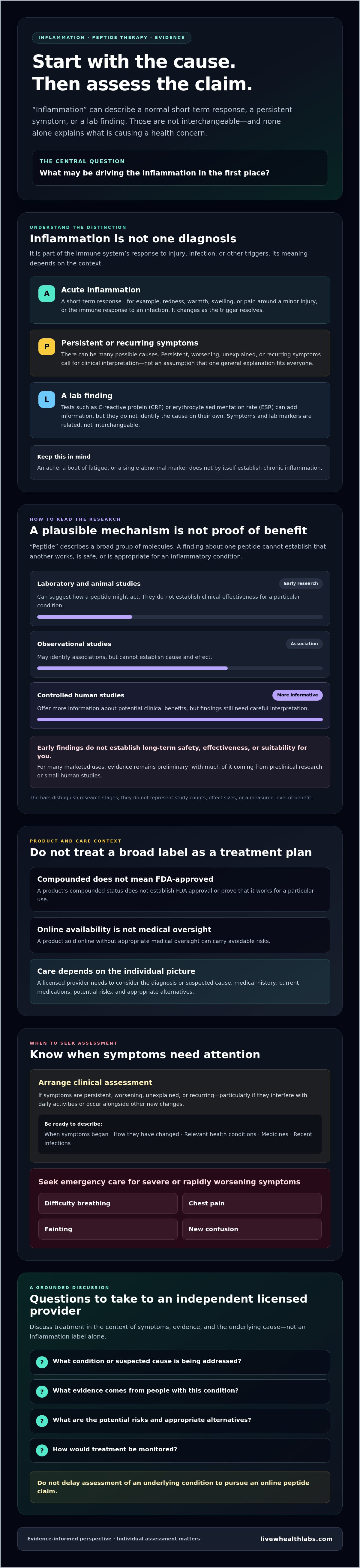
Acute inflammation is a short-term response, such as redness, warmth, swelling, or pain around a minor injury, or the immune response to an infection. It occurs in context and changes as the trigger resolves. Persistent inflammation lasts or recurs over time and can have many possible causes. It calls for clinical interpretation, not an assumption that one general explanation fits everyone.
Symptoms and laboratory markers are related, but they aren’t interchangeable. You may notice pain, swelling, or fatigue, while a clinician may consider tests such as C-reactive protein (CRP) or erythrocyte sedimentation rate (ESR). These results can add information, but they don’t identify the cause on their own. An ache, a bout of fatigue, or a single abnormal marker doesn’t by itself establish chronic inflammation.
Which signs call for medical assessment?
Seek emergency care for severe or rapidly worsening symptoms, including difficulty breathing, chest pain, fainting, or new confusion. For other concerns, don’t rely on a lab result or an online peptide claim to guide treatment. The next step is to clarify what your symptoms and available evidence mean; a clinician can help distinguish a temporary response from a problem that needs further evaluation.
What does current evidence say about peptide therapy for inflammation?
“Peptide” describes a broad group of molecules, not one uniform treatment. Different peptides can have different structures, biological roles, and proposed uses. A finding about one molecule therefore can’t establish that another works, is safe, or is appropriate for an inflammatory condition. This distinction is essential when evaluating peptide therapy for inflammation, where broad wellness claims can outpace condition-specific evidence.
Biological plausibility is a reason to investigate a treatment, not proof that it is clinically effective for a particular condition. To assess a claim, look for evidence in people with the condition in question, not only a proposed mechanism or results from cells or animals.
Why peptide research does not equal a proven treatment
Research evidence varies in how directly it applies to treatment decisions. Laboratory and animal studies can suggest how a peptide might act. Observational studies may identify associations, but they can’t establish cause and effect. Controlled human studies are more informative about potential clinical benefits, though their findings still need careful interpretation.
When reviewing a study, check who participated, what condition was studied, which outcome was measured, and when the results were published. Ask whether the outcome reflects a meaningful change in symptoms or function, and whether the study’s design and size support its conclusions. Early findings don’t, on their own, demonstrate long-term safety, effectiveness, or suitability for you. A product’s compounded status also doesn’t establish FDA approval or prove that it works for a particular use.
What a clinician must assess before considering treatment
A treatment decision depends on more than an inflammation-related symptom or lab result. An independent licensed provider needs to consider the diagnosis or suspected cause, medical history, current medications, potential risks, and appropriate alternatives. The provider, not Whealth Labs, makes clinical decisions about evaluation, eligibility, and prescribing.
Before discussing peptide therapy, ask which specific condition the proposed treatment is intended for, what human evidence supports that use, what uncertainties and risks remain, and how progress or adverse effects would be monitored. Ask whether established care should be considered first or continued. These questions can help distinguish a medically reasoned option from a general wellness promise.
For an overview of how provider evaluation and administrative coordination differ, see the precision peptide therapy guide. Whealth Labs coordinates access to independent licensed providers and related administrative processes; it doesn’t diagnose or treat inflammation. Readers seeking information about that coordination process can learn more through Whealth Labs’ educational resources.
How does peptide therapy compare with established inflammation care?
Care is most useful when it addresses a defined health concern, not just the word “inflammation.” A clinician may consider symptoms, medical history, and selected test results to identify a cause and decide what care fits. Peptide therapy for inflammation shouldn’t be treated as a substitute for diagnosis or established care. Evidence, suitability, and risks need to be assessed for the specific condition and proposed treatment.
What established care can involve
If you’ve been prescribed treatment, don’t stop or replace it with a peptide or another approach without speaking with the prescribing clinician. A change that seems reasonable for a general inflammation label may be inappropriate for the condition being treated.
| Approach | Primary goal | Evidence and clinical role |
|---|---|---|
| Clinician-directed care | Assess and address a suspected or diagnosed cause | Selected according to the condition, individual history, and clinical judgment |
| General health habits | Support overall health and reduce modifiable risk factors | Can complement care, but aren’t a diagnosis or a replacement for treatment |
| Investigational approaches | Explore a proposed biological effect or potential use | May have limited or early evidence; claims require condition-specific evaluation |
How to judge claims about compounded formulations
Keep the roles distinct. An independent licensed provider makes the clinical decision about whether a treatment is appropriate and, where applicable, prescribes it. A compounding pharmacy prepares a formulation under the relevant prescription, while an administrative platform may coordinate access and fulfillment. Compounding itself is not evidence of effectiveness and doesn’t mean a formulation is FDA-approved for a particular use.
When reviewing a claim, ask which condition the formulation is intended to address and what human evidence supports that use. Also ask what uncertainties remain, what alternatives are available, and how the provider would monitor your care. Learn more about customized wellness formulations and how individualized formulations differ from clinical decision-making. For information about coordinated access to independent providers, explore provider coordination.
How to reduce inflammation risk with practical, evidence-informed steps
Everyday habits can support overall health, but they aren’t cures for inflammation and can’t replace assessment or treatment when symptoms need attention. Start with manageable changes rather than a strict “anti-inflammatory” regimen. Aim for a routine that fits your health, ability, and clinician’s guidance, while keeping unexplained or persistent symptoms in view.
Build a sustainable health routine
Consider which habits are realistic to review and adjust:
- Sleep: Aim for a consistent sleep routine where possible. If sleep is regularly disrupted or unrefreshing, mention it during a clinical conversation.
- Movement: Choose regular activity suited to your ability and symptoms. If movement worsens pain or you have a diagnosed condition, ask a clinician what level is appropriate.
- Nutrition: Favor a varied, balanced eating pattern that works for your needs. Don’t assume a particular food is an inflammatory trigger for everyone; discuss suspected food-related symptoms with a qualified professional before making major restrictions.
- Tobacco: Avoiding tobacco supports general health. If you use tobacco and want to stop, ask a healthcare professional about appropriate support.
Be cautious of detox plans, extreme diets, and supplement claims framed as quick fixes. Supplements can have risks or interact with medications, so discuss them with a clinician or pharmacist before adding them. Lifestyle measures may complement care, but they shouldn’t delay evaluation or replace prescribed treatment.
Prepare for a useful clinical conversation
A brief log can help you describe what’s happening. Before an appointment, note:
- What symptoms you experience, when they began, and how long they last
- Whether symptoms are improving, worsening, recurring, or affecting daily activities
- Relevant diagnoses, recent health changes, and current medications or supplements
- Questions about possible causes, testing, and what findings might change the care plan
Ask which conditions the clinician is considering and what the next step would be if symptoms persist or change. This makes the discussion more specific than starting with a general search for ways to reduce inflammation. If you’re considering peptide therapy for inflammation, raise it with a licensed provider and ask about the evidence, risks, and alternatives for your situation. Don’t start, stop, or replace prescribed treatment without the prescribing clinician’s advice.
Whealth Labs coordinates access to independent licensed providers; medical evaluation and treatment decisions remain with those providers. To learn about the administrative coordination process, explore Whealth Labs’ coordination process.
How to discuss peptide therapy and choose a responsible next step
A useful conversation begins with the health concern, not a promise attached to a particular peptide. If you’re considering peptide therapy for inflammation, bring the specific symptoms or diagnosis you want to discuss and ask the provider to explain the clinical rationale. A thoughtful review should make clear what is known, what remains uncertain, and what other options may be appropriate.
Questions to ask before considering a peptide
Use these questions to understand whether a proposed intervention has a clear basis in your individual situation:
- What diagnosis or clinical rationale supports considering this specific treatment for me?
- What evidence applies to my condition? Does it come from human studies, and what outcomes and limitations should I understand?
- What risks and uncertainties are relevant given my health history and current medications?
- What alternatives are available, including established care, and what are the reasons for considering one option over another?
- Who would prescribe and dispense the treatment, and what follow-up or monitoring would be planned?
Ask for clear answers you can consider without pressure. If the discussion doesn’t address your diagnosis, evidence, risks, alternatives, or follow-up, it’s reasonable to request clarification before making a decision. Don’t stop or replace prescribed treatment without advice from the clinician responsible for your care.
What a coordinated telehealth pathway can and cannot do
An online intake can help collect information and connect a patient with an independent licensed provider for evaluation. It doesn’t establish a diagnosis, guarantee that a peptide is appropriate, or ensure that a prescription will be issued. Eligibility and prescribing decisions belong to the provider after reviewing the individual case.
Whealth Labs is an administrative and educational coordination platform, not a clinic or source of medical advice. It can facilitate access to independent providers and coordinate with compounding pharmacies when a provider determines a prescription is appropriate. The provider remains responsible for clinical decision-making; coordination does not itself establish that a treatment is effective or suitable.
Taking time to understand the process is a reasonable next step. Learn how Whealth Labs coordinates care and review the role of provider evaluation before deciding what questions to raise with a licensed clinician.
Make your next step evidence-led and personal
Inflammation is a biological response, not a diagnosis on its own. Understanding its possible cause matters more than reacting to a symptom or lab result in isolation. Peptide therapy for inflammation also requires distinguishing early research from demonstrated benefit for a specific condition. Suitability and prescribing decisions belong to an independent licensed provider.
Practical habits can support overall health, but they don’t replace assessment or prescribed care. Keep track of symptoms, discuss persistent or changing concerns with a clinician, and ask clear questions about evidence, risks, alternatives, and follow-up before considering a treatment.
Whealth Labs coordinates access to independent licensed providers and licensed compounding pharmacies when a provider determines treatment is appropriate. Its administrative role includes HIPAA-compliant handling of health information; it doesn’t diagnose or provide medical advice. Learn how Whealth Labs coordinates access to independent providers.
A measured, informed conversation can help you choose a next step with greater confidence. You deserve care guided by your individual health needs, not broad promises.
Frequently Asked Questions
Can peptide therapy reduce inflammation?
It hasn’t been established that peptide therapy reduces inflammation across conditions. Peptides are different molecules, and evidence for one doesn’t demonstrate that another is effective or safe for a particular diagnosis. For peptide therapy for inflammation, ask what human research supports the specific proposed use, what its limitations are, and what established options apply. A licensed provider should assess your health situation; don’t delay evaluation or replace prescribed care based on online claims.
What is the fastest way to reduce inflammation in the body?
There’s no single fastest method, because the right response depends on what’s causing the symptoms. Inflammation related to an injury, infection, or diagnosed disease may call for different care. A clinician can assess the cause and recommend an appropriate next step. Don’t try to suppress symptoms with an unverified product or stop prescribed treatment on your own. Seek emergency care for severe or rapidly worsening symptoms, such as difficulty breathing or chest pain.
Can lifestyle changes help with inflammation?
Healthy routines can support overall health, but they aren’t a cure for inflammation or a replacement for medical care. Consistent sleep, regular movement suited to your ability, a varied and balanced eating pattern, and avoiding tobacco are reasonable areas to review. No single food or routine is right for everyone. Before starting supplements, detox plans, or restrictive diets, discuss potential risks and medication interactions with a qualified clinician or pharmacist.
How do I know whether I have chronic inflammation?
You can’t reliably identify chronic inflammation from one symptom or lab result alone. Persistent or recurring pain, swelling, or fatigue can have many causes, while tests such as CRP may provide information without identifying the cause by themselves. A qualified clinician interprets symptoms, medical history, examination findings, and any selected tests together. Seek assessment for symptoms that are persistent, worsening, unexplained, or recurring rather than self-diagnosing from an online checklist.
Are compounded peptides FDA-approved for inflammation?
No. Compounded peptides aren’t FDA-approved as finished drugs for inflammation, and compounding doesn’t establish that a formulation is effective for a particular condition. Some peptide drugs may have FDA approval for specific indications, but that doesn’t extend to other uses or compounded preparations. Ask the provider and pharmacy what the product is intended for, what evidence supports that use, and what is known about its risks and quality. Avoid products sold as “research use only.”
What should I ask a provider before considering peptide therapy?
Ask what diagnosis or clinical rationale supports considering the specific peptide, what human evidence applies to your condition, and what risks and uncertainties matter given your history and medications. Discuss established alternatives, who would prescribe and dispense the treatment, and what follow-up or monitoring is planned. An independent licensed provider makes eligibility and prescribing decisions. Whealth Labs coordinates access to providers and pharmacies, but doesn’t diagnose or provide medical advice.