
The fastest route back to consistent training may not involve a peptide. If soreness or fatigue keeps interrupting your workouts, it’s understandable to look for a faster solution. But peptide therapy for muscle recovery is discussed online with varying levels of evidence, and claims about specific compounds can go beyond what human research has established.
Start with the factors that shape recovery between sessions: training load, sleep, nutrition, and rest. This article explains how to distinguish ordinary post-workout soreness from symptoms that deserve medical evaluation, how to assess peptide-related claims, and what practical habits to review before considering an advanced intervention.
You’ll also learn why a proposed biological mechanism doesn’t prove a treatment works, and what an individualized clinical evaluation can help clarify. Whealth Labs coordinates access to independent licensed providers, who determine whether a treatment is appropriate. The aim is to help you separate established recovery practices from uncertain claims and make decisions with qualified guidance.
Key Takeaways
- Learn how ordinary post-workout soreness differs from persistent pain or reduced function that may warrant medical evaluation.
- Understand why a proposed peptide mechanism or early research doesn’t, on its own, establish clinical benefits for muscle recovery.
- Compare training-load adjustments, sleep, and nutrition with peptide therapy for muscle recovery in terms of evidence and practical role.
- Use a simple training and symptom log to spot patterns, while remembering that tracking doesn’t replace medical care.
- Understand how Whealth Labs coordinates access to independent licensed providers, who make clinical decisions about whether a therapy is appropriate.
Peptide Therapy for Muscle Recovery: What Does Recovery Actually Mean?
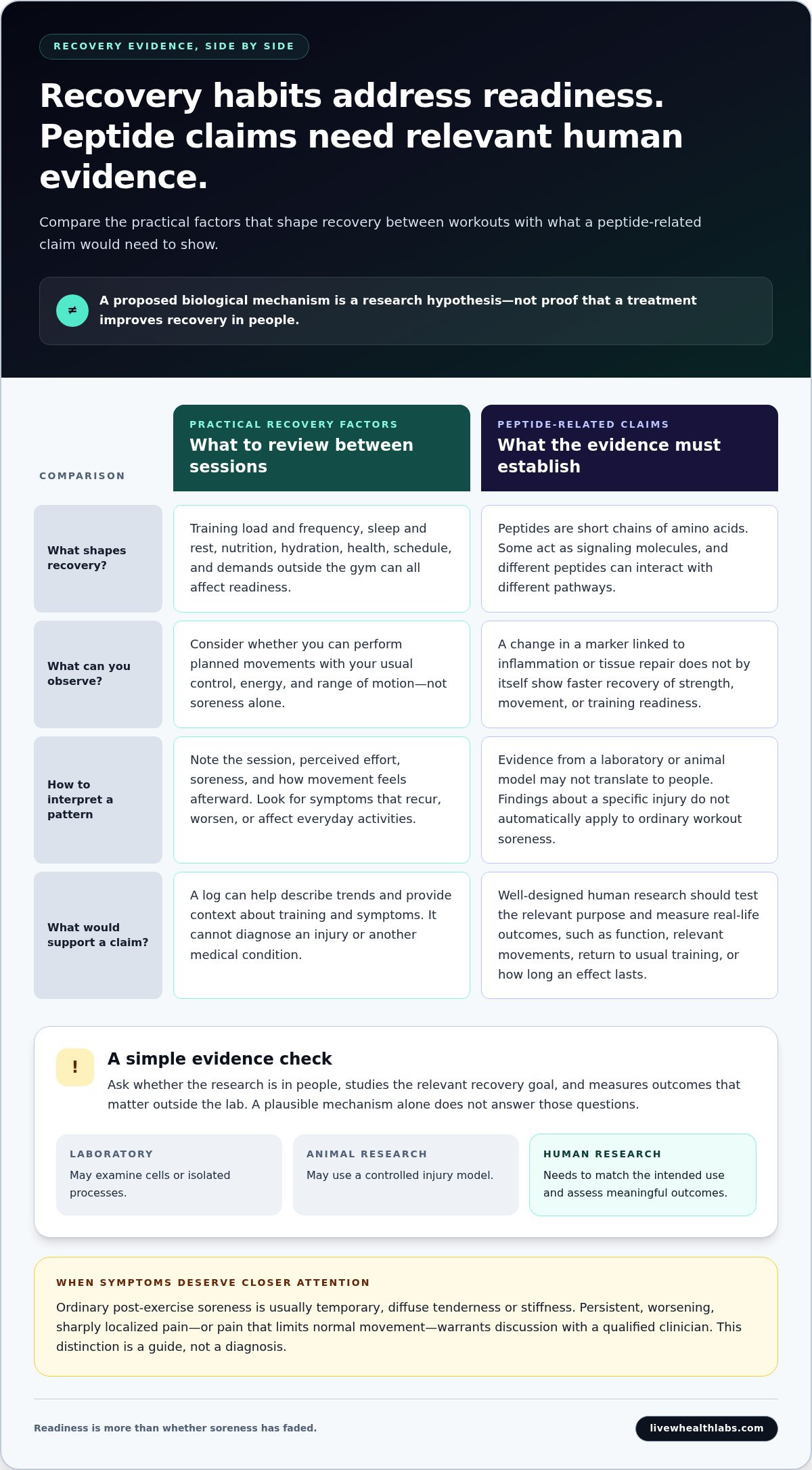
Workout recovery is the process of restoring readiness between training sessions. That means looking beyond soreness: can you perform your planned movements with your usual control, energy, and range of motion? If you’re exploring peptide therapy for muscle recovery, define the problem you want to solve first. A treatment claim is more meaningful when considered alongside your actual symptoms and training, rather than as a substitute for assessing persistent problems.
Normal post-exercise soreness is usually temporary, diffuse tenderness or stiffness after exertion. Persistent, worsening, sharply localized pain or pain that limits normal movement is more concerning. This distinction is a guide, not a diagnosis. Symptoms can have different causes, and soreness alone doesn’t show whether a workout was effective.
What changes in the body after a workout?
Training challenges muscle and other tissues. Afterward, the body responds to that workload, repairing small amounts of exercise-related tissue disruption and adapting to repeated demands. This is a normal part of training, but the response varies with the session, your recent training history, and individual factors. Recovery isn’t a switch that flips as soon as discomfort fades.
Short-term fatigue may feel like heaviness, reduced enthusiasm, or temporary difficulty matching your usual effort. Soreness can follow too, particularly after unfamiliar movements or a change in workload. Neither symptom alone measures training quality or future progress. Persistent pain, recurring difficulty with ordinary movements, or a decline that doesn’t resolve as expected deserves closer attention.
When is slow recovery a reason to reassess?
Look for a pattern rather than judging by one uncomfortable day. Note whether symptoms recur after similar sessions, worsen over time, or interfere with everyday activities such as walking, climbing stairs, or lifting routine items. Consider recent changes in workload, sleep, nutrition, hydration, or life demands that may affect how ready you feel for the next session.
These observations can help you describe the issue, but they can’t diagnose overtraining, an injury, or another medical condition. Keep a training log with the session, perceived effort, soreness, and how movement feels afterward. A consistent record can make trends easier to explain. If pain persists, worsens, or repeatedly limits function, discuss it with a qualified clinician instead of trying to identify the cause from symptoms alone.
Recovery depends on the whole context: how much and how often you train, whether you get enough rest, whether meals provide enough energy and nutrients, hydration, and your individual health and schedule. A demanding week outside the gym can matter too. These factors help explain why two people may respond differently to the same workout and why a single soreness score is an incomplete measure of readiness.
Peptide discussions use “recovery” to describe different goals, from tissue repair to general readiness. For background on one compound often discussed in this context, the BPC-157 peptide entry describes its origins and research. Background information doesn’t establish that a peptide improves ordinary post-workout recovery. First clarify what’s happening in your training and whether your symptoms call for clinical assessment.
How Peptides Could Relate to Muscle Recovery, and What Mechanisms Can’t Prove
Peptides are short chains of amino acids, and some act as signaling molecules that influence biological processes. Their actions aren’t interchangeable: different peptides can interact with different receptors or pathways. Research into those signals may raise questions about tissue response and repair, but it doesn’t establish that a peptide will reduce routine soreness or help someone return to training sooner.
Biological plausibility alone does not establish clinical benefit. A proposed mechanism is a research hypothesis, not a guaranteed outcome. This distinction matters when evaluating peptide therapy for muscle recovery: effects observed in a laboratory or animal model may not occur in people, and evidence about healing a specific injury cannot automatically be applied to ordinary workout demands.
From biological signaling to a recovery claim
Studies can differ in ways that affect what their findings mean. Laboratory experiments may examine cells or isolated processes; animal research may use a controlled injury model; human studies may focus on a particular diagnosis rather than healthy people managing training soreness. The formulation, route of administration, participant characteristics, and measured outcome can also vary. A finding in one context doesn’t answer every recovery question.
For example, a change in a marker associated with inflammation or tissue repair isn’t the same as showing that people regain strength, movement, or training readiness faster. Even an injury study may not apply to muscle fatigue after a demanding session. The conditions, treatment, and practical goal differ.
What evidence would support a useful recovery treatment?
A convincing claim should be supported by well-designed human research that tests the treatment for the relevant purpose and measures outcomes that matter in real life. Useful outcomes might include function, ability to perform relevant movements, return to usual training, or whether an effect lasts beyond a short observation period. A temporary change in a symptom or laboratory measure alone can’t establish durable improvement.
When reviewing a claim, consider whether the research:
- Involved people with a situation similar to the one being discussed.
- Measured function or readiness, not only a biological marker.
- Compared results with an appropriate control and followed participants long enough to assess whether effects persisted.
- Reported the exact formulation and treatment context, so the findings can be interpreted accurately.
For many peptides promoted for recovery, human evidence remains limited, while some proposed effects come chiefly from preclinical research. Regulatory status is also specific to the compound and indication. As of October 2026, most peptides marketed for muscle recovery aren’t FDA-approved for that purpose. Don’t infer effectiveness or regulatory status from a proposed mechanism or an online claim. Discuss the specific therapy and intended use with a qualified clinician.
Whealth Labs coordinates access to independent licensed providers for individualized evaluation. The provider determines whether treatment is appropriate. To explore a structured route to that conversation, visit coordinated peptide therapy access.
Peptide Therapy or Proven Recovery Habits: How to Compare the Evidence
Recovery strategies have different purposes and levels of evidence. Managing training load, sleeping consistently, and meeting overall nutrition needs are practical foundations. Clinical peptide evaluation is a different step: it considers whether a specific therapy may be appropriate for an individual. An evaluation doesn’t establish that peptides are a proven shortcut for soreness or muscle repair.
| Intervention | Evidence status | Practical role | Key limitation |
|---|---|---|---|
| Training-load management | Established training principle | Progress workload in a way that allows adaptation and adequate rest between demanding sessions. | The right adjustment depends on training history, goals, and how you’re responding. |
| Sleep | Foundational recovery support | Protect consistent, sufficient sleep as part of readiness and general health. | Sleep alone can’t resolve every source of fatigue or pain. |
| Nutrition | Foundational support for training and normal body function | Eat enough overall and include a balanced pattern that supports your activity. | Needs vary; a single food or supplement isn’t a substitute for an adequate overall diet. |
| Clinical peptide evaluation | Peptide-specific evidence varies; many muscle-recovery claims lack strong human evidence | A qualified provider can assess whether a particular therapy is appropriate in context. | Evaluation is not proof of benefit, and evidence, safety, and regulatory status differ by peptide and intended use. |
Which recovery practices should come first?
Start with the parts of your routine you can review. If training volume or intensity has increased quickly, consider whether your plan leaves enough rest between demanding sessions. Pair progressive workloads with consistent sleep and sufficient overall nutrition. These aren’t rigid schedules or universal targets; adjust them to your training, circumstances, and response. Hydration is another everyday consideration, particularly around exercise, but it doesn’t replace rest, food, or appropriate clinical care.
How should readers interpret peptide evidence?
Before accepting a claim, ask whether the evidence comes from human studies, measures an outcome relevant to your goal, and examines a treatment comparable to the one being discussed. Findings about a laboratory marker or a specific injury aren’t automatically evidence of improved readiness after ordinary workouts. Reports of benefit also don’t resolve questions about treatment safety, product quality, or regulatory status.
Promising research can justify further study; routine care requires reliable evidence that a treatment helps people achieve relevant outcomes. This distinction matters for peptide therapy for muscle recovery, where claims may rely on early or preclinical findings rather than demonstrated benefits for routine post-exercise soreness. As of October 2026, the FDA has not approved most peptides marketed for muscle recovery for that purpose. Regulatory status is specific to the compound and indication, so consider it alongside the evidence for the intended use.
Foundational habits and peptide evaluation aren’t competing shortcuts. The first supports training readiness without relying on a peptide claim; the second is an individualized clinical question, not a replacement for those fundamentals. Whealth Labs coordinates access to independent licensed providers, who make clinical decisions about treatment appropriateness. For a structured route to individualized evaluation, explore peptide therapy coordination.
How to Recover from Workouts Faster: A Practical, Stepwise Plan
Before considering an advanced intervention, make your training and recovery routine easier to assess. A few consistent adjustments can help reveal whether workload, rest, or daily habits may be contributing to how you feel. This plan can’t guarantee faster recovery or replace medical care. Use it to make considered changes and notice when professional assessment may be appropriate.
- Review your training load. Look at recent changes in exercise type, intensity, volume, and frequency. If fatigue continues, consider reducing demanding work or choosing a lighter session while you reassess. Plan rest around the hardest sessions instead of treating every workout as equally demanding.
- Protect sleep. Keep a consistent routine that gives you a suitable opportunity to rest. If sleep has become irregular, note that alongside your training rather than assuming every dip in performance is caused by the workout itself.
- Support nutrition and hydration. Regular meals and sufficient overall food support training and normal body function. Choose fluids in a way that fits your activity and individual needs; a universal target may not suit your circumstances.
- Monitor patterns. Keep a simple log of the session, perceived effort, sleep, soreness, energy, and whether you completed your usual activity. Record changes over time. Brief, consistent notes can be more useful than trying to interpret a single difficult workout.
A simple recovery routine between training sessions
Use your log to plan the next session, not to prove you should push through. If fatigue lingers, adjust the workload or choose a less demanding activity while you observe how you respond. Keep meals and hydration regular, and make room for rest in your training week. Let your schedule, health, and goals guide these choices rather than following a rigid template.
For example, record when a session felt unusually difficult, sleep was disrupted, and your next workout felt less manageable. If the same pattern recurs, consider whether the overall plan needs adjustment. Self-tracking can organize useful information, but it can’t determine the cause of symptoms or replace clinical assessment.
When should a clinician be part of the plan?
Seek professional assessment for persistent or worsening pain, unusual symptoms, or recovery difficulties that repeatedly limit training or everyday activities. For localized issues such as tendon strain, evidence-based rehabilitation clinics like benchmarkphysio.com focus on established interventions, such as shockwave therapy and progressive loading, rather than experimental alternatives. Share your training history, recent workload changes, health conditions, and medications with the clinician. This context can help them assess your situation without assuming a particular diagnosis or treatment.
Peptide therapy for muscle recovery shouldn’t be treated as a self-directed fix for symptoms. An independent licensed provider determines whether any therapy is appropriate. Whealth Labs coordinates access and administrative support, but doesn’t practice medicine or make prescribing decisions. If an individualized clinical conversation is relevant to your situation, explore coordinated provider access.
Considering Peptide Therapy for Muscle Recovery? Start with Clinical Evaluation
Interest in peptide therapy for muscle recovery should start with a clinical question, not an assumption that a particular compound will ease soreness or improve training readiness. Evidence varies by peptide and intended use, and findings from laboratory or early research don’t necessarily establish benefit for everyday workout recovery. An independent licensed provider must assess whether any therapy is appropriate for your circumstances.
Whealth Labs is an administrative coordination platform, not a medical practice. It coordinates access to independent licensed providers and compounding pharmacies for individually prescribed therapies. The provider reviews your health information and makes clinical decisions, including whether treatment is suitable. An evaluation is a chance to discuss your circumstances, not a promise of eligibility, a prescription, or a particular result.
What responsible evaluation should consider
A provider-led discussion can put your goals in context alongside your health history, current treatments, medications, and relevant risks. Be ready to explain what you hope to address, how long the concern has been present, and how it affects training or daily activities. This information helps the provider consider whether a therapy is appropriate or whether another course of action is more suitable.
You don’t need to arrive with a self-selected peptide or protocol. The provider evaluates the clinical question and makes the treatment decision. A consultation doesn’t guarantee eligibility or a prescription, and no particular outcome can be promised. Keeping the discussion individualized helps ground it in clinical judgment rather than online claims.
How coordinated care fits into the process
The process is structured, with separate roles at each stage:
- Share relevant information. Provide details about your goals, health history, current treatments, and recovery concerns.
- Meet with an independent provider. The provider evaluates the information and discusses the clinical context.
- Receive a clinical decision. The provider determines whether a therapy is appropriate and makes any prescribing decisions.
- Coordinate next steps, if applicable. Whealth Labs supports administrative coordination among patients, independent providers, and compounding pharmacies.
Coordination helps organize the administrative pathway, but it doesn’t replace clinical care or determine treatment suitability. Whealth Labs supports HIPAA-compliant administrative coordination. This describes the coordination process, not a guarantee of absolute security. Clinical decisions remain with the independent provider.
A measured approach keeps the purpose clear: understand the evidence, share relevant context, and allow a qualified provider to assess whether treatment makes sense. To explore this structured process, Whealth Labs coordinates access to independent provider evaluation. The provider determines whether treatment is appropriate.
Make Your Next Recovery Decision With Clarity
Your next step doesn’t need to be a quick decision about a peptide. Start by identifying what you want to improve, what you’ve already tried, and whether ongoing symptoms deserve clinical attention. That context can make a conversation about peptide therapy for muscle recovery more focused and keep expectations aligned with the limits of current evidence.
If you choose to explore therapy, keep coordination and clinical care distinct. Whealth Labs coordinates access to independent licensed providers and compounding pharmacies, and supports HIPAA-compliant administrative coordination. The independent provider evaluates your circumstances and makes clinical decisions. An evaluation may or may not lead to a treatment recommendation, and no particular outcome is assured.
To explore individualized evaluation, start with coordinated access to precision peptide therapy. Move forward with clear questions, realistic expectations, and guidance from an independent licensed provider.
Frequently Asked Questions
Can peptide therapy help you recover from workouts faster?
It hasn’t been established that peptide therapy reliably speeds recovery from ordinary workouts. Evidence depends on the specific peptide and intended use, and findings from laboratory or animal research don’t demonstrate faster recovery in people. If you’re considering it, identify the specific clinical concern and discuss it with an independent licensed provider. The provider can assess the evidence and your circumstances, but can’t guarantee a faster return to training.
Are peptides proven to reduce muscle soreness after exercise?
No, peptides aren’t generally proven to reduce routine post-exercise soreness. Online testimonials or proposed effects on tissue processes aren’t equivalent to controlled human evidence showing a meaningful reduction in soreness or improved function. “Peptides” refers to a broad group of compounds, not one interchangeable treatment. Check whether a claim concerns the same peptide, formulation, and outcome you’re asking about, and don’t treat marketing language as clinical proof.
What should I do first if I am not recovering between workouts?
First, identify what has changed: training demands, sleep, meal patterns, hydration, or other stressors. For example, if your workouts have become more frequent while sleep has shortened, consider easing the training demand and restoring a steadier routine. Note whether your energy and ability to do familiar activities improve. If the problem persists or interferes with daily life, seek clinical assessment rather than adding a supplement or peptide on your own.
Is persistent muscle soreness normal after every workout?
No. Soreness can follow unfamiliar or demanding exercise, but persistent soreness after every session shouldn’t be assumed to be a normal measure of progress. Consider whether discomfort is becoming more intense, occurring in the same area, or changing how you move. A brief record of symptoms and the activities that bring them on can help you describe the pattern. Ongoing or function-limiting symptoms merit discussion with a qualified clinician.
Can peptides repair a muscle injury or speed healing?
There isn’t enough reliable human evidence to claim that peptides repair muscle injuries or speed healing. Some proposed effects come from laboratory or animal research, which can inform further study but doesn’t prove that a treatment works for people. A suspected injury needs appropriate clinical assessment, particularly if pain is worsening or movement is limited. Don’t use a peptide as a substitute for evaluation or rely on an online protocol to guide treatment.
Do you need a prescription for peptide therapy in the United States?
For therapies prescribed to an individual, a prescription from an authorized clinician is part of the process; peptides aren’t over-the-counter products. However, a prescription doesn’t make every peptide an FDA-approved medicine or mean it can legally be compounded. Many compounds marketed for recovery aren’t FDA-approved for that purpose, and compounding rules vary by substance. Discuss current regulatory details with a qualified provider before considering treatment.
How can a licensed provider assess whether peptide therapy is appropriate?
An independent licensed provider can review your health history, goals, symptoms, current medications, and relevant risks, then consider whether a therapy is clinically appropriate. Bring a concise record of your training concerns and any treatments or supplements you use. Whealth Labs coordinates access to independent providers and pharmacies, but doesn’t practice medicine. The provider makes clinical decisions; an evaluation doesn’t guarantee eligibility, a prescription, or a particular outcome.