
Peptide therapy for weight loss is a clinical decision, not a product category or a guaranteed result. Prescription medicines that act on peptide-related pathways have evidence for specific uses. Products marketed online may have different standards and risks.
If you’re unsure what counts as a legitimate treatment, how much evidence supports it, or whether you might be eligible, that uncertainty is understandable. Safety depends on more than the medicine itself. Medical history, potential side effects, follow-up, and clear responsibility for prescribing all matter.
This article explains how evidence differs among peptide-based weight-loss treatments and unapproved products, what a licensed provider may assess before prescribing, and why eligibility is an individual medical decision. It also explains the distinct roles of an independent provider, a coordination platform, and a pharmacy. Whealth Labs coordinates access, consent, and patient information with independent licensed providers and compounding pharmacies. The provider, not the platform, makes clinical decisions. The goal is to clarify what treatment may or may not offer.
Key Takeaways
- Peptide therapy for weight loss isn’t one standardized treatment. Evidence depends on the specific medicine and its approved use.
- Learn how to distinguish prescription medicines with clinical evidence from products marketed online under different standards.
- Understand why potential side effects, medical history, current medicines, and follow-up matter in a provider’s assessment.
- Use a structured discussion with a licensed provider to explore whether medical weight-loss treatment may fit your circumstances. An article can’t diagnose you.
- Independent providers make clinical and prescribing decisions. A coordination platform and pharmacy have separate administrative and dispensing roles.
What Does Peptide Therapy for Weight Loss Mean?
Peptide-based weight-loss treatment uses a specific prescription medicine containing or acting like a peptide to support medical weight management under a licensed provider’s care. It describes certain medicines, not one universal treatment plan. A peptide is a broad category of molecules made from amino acids, and peptides have varied roles in the body. The label alone doesn’t show that a substance is suitable, effective, or approved for weight management.
In clinical care, the useful questions are specific: Which medicine is being considered? What is its approved indication? What are its known risks, and does the person’s health history support its use? These questions help distinguish evidence-based prescribing from broad claims about “peptides.”
Are weight-loss medications the same thing as peptide therapy?
No. Some prescription medicines used for weight management are peptide-based, while others work through different mechanisms. GLP-1 receptor agonists are one medicine class, not a synonym for every peptide treatment. They act on receptors involved in appetite and blood-sugar regulation. An overview of GLP-1 receptor agonists can help explain the class, but it doesn’t replace medication-specific labeling or medical advice.
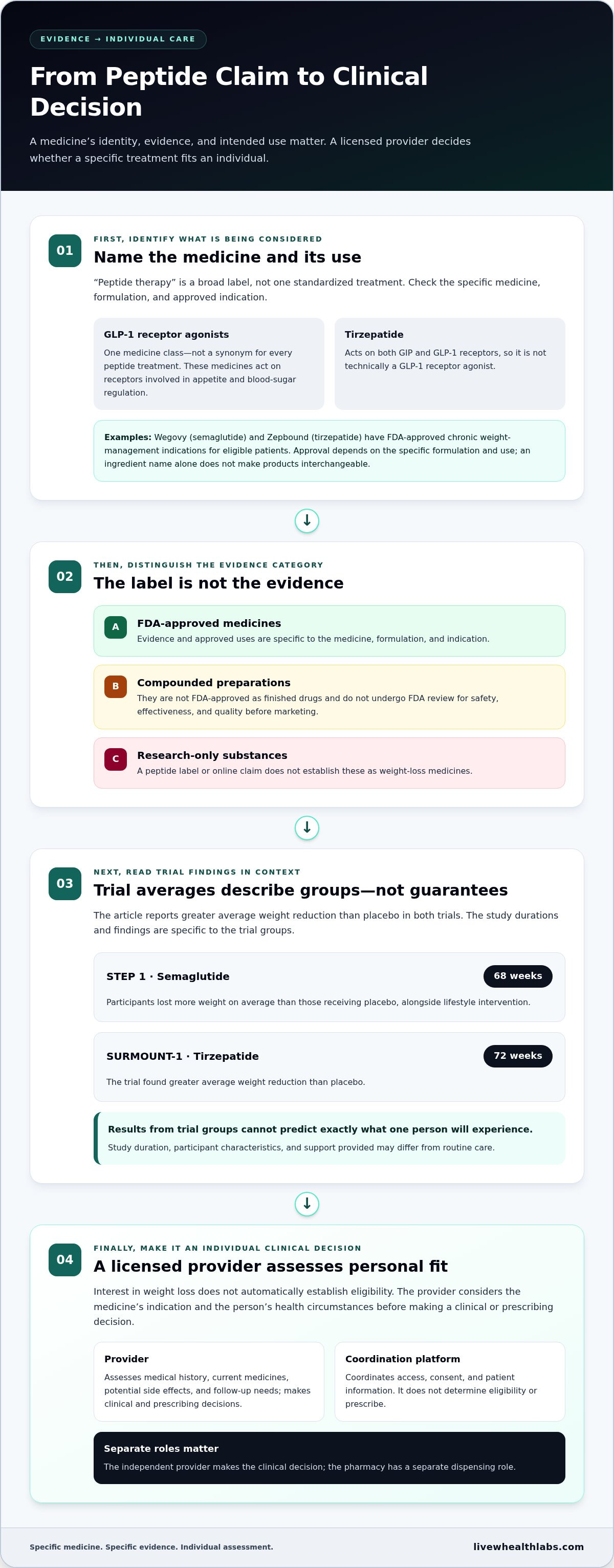
Some formulations of semaglutide and tirzepatide have FDA-approved indications for chronic weight management in specified patient groups. Other formulations of the same active ingredients may have different indications. The medicine, formulation, patient group, and approved use all matter. A familiar ingredient name doesn’t make every product interchangeable, and patients exploring popular terms—such as asking what is the skinny shot—will find that clinical options center on specific prescribed compounds rather than buzzwords.
What peptide therapy does not mean
It doesn’t mean that any substance labeled a peptide is a weight-loss medicine. Research-only chemicals and products promoted online without appropriate medical oversight aren’t equivalent to prescription treatments with established indications and prescribing information. A peptide label by itself doesn’t demonstrate safety, effectiveness, quality, or FDA approval for weight management.
Interest in losing weight also doesn’t automatically make someone a candidate for medication. A licensed provider assesses whether a specific treatment is appropriate, considering the person’s health circumstances and the medicine’s indication. The provider makes the clinical assessment and prescribing decision. A coordination platform can facilitate administrative steps, but it doesn’t determine eligibility or prescribe.
Keeping these distinctions clear helps set realistic expectations. “Peptide therapy” is a broad phrase; responsible care is specific to a medicine, an indication, and an individual clinical decision.
What Does the Evidence Say About Peptide-Based Weight-Loss Medicines?
The evidence is specific to each medicine. It doesn’t show that every peptide supports weight loss. Some medicines act on pathways involved in appetite, digestion, and blood-glucose regulation. Their effects and risks have been studied in defined patient groups, but clinical trial results can’t predict exactly what one person will experience.
How GLP-1 receptor agonists may affect weight
GLP-1 receptor agonists activate a receptor involved in blood-sugar control and appetite regulation. Depending on the medicine, these effects can influence hunger, fullness, and food intake. Tirzepatide acts on both GIP and GLP-1 receptors, so it isn’t technically a GLP-1 receptor agonist, even though it shares some relevant pathways. No medicine works identically for everyone.
FDA-approved weight-management indications apply to specific formulations and patient groups. For example, FDA labeling includes Wegovy (semaglutide) and Zepbound (tirzepatide) for chronic weight management in eligible patients. A brand name, active ingredient, formulation, and indication are distinct. An ingredient’s approval for one use or formulation doesn’t establish approval for every product containing it.
What clinical evidence can and cannot tell you
Large trials provide evidence about average outcomes among the participants studied. In the STEP 1 trial, published in the New England Journal of Medicine, participants receiving semaglutide lost more weight on average over 68 weeks than those receiving placebo, alongside lifestyle intervention. SURMOUNT-1, also published in the journal, found greater average weight reduction with tirzepatide than placebo over 72 weeks. These results describe trial groups, not a promised result for an individual. Study duration, participant characteristics, and the support provided may differ from routine care.
For broader context on peptide claims and the distinction between studied medicines and less-verified products, see Harvard Health Publishing’s overview of peptides, potential benefits, and safety concerns. For more on coordinated treatment access, read about precision peptide therapy online.
| Category | How to interpret the evidence |
|---|---|
| FDA-approved medicines | Evidence and approved uses are specific to the medicine, formulation, and indication. |
| Compounded preparations | Not FDA-approved as finished drugs; they don’t undergo FDA review for safety, effectiveness, and quality before marketing. |
| Research-only substances | Shouldn’t be treated as established weight-loss medicines based on a peptide label or online claims. |
In practice, peptide therapy for weight loss requires more than matching a medicine to a trial result. An independent licensed provider assesses the person’s health context, treatment goals, and relevant risks before deciding whether a medicine is appropriate. Whealth Labs coordinates the administrative steps around that process; the provider makes clinical and prescribing decisions. Learn about Whealth Labs’ coordinated peptide therapy.
Is Peptide Therapy for Weight Loss Safe? Risks, Limits, and Common Misconceptions
A peptide-based medicine isn’t automatically safe or appropriate for every person. Risks depend on the specific drug, its formulation, health conditions, and other medicines being used. The phrase “peptide therapy for weight loss” isn’t a safety guarantee or a single, standardized protocol.
For example, FDA prescribing information for semaglutide and tirzepatide describes gastrointestinal effects such as nausea, vomiting, diarrhea, constipation, and abdominal discomfort. The labels also warn about potentially serious risks, including pancreatitis, gallbladder problems, kidney injury associated with dehydration, and severe allergic reactions. Specific warnings and contraindications vary by medicine. Semaglutide and tirzepatide labeling includes a boxed warning about thyroid C-cell tumors observed in rodents. These medicines are contraindicated for people with a personal or family history of medullary thyroid carcinoma or multiple endocrine neoplasia syndrome type 2.
What should patients understand about side effects and monitoring?
There’s no universal monitoring schedule. The prescribing provider considers a patient’s medical history, current medicines, symptoms, and treatment response when determining follow-up. Some medicines can also affect blood-glucose management, so a provider may consider other diabetes treatments when assessing risk. Share all medicines and supplements, and report new or worsening symptoms rather than adjusting or stopping treatment without clinical guidance.
Seek urgent medical help for severe or concerning symptoms, such as intense persistent abdominal pain, signs of a serious allergic reaction, or symptoms of severe dehydration. Harvard Health Publishing’s discussion of what are peptides also distinguishes studied prescription medicines from products marketed with less-established safety information.
Medical supervision can help identify and manage risks, but it doesn’t eliminate risk or guarantee results.
Are compounded peptide medications equivalent to FDA-approved medicines?
No. Compounded drugs aren’t FDA-approved, and the FDA doesn’t review them for safety, effectiveness, and quality before they’re marketed as it does approved drugs. Compounding is a distinct practice subject to applicable federal and state requirements. Its appropriateness depends on the specific circumstances and current rules. A compounded preparation shouldn’t be assumed equivalent to an FDA-approved medicine simply because it contains the same active ingredient.
That distinction matters when evaluating online claims. A product’s peptide label, advertised benefits, or similarity in name doesn’t establish its approval status or suitability. Treatment decisions belong to an independent licensed provider, who can assess the patient and the specific medicine under consideration. Whealth Labs coordinates administrative steps with independent providers and pharmacies, without making prescribing decisions. Learn more about coordinated peptide therapy.
How to Evaluate Whether Medical Weight-Loss Treatment Fits Your Situation
A useful treatment discussion isn’t a self-test. It’s a shared clinical decision that considers your health, priorities, and the evidence for a particular option. This framework can help you prepare for a conversation without trying to determine your own eligibility.
What should a clinician assess before considering treatment?
Be candid about your priorities and concerns, including what you hope treatment will help with and what risks or practical demands you’re weighing. This context helps the provider discuss options relevant to you. No single answer or online questionnaire can replace an individualized assessment.
What questions help clarify a treatment decision?
Use these prompts to guide a discussion, not as a pass-or-fail checklist:
- Expected benefits: What outcomes might be realistic for this medicine and my circumstances? How will we assess whether it’s helping?
- Risks and uncertainty: Which side effects or health risks are most relevant to me, and what symptoms should prompt follow-up?
- Alternatives: What other approaches could be considered, including options that don’t involve medication? How do their potential benefits and limitations compare?
- Ongoing care: What follow-up and monitoring may be appropriate, and how might the plan change if the medicine isn’t suitable or doesn’t meet our goals?
Answers should reflect the specific treatment being considered, not a broad claim about peptide therapy for weight loss. Prescribing remains the independent licensed provider’s clinical decision. A consultation can clarify options, but it doesn’t guarantee eligibility or a prescription.
Individualized care also depends on coordinated communication and clear roles. Explore customized wellness formulations for broader context on personalization. To explore a coordinated treatment pathway, learn about coordinated peptide therapy.
How Whealth Labs Coordinates Access to Medically Supervised Peptide Therapy
Coordinated access can make administrative steps clearer, but it doesn’t replace clinical care. In Whealth Labs’ process, the patient, an independent licensed provider, the coordination platform, and, when applicable, a pharmacy each have distinct roles. The provider evaluates whether treatment is appropriate and makes any prescribing decision. A consultation does not guarantee a prescription or eligibility for peptide therapy for weight loss.
What happens during a coordinated telehealth process?
The process begins with the patient sharing relevant information and completing consent steps so that information can be coordinated for review. Whealth Labs facilitates access and HIPAA-compliant handling of patient information. The independent provider reviews the available information and determines whether a consultation or additional details are clinically needed.
If the provider determines treatment may be appropriate, they discuss the clinical plan, including the medicine under consideration and any follow-up they consider necessary. If treatment isn’t appropriate, the provider makes that determination independently. The platform coordinates administrative steps; it doesn’t assess symptoms, select treatment, or prescribe. For more context on this facilitation role, see administrative medical coordination fees.
Who handles clinical care, coordination, and fulfillment?
Clear role boundaries matter throughout the process:
- Independent licensed provider: Reviews the patient’s clinical information, determines suitability, makes prescribing decisions, and sets any appropriate follow-up.
- Whealth Labs: Coordinates access, consent, and administrative communication, with HIPAA-compliant handling of patient information. It does not practice medicine or independently prescribe.
- Pharmacy: When a provider issues a prescription and applicable requirements allow, a licensed compounding pharmacy may fulfill it. The pharmacy’s role is distinct from the provider’s clinical assessment.
A prescription isn’t automatic. Pharmacy coordination follows a provider’s prescribing decision when applicable. The process may vary according to the clinical review and requirements relevant to the specific prescription. Clear roles help patients understand who makes medical decisions and who supports the administrative process.
For those exploring peptide therapy for weight loss, Whealth Labs offers a coordinated pathway that keeps administrative facilitation separate from independent clinical judgment. Explore coordinated peptide therapy to learn more about how the process is organized.
Make Your Next Step an Informed One
Peptide therapy for weight loss isn’t a single treatment, and evidence for one prescription medicine doesn’t apply to every product marketed as a peptide. The right decision depends on a specific medicine, its approved use, and an independent licensed provider’s assessment of your health, goals, and potential risks.
Medical oversight supports informed decisions, but it can’t guarantee a prescription or a particular outcome. It also helps to know who does what: the provider makes clinical and prescribing decisions, while Whealth Labs coordinates access, consent, and HIPAA-compliant handling of patient information. When a prescription and applicable requirements allow, coordination with a licensed compounding pharmacy may be part of the process.
To understand how these roles fit together, explore medically coordinated wellness options. Start by learning how the process works and, if you choose to proceed, sharing your information for review by an independent licensed provider.
Frequently Asked Questions
Is peptide therapy FDA-approved for weight loss?
“Peptide therapy” is a broad category, not a single FDA-approved treatment. FDA approval depends on the specific medicine, formulation, and indication. Some prescription medicines have approved weight-management uses for eligible patients. Compounded preparations aren’t FDA-approved, and research-only substances shouldn’t be treated as approved weight-loss medicines. Check current FDA prescribing information for a specific product, and discuss whether it’s appropriate for you with a licensed provider.
Can peptide therapy help you lose weight?
Some prescription peptide-based medicines are used for weight management in appropriate patients, but individual responses vary. Evidence relates to specific medicines studied in particular populations, not every substance described as a peptide. No result is guaranteed. A licensed provider can assess a treatment’s potential benefits and risks in light of your health history, goals, and circumstances, and determine whether that medicine may be suitable.
What is the difference between semaglutide and peptide therapy?
Semaglutide is a specific medicine; “peptide therapy” is a broad term for treatments involving peptides and isn’t one drug. FDA-approved uses depend on the particular product and indication, so products containing semaglutide aren’t automatically interchangeable. Formulation matters. Refer to current FDA labeling for product-specific information, and don’t start, stop, or change a medicine without discussing it with your prescriber.
Are compounded peptides the same as FDA-approved weight-loss medications?
No. Compounded drugs aren’t FDA-approved and aren’t reviewed through the same premarket approval process as FDA-approved medicines. Compounding may occur under defined circumstances and applicable requirements, which can depend on the situation and current FDA guidance. A compounded preparation shouldn’t be assumed equivalent to an approved medicine, universally unlawful, or guaranteed to meet a particular quality standard. A licensed provider can discuss the specific prescription and relevant considerations.
Who is eligible for peptide therapy for weight loss?
Eligibility depends on the specific medicine’s approved indication and an individual clinical assessment. A licensed provider considers factors such as medical history, current medicines, relevant health conditions, goals, and potential risks. There isn’t a self-screening rule or online form that can determine eligibility on its own, and submitting information doesn’t guarantee treatment. The independent provider, not a coordination platform, makes the clinical and prescribing decision.
What side effects can peptide-based weight-loss medicines cause?
Possible side effects vary by medicine and patient. For some prescription medicines, labeling lists gastrointestinal effects such as nausea, vomiting, diarrhea, constipation, or abdominal discomfort, along with warnings about more serious risks. Discuss your health history, other medicines, interactions, and monitoring with your prescriber. Seek urgent medical attention for severe or concerning symptoms. This general information can’t determine the cause of symptoms or replace medical advice.
How does telehealth peptide therapy work through Whealth Labs?
The process involves sharing information and completing consent steps, followed by review by an independent licensed provider. A clinical consultation may be indicated. That provider decides whether treatment is appropriate, whether to prescribe, and what follow-up is needed. Whealth Labs coordinates administrative steps and HIPAA-compliant information handling but doesn’t practice medicine. If a prescription is issued, pharmacy fulfillment follows the provider’s direction and applicable requirements. A prescription isn’t guaranteed.