
A peptide can be biologically interesting without being a proven anti-aging treatment. That distinction matters when evaluating peptides for anti-aging 2026, a field where claims about longevity, skin, and cellular aging can outpace the human evidence. Clear answers are especially useful when laboratory findings, clinical studies, prescription therapies, and products labeled “research use only” appear side by side.
This guide compares peptide options by intended use and quality of evidence, so you can see what research in people has examined and where findings remain preliminary. It also explains the regulatory context: no peptide is FDA-approved specifically for “anti-aging,” though some have approval for defined medical conditions.
You’ll learn how to distinguish human evidence from early research, why research-use products aren’t equivalent to prescribed therapies, and what licensed-provider oversight can and can’t establish. The goal is a practical framework for weighing potential benefits, limitations, and clinical context, not a promise that any peptide reverses aging or guarantees a health outcome.
Key Takeaways
- Assess peptides for anti-aging 2026 by intended use and quality of human evidence, not by biological mechanisms alone.
- Topical cosmetic peptides, prescription-related therapies, and experimental compounds are different categories, not interchangeable options.
- Check whether a study’s outcomes and participants match the benefit a product or treatment claims.
- Licensed-provider oversight supports individualized medical decisions, but it doesn’t prove that a peptide is effective for aging-related goals.
- Whealth Labs coordinates administrative steps with independent licensed providers and compounding pharmacies; medical decisions remain with those providers.
What Does “Peptides for Anti-Aging” Mean in 2026?
Peptides are short chains of amino acids. Some act as signals that influence biological processes in the body, but the same broad label covers compounds with very different purposes in products and research. “Anti-aging” is not one established medical indication. It may refer to visible skin changes, a measurable health concern, or a general hope of slowing biological aging. Evidence for one goal does not establish benefits for another.
That distinction is central when assessing peptides for anti-aging 2026. A proposed mechanism, a finding in cells grown in a lab, or an animal result can support further study. None of these alone shows that people will live longer, age more slowly, or experience a meaningful improvement in health or appearance.
Why “anti-aging peptide” is not one treatment category
The phrase can refer to topical cosmetic ingredients, prescription-related therapies used for a defined medical purpose, medications prepared by compounding pharmacies, or compounds sold for research use. These categories differ in intended use and regulatory context. A shared peptide label does not establish shared benefits, risks, quality standards, or suitability.
Topical cosmetic peptides are applied to the skin and are generally discussed in relation to appearance. A systemic therapy is intended to act beyond the skin and raises medical questions that call for individualized evaluation. Compounded medications are distinct from mass-produced FDA-approved drugs; compounding does not itself establish FDA approval or prove an anti-aging benefit. Nor does a “research use only” label make a compound appropriate for human use.
For example, Copper peptide GHK-Cu is discussed in cosmetic contexts, but proposed mechanisms are not proof of a clinically meaningful result. The application matters: evidence about a topical product cannot automatically support claims about a systemic treatment.
What readers should expect from 2026 evidence
Research interest is not proof of longer life or slower aging. The meaning of a finding depends on the compound, the people studied, the study design, and the indication being examined. A change in a biomarker may be scientifically interesting, but it is not necessarily an outcome a patient can feel or a clinician can interpret as a meaningful health benefit.
- Cosmetic ingredients: Assess evidence for the specific skin-related outcome being claimed.
- Prescription-related therapies: Separate evidence for an established indication from claims about aging more broadly.
- Compounded medications: Distinguish the preparation pathway from evidence of efficacy and regulatory approval.
- Research-use compounds: Don’t treat early findings or product availability as proof of human safety or benefit.
A useful peptide comparison matches each compound to its intended use, the quality of human research, and its regulatory context. Biological promise alone is not proof of age reversal. Regulatory status can change, so check current primary sources for the specific compound and indication. This framework helps compare options without assuming every peptide has the same evidence or care pathway.
How Strong Is the Evidence Behind Anti-Aging Peptides?
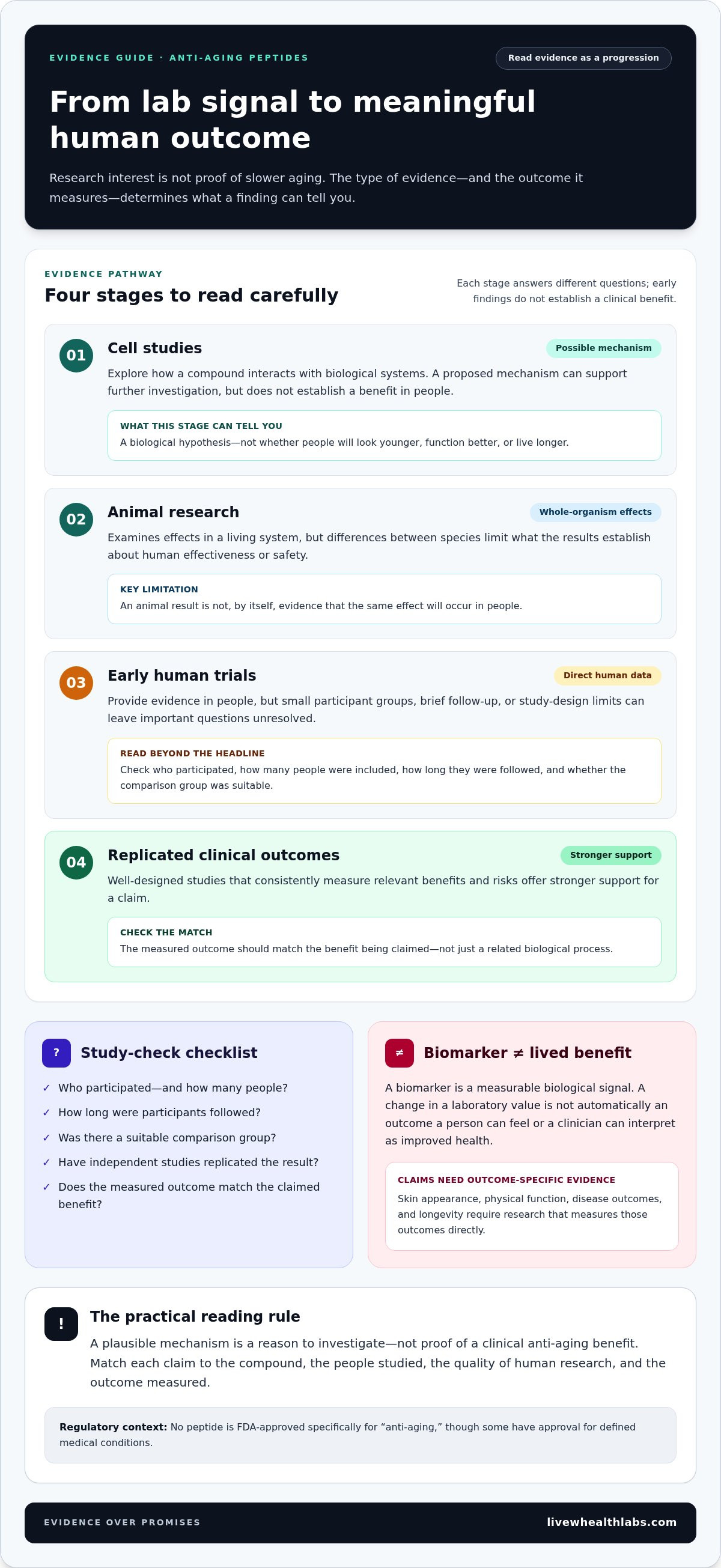
Read evidence as a progression, not a leaderboard. A finding can justify another study without establishing that a peptide benefits people. For peptides for anti-aging 2026, the useful question is not simply whether research exists. Ask what type of evidence supports the specific claim and how closely the study’s outcome matches the goal being promoted.
A plausible mechanism is a reason to investigate, not proof of a clinical anti-aging benefit. Cell signaling, collagen-related pathways, or mitochondrial activity can help researchers develop a hypothesis. They cannot show on their own that people will look younger, function better, or live longer.
From laboratory mechanism to human outcome
Cell studies help researchers explore how a compound interacts with biological systems. Animal research can examine effects in a whole organism, but differences between species limit what those results establish about human effectiveness or safety. Early human trials provide direct evidence in people, yet small participant groups or brief follow-up can leave important questions unresolved.
Look beyond a study’s headline. Check who participated, how many people were included, how long they were followed, whether there was a suitable comparison group, and whether independent studies have replicated the result.
- Cell studies: Suggest a possible mechanism, but don’t establish a human benefit.
- Animal research: Tests effects in living systems, but results may not translate to people.
- Early human trials: Provide direct human data, though study size, duration, and design can limit confidence.
- Replicated clinical outcomes: Offer stronger support when well-designed studies consistently measure relevant benefits and risks.
A biomarker is a measurable biological signal, not automatically an outcome a person can feel or a clinician can interpret as improved health. A change in a laboratory value may be worth studying, but claims about skin appearance, physical function, disease outcomes, or longevity require research that measures those outcomes directly.
What human studies can and cannot tell us
Match the result to the claim. A study measuring skin appearance does not establish a longer lifespan. Evidence for a particular diagnosed condition does not automatically support use for general aging goals. The study population matters, too: findings in people with a specific condition may not apply to healthy adults seeking preventive or cosmetic benefits.
Check the paper’s publication date, methods, and stated limitations. Look for a trial registration and current status in a registry such as ClinicalTrials.gov. Registration can clarify what researchers planned to measure, but a listed or completed trial is not proof of a positive result. Harvard Health Publishing’s Peptides: Potential Benefits and Safety Concerns also discusses the need to consider safety, particularly for unregulated injectable products.
For prescription-related questions, an independent licensed provider can assess the clinical context. Whealth Labs supports the administrative process separately, coordinating care with independent licensed providers. Learn about coordinated peptide care and how that process works.
How Do Topical, Prescription-Related, and Research Peptides Compare?
“Peptide” describes a broad group of compounds, not one type of treatment. A topical cosmetic ingredient, a prescribed therapy for a defined condition, and an experimental compound differ in how they’re used, what evidence is relevant, and which regulatory questions apply. The table below compares categories; it is not a ranked shortlist or a recommendation.
| Category | Intended use | Evidence type | Key uncertainty |
|---|---|---|---|
| Topical cosmetic peptides, such as Matrixyl, Argireline, and GHK-Cu | Skin-focused cosmetic goals | Product- and ingredient-specific cosmetic research, including studies of skin-related outcomes | Results for one formulation or outcome may not apply to another product or establish broader health effects. |
| Prescription-related therapies | A defined medical indication, where applicable | Evidence depends on the individual compound, indication, and clinical research | Evidence for an approved indication does not establish effectiveness for general aging goals. |
| Compounded medications | Individually prescribed use in an appropriate clinical context | Must be assessed for the specific compound and intended use | Compounding status alone doesn’t prove FDA approval or clinical benefit. |
| Experimental or research-use compounds, including epitalon and MOTS-c | Investigation of proposed biological effects | May include laboratory, animal, or early human research | Research interest doesn’t establish human safety or anti-aging effectiveness; research-use labeling isn’t an endorsement for human use. |
Topical peptides and skin-focused claims
Interpret cosmetic research in its own context. A study of a topical ingredient or finished formulation may examine a specific skin outcome, such as the appearance of fine lines. That result does not show that the ingredient affects aging throughout the body. Names such as Matrixyl, Argireline, and GHK-Cu refer to examples discussed in skincare, not interchangeable products with identical evidence. Formulation, use, and the outcome measured all matter. For patients seeking broader aesthetic and wellness guidance, comprehensive medical clinics such as Femi Premium focus on individualized treatment consultations to align procedures with personal health goals.
Systemic and experimental compounds in longevity discussions
Longevity discussions may group compounds by proposed targets, including mitochondrial function. That framing can describe a research question, but it is not a clinical conclusion. SS-31, also known as elamipretide, has an FDA-approved use for Barth syndrome, a specific medical condition. That status does not mean it is approved for anti-aging. Epitalon and MOTS-c are examples of compounds discussed in research contexts—often supplied for laboratory experimentation by vendors like ozzpeptides.com—not established anti-aging therapies or recommendations for self-treatment.
When comparing peptides for anti-aging 2026, check each compound’s exact intended use, evidence, and regulatory context. Verify current status against primary sources, since authorization for one indication cannot be generalized to another. A category label can orient the comparison, but it does not establish whether a particular claim is supported.
How Can You Evaluate Anti-Aging Peptide Claims Responsibly?
Start with the claim, not the compound’s reputation. Marketing can blur cosmetic goals, treatment of a medical condition, and broad promises about longevity. Use the steps below to identify what is being claimed, what evidence supports it, and where medical judgment belongs.
A five-step checklist for reviewing a peptide claim
- Identify the promised outcome. Is the claim about skin appearance, a diagnosed condition, a biomarker, or longer life? These are different outcomes, and evidence for one does not prove another.
- Clarify the category. Determine whether the product is a topical cosmetic, a prescribed therapy, a compounded medication, or a compound labeled for research use. The category affects how to interpret its claims and context.
- Find human evidence. Look for studies in people and note the design, duration, participant group, comparison method, and outcomes measured. A testimonial or laboratory finding is not a substitute for controlled clinical evidence.
- Match evidence to the indication. Check whether the study population and measured result match the advertised benefit. A finding in people with a specific condition may not apply to healthy adults, and a biomarker change alone does not establish that aging has slowed.
- Check regulatory context and oversight. Use current primary sources to verify FDA status and relevant compounding context for the specific compound and intended indication. Regulatory status can differ by compound and use, and it is not proof of efficacy.
Be cautious with claims built mainly on words such as “cellular,” “regenerative,” or “longevity.” Mechanistic language may describe a research hypothesis, but it does not show whether people experienced a meaningful benefit. Tracking biomarkers over time can provide information for a clinical discussion, but it cannot independently establish safety, effectiveness, or slowed aging. Interpretation depends on what was measured and why.
Questions to take into a clinical discussion
A focused conversation with a licensed provider can help place a proposed therapy in the context of your health and goals. Consider asking:
- What human evidence supports this specific goal, and what remains uncertain?
- Were the studies conducted in people like me, and did they measure an outcome that matters to this goal?
- What risks, alternatives, and follow-up considerations are relevant to my circumstances?
- What is the precise regulatory context for this compound and intended use?
- Who makes the medical decisions, and who handles administrative coordination or prescription fulfillment?
Independent licensed providers make medical decisions, including whether a prescription-related option is appropriate. Whealth Labs coordinates administrative processes with independent providers and compounding pharmacies. That coordination is separate from prescribing and clinical judgment. Explore coordinated peptide care with independent licensed-provider oversight.
Where Does Coordinated Peptide Care Fit in the 2026 Landscape?
Even after reviewing the evidence, you may have questions about whether a prescription-related therapy fits your circumstances. Coordinated care organizes administrative steps between a patient, an independent licensed provider, and a compounding pharmacy. Its role is to support the process, not turn an emerging research idea into a medical recommendation.
What coordinated access does, and does not, mean
Whealth Labs facilitates administrative coordination for individually prescribed peptide and wellness therapies. This can include coordinating patient information and medical-consent processes, as well as prescription fulfillment with independent licensed providers and compounding pharmacies. Patient data is handled using HIPAA-compliant processes.
The clinical boundary is clear: independent licensed providers make medical decisions. They assess the individual context and determine whether a prescription is appropriate. Whealth Labs does not diagnose, prescribe, or practice medicine. Administrative coordination does not determine eligibility, guarantee a prescription, or predict a treatment result.
A well-organized pathway and a sound medical decision are different things. Administrative coordination can connect the relevant parties and manage process steps, while the provider remains responsible for clinical judgment. Neither coordination nor a prescription is proof that a therapy reverses aging or will produce a particular benefit.
A measured next step for readers considering peptide therapy
Before discussing prescription-related options, organize the questions that matter to you. Bring your specific goal, the evidence you’ve reviewed, and any uncertainty about the intended use to a conversation with an independent licensed provider. Ask how the available human evidence applies to your situation, what risks and alternatives deserve consideration, and what follow-up would be appropriate. Online claims or product availability are not substitutes for an individualized assessment.
For a closer look at how coordinated access works, Precision Peptide Therapy Online: The 2026 Guide to Medically Coordinated Wellness explains the relationship between patients, independent providers, and administrative support. For a broader discussion of proposed aging-related goals and biological signaling, Peptide Therapy for Longevity: The 2026 Shift Toward Precision Biological Signaling offers additional context. These topics can help you frame questions, but they don’t replace provider evaluation.
Make the next step a considered one. If peptide therapy is under consideration, review the evidence and reflect on your circumstances before exploring coordinated care. Medical decisions remain with an independent licensed provider.
Make Your Next Step Deliberate
After exploring peptides for anti-aging 2026, the most useful question may not be “Which compound should I choose?” Start by asking whether your goal is clearly defined, whether the evidence speaks to that goal, and whether an individualized clinical discussion is appropriate. This keeps curiosity grounded in the distinction between promising research and established care.
If you’re considering a prescription-related option, use your questions as the starting point for a conversation with an independent licensed provider. A coordinated process can support that discussion through HIPAA-compliant patient data handling and administrative coordination with licensed compounding pharmacies, while medical decisions remain with the provider. It does not promise eligibility or a particular outcome; it provides a structured way to explore next steps while keeping roles clear.
Explore coordinated peptide care when you’re ready to consider the process in light of your goals and circumstances. A measured, informed decision is a strong place to begin.
Frequently Asked Questions
Are peptides proven to reverse aging?
No peptide has been established as a way to reverse aging in people. A laboratory result or change in a biological marker doesn’t demonstrate that a person’s aging process has reversed or that their lifespan has increased. Evaluate claims against the outcome actually measured: a study of skin appearance, for example, cannot establish a whole-body effect. Be wary of promises that go beyond the research or guarantee a particular result.
Which peptides for anti-aging have the strongest human evidence in 2026?
There isn’t a single peptide with established human evidence for general anti-aging. Evidence depends on the specific goal: a topical product might be studied for a skin outcome, while a prescription peptide may have research for a particular medical indication. Those findings aren’t interchangeable. For peptides for anti-aging 2026, compare the exact compound, participant group, and measured outcome rather than relying on a ranked list or the phrase “clinically studied.”
Are topical peptides the same as prescription peptide therapy?
No. Topical cosmetic peptides are formulated for application to the skin, while prescription-related therapies are considered in a medical context and may be intended to act systemically. Evidence for a cream or serum doesn’t establish the safety or effectiveness of an injectable or other prescription formulation. Even products featuring the same named ingredient can differ in formulation and intended use, so assess evidence for the specific product and claim.
Are anti-aging peptides FDA-approved?
No peptide is FDA-approved specifically for the broad purpose of anti-aging as of 2026. Some peptide medicines have FDA approval for defined conditions, but that approval doesn’t establish an anti-aging benefit. Compounded preparations also shouldn’t be assumed to be FDA-approved drugs. Check the FDA’s current information for the particular compound and indication, since approval for one medical use does not automatically apply to another.
Can I use research peptides for anti-aging?
Products labeled “research use only” aren’t intended for human use, and that label shouldn’t be treated as evidence of safety, purity, or effectiveness. Online availability doesn’t change the product’s intended status. Avoid using such products for self-treatment. If you’re considering a peptide for a health-related goal, discuss the evidence and potential risks with an independent licensed provider rather than relying on seller claims or informal protocols.
Do peptides stimulate collagen or improve skin appearance?
Some topical peptides are studied for skin-related effects, including collagen-related pathways, and certain cosmetic formulations have clinical evidence for specific appearance outcomes. That doesn’t mean every peptide product stimulates collagen in a meaningful way or produces a visible result. The formula, study methods, and outcome matter. Look for research on the finished product and the particular claim, not just a general explanation of how an ingredient might work.
How should I evaluate an anti-aging peptide claim?
Start by writing down the promised result, then identify whether the product is cosmetic, prescribed, compounded, or labeled for research use. Look for human studies that measure that same result in a relevant population, and note the study’s duration and limitations. Verify regulatory information from current primary sources. Bring unresolved questions about evidence, risks, and follow-up to an independent licensed provider before making decisions about prescription-related care.