
What matters most in regulated wellness therapy access is not how quickly a process moves, but whether each decision and responsibility is clear. A coordinated pathway may involve administrative support, an independent clinician’s assessment, and pharmacy fulfillment. Each participant has a distinct role.
Before sharing sensitive health information or investing time in a process, it’s reasonable to ask: Who reviews your health history? How are provider credentials and eligibility decisions handled? What privacy protections apply, and which coordination or fulfillment fees may arise?
This guide explains how to assess those questions without assuming a consultation guarantees eligibility, a prescription, or a particular treatment. You’ll learn how to distinguish administrative coordination from clinical judgment, what to verify about a provider and pharmacy, and which privacy and fee details to clarify before proceeding. The goal is to help you decide whether a coordinated care pathway fits your needs.
Key Takeaways
- Assess regulated wellness therapy access as a coordinated pathway, with clinical decisions made independently from administrative support.
- Check provider credentials, how eligibility is assessed, and who makes prescribing decisions.
- Review privacy practices and ask which pharmacy may fulfill a prescription if one is issued.
- Clarify coordination and fulfillment fees, including what each fee covers, before proceeding.
- Use a practical sequence of questions to decide whether the process suits your needs, without assuming you’ll qualify for treatment.
What Regulated Wellness Therapy Access Means for Patients
Before sharing health information, make sure you understand who will review it, who makes clinical decisions, and what happens next. Regulated wellness therapy access describes a coordinated pathway in which administrative support connects a patient with an independent provider for clinical assessment. The term alone doesn’t establish that a service is appropriate for you or explain exactly how its process works. Ask each participant to describe their role.
A care pathway is a useful way to think about how steps and responsibilities fit together. In a wellness access process, coordination may help organize connections and prescription fulfillment, while clinical decisions remain with the independent provider. A platform that coordinates access isn’t necessarily a medical provider, and its involvement shouldn’t be mistaken for an assessment or recommendation.
How coordinated access differs from buying a wellness product
A product purchase may involve selecting an item directly. A clinical pathway is different: a provider first considers a person’s health information and decides whether a treatment is suitable. Over-the-counter products and products marketed for research use aren’t substitutes for an individualized assessment. Don’t assume a therapy is appropriate before speaking with a clinician, and be cautious of any service that presents a prescription or treatment outcome as assured. The importance of professional clinical evaluation extends across healthcare; for families monitoring early childhood milestones, starsassessmentcenter.com provides comprehensive developmental assessments to identify potential delays in infants and toddlers.
Who makes each decision in the access pathway?
Responsibilities should be clear and separate. Whealth Labs describes its role as administrative and educational coordination, connecting patients with independent licensed providers and compounding pharmacies. The platform isn’t the medical decision-maker. The independent provider conducts the consultation, assesses eligibility, and determines whether to recommend or prescribe treatment. If a prescription is issued, a compounding pharmacy handles fulfillment.
Before proceeding, ask which provider would conduct the consultation and how you can identify the pharmacy involved if treatment is prescribed. Confirm what the platform coordinates and what remains the provider’s responsibility. This helps you evaluate the process without treating administrative convenience as evidence of clinical suitability.
How Clinical Oversight, Privacy, and Pharmacy Coordination Fit Together
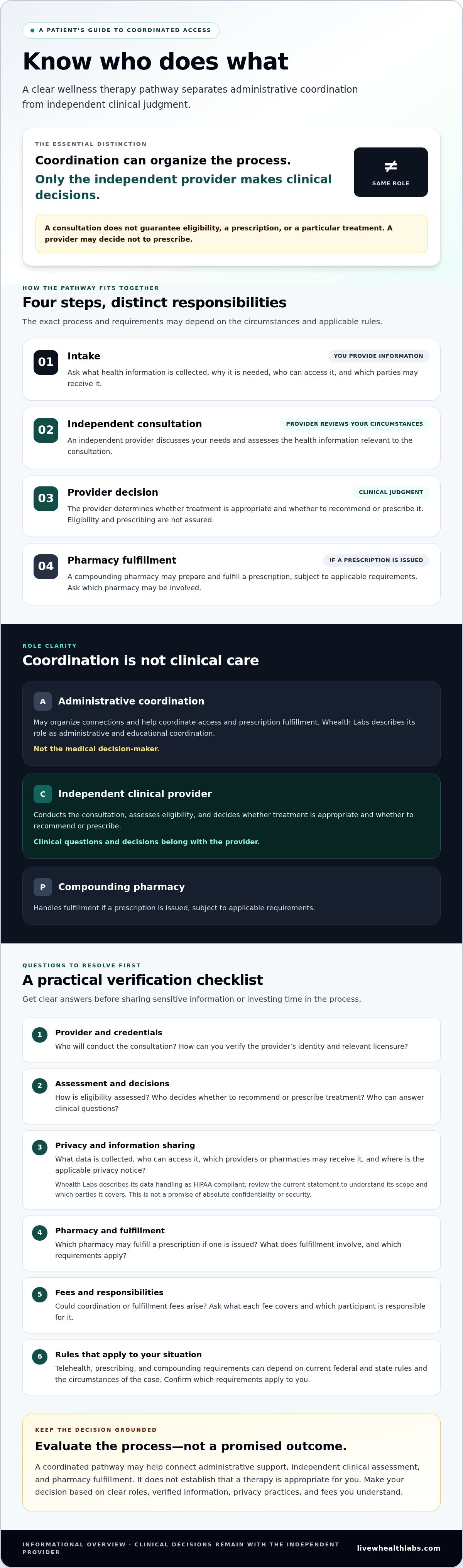
A coordinated process is easier to evaluate when each step and decision-maker is visible. In regulated wellness therapy access, the pathway may move from intake to an independent consultation, then to a provider’s decision and, if a prescription is issued, pharmacy fulfillment. Administrative coordination can organize information and connections; it isn’t the same as diagnosing a condition, recommending treatment, or prescribing.
- Intake: You provide information through the process. Ask what is collected and why it is needed.
- Consultation: An independent provider reviews your circumstances and discusses your needs.
- Provider decision: The provider decides whether a treatment is appropriate and whether to prescribe. A decision not to prescribe is possible.
- Fulfillment: If prescribed, a compounding pharmacy may prepare and fulfill the prescription, subject to applicable requirements.
What an independent provider is responsible for
The provider, not the coordination platform, assesses your health information and makes clinical decisions. Before a consultation, ask who the provider is, how to verify their identity and relevant licensure, and how the consultation will take place. Clarify who you can contact with clinical questions. These checks help distinguish a provider relationship from administrative support, without assuming that a consultation will result in eligibility or a prescription.
For patients exploring outpatient mental health services, consulting a dedicated Psychiatrist Portland Oregon offers the same standard of direct clinical evaluation and individualized care.
What to understand about data and pharmacy fulfillment
Before submitting sensitive information, ask what health details are collected, who can access them, which independent providers or pharmacies may receive them, and how they’re used during coordination. Find the applicable privacy notice and check where to direct questions about data handling. Whealth Labs describes its data handling as HIPAA-compliant; review the current statement to understand its scope and which parties it covers. Don’t treat a general privacy statement as a promise of absolute confidentiality or security. For more context, see this guide to telemedicine for precision peptides.
A pharmacy’s role begins with fulfillment if an appropriate prescription is issued; it doesn’t replace the provider’s assessment. The Pew Charitable Trusts’ overview of pharmacy coordination describes the oversight context for drug compounding, but current requirements should be verified for the specific prescription and pharmacy. You can also review Whealth Labs’ access information and clarify how its coordination role relates to the provider’s and pharmacy’s responsibilities.
How to Compare Regulated Wellness Therapy Access Services
Compare how a service works, not how polished its language sounds. Terms such as “personalized” or “precision care” may describe an approach, but they don’t explain who provides care, how decisions are made, or what you’ll pay. For regulated wellness therapy access, look for specific, verifiable explanations of responsibilities and next steps.
Use the same questions for each service. A clear answer should identify the relevant person or organization and explain who handles clinical, privacy, and financial responsibilities.
| Area to compare | What to verify | A useful question |
|---|---|---|
| Provider independence | Who conducts the consultation, and how to identify and verify the provider’s credentials. | “Who will assess my information, and how can I confirm their professional credentials?” |
| Clinical decisions | Whether an independent provider decides eligibility, treatment recommendations, and prescribing. | “Can the provider decide that treatment isn’t appropriate, and what happens next?” |
| Privacy | What information is collected, how it’s used, and which parties may receive it. | “Where can I review the privacy notice and understand who may access my information?” |
| Pharmacy role | Which pharmacy may fulfill a prescription and how fulfillment is handled if one is issued. | “How will I know which pharmacy is involved, and what is its role?” |
| Fees | Which charges relate to coordination, consultation, or fulfillment, and when they’re disclosed. | “What could I be charged if no prescription is issued?” |
Look for clear answers, including when treatment is declined
A responsible description should allow for the provider to decline treatment. Check what happens in that case, including any next steps and whether charges still apply. Don’t infer that a consultation guarantees a prescription, or that an appealing service description demonstrates safety, effectiveness, or regulatory approval.
Ask what communication or follow-up arrangements are described and who provides them. Administrative coordination and clinical follow-up are different responsibilities, so the service should identify who handles each. If an answer is vague, request clarification before sharing more health information or proceeding.
For more detail on how charges may be presented, review this guide to administrative medical coordination fees. Compare the stated services and fee terms directly. Similarly named charges don’t necessarily cover the same work across different services.
What to Verify Before Starting a Wellness Therapy Access Process
Before entering a regulated wellness therapy access process, work through the steps in order: understand the service, verify the provider, review privacy terms, clarify fees, and then decide whether to proceed. You don’t need to submit sensitive information or pay a fee before you understand the process and its terms.
A patient’s pre-enrollment verification checklist
- Understand the service: Confirm which organization coordinates administrative steps and which independent provider is responsible for medical care and clinical decisions.
- Verify the provider: Ask who will conduct the consultation, how to confirm their identity and relevant licensure, and how the consultation will be arranged.
- Review privacy and consent: Check what information is requested, how it’s handled, and which parties, such as an independent provider or pharmacy, may receive it. Read the privacy notice and consent documents before submitting health details.
- Clarify fees: Ask which charges cover coordination, consultation, or prescription fulfillment, when each may apply, and what happens if the provider doesn’t prescribe treatment. Don’t assume every charge depends on receiving a prescription.
- Decide at your pace: Proceed only when the service, privacy terms, and financial conditions are clear to you.
Look for direct answers in the service terms, not just reassuring labels. If a fee or data-sharing practice is unclear, ask for an explanation before agreeing or paying.
What to prepare for an independent consultation
Once you understand the process, organize relevant medical history, current medications, and questions you want the provider to address. You might ask what risks and alternatives are relevant to your circumstances, how the provider will assess whether a therapy is appropriate, and what follow-up or communication arrangements are available. The provider may determine that a therapy isn’t suitable; a consultation doesn’t guarantee a prescription or specific treatment.
If you’re considering Whealth Labs, you can review its access coordination process and clarify how administrative coordination relates to an independent provider’s clinical assessment. Reviewing the process helps inform your decision; it doesn’t assure eligibility or treatment.
How Whealth Labs Coordinates Access Without Practicing Medicine
Whealth Labs’ role in regulated wellness therapy access is administrative and educational coordination, not direct medical practice. The platform connects patients with independent licensed providers and compounding pharmacies. Coordination can help organize access, but it doesn’t replace a provider’s assessment or determine whether a patient should receive treatment.
What the Whealth Labs coordination model includes
Whealth Labs lists independent provider consultations among its offerings. The provider conducts the consultation and makes clinical decisions, including whether a therapy is appropriate and whether to prescribe. If a prescription is issued, the platform’s stated role includes facilitating fulfillment through a compounding pharmacy. A consultation or coordination does not guarantee eligibility, a prescription, or a particular formulation.
For information about related formulations, see customized wellness formulations. Before sharing health information, read the current privacy materials. Whealth Labs describes its data handling as HIPAA-compliant; review the current statement to understand its scope, the information covered, and the parties involved.
Review the practical terms before proceeding
Administrative coordination and pharmacy fulfillment may involve separate charges. Before agreeing to proceed, check the current fee disclosures and ask what each charge covers, when it applies, and what happens if the provider doesn’t issue a prescription. Don’t assume a broad service description means a fee includes a consultation, medication, or fulfillment. The written terms should make these distinctions clear.
It’s also reasonable to confirm how to identify the independent provider and pharmacy involved in your case, and where to direct questions about consent, information handling, or coordination. These checks help you understand which organization is responsible for each part of the pathway.
A considered next step
Before moving forward, review Whealth Labs’ service scope, consent information, privacy statement, and fee disclosures. The independent provider determines whether a consultation or therapy is appropriate; the platform doesn’t make that clinical decision. If the process is clear and fits your needs, you can Explore Whealth Labs’ coordinated access process for more information. Take time to understand the terms before deciding whether to proceed.
Make Your Next Step an Informed One
Responsible regulated wellness therapy access depends on a clear distinction: the platform coordinates the process, while an independent provider assesses your circumstances and makes clinical and prescribing decisions. Before sharing health information or proceeding, confirm who is involved, review current privacy disclosures, and understand which coordination or fulfillment fees may apply.
Whealth Labs describes its role as connecting patients with independent licensed providers and coordinating with compounding pharmacies when a prescription is issued. It also describes its health-data handling as HIPAA-compliant. Review the current disclosures to understand their scope, and remember that a consultation doesn’t guarantee eligibility, a prescription, or a particular treatment.
To understand how the administrative steps fit together, explore Whealth Labs’ coordinated access process. Review the service terms and prepare your questions before deciding whether to proceed.
Frequently Asked Questions
What does regulated wellness therapy access mean?
Regulated wellness therapy access is a coordinated process that connects a patient with an independent provider for clinical assessment and may coordinate prescription fulfillment if treatment is prescribed. The platform handles administrative steps; it doesn’t make the provider’s clinical decision. Before sharing health information, clarify who conducts the consultation, who can access your information, how fees work, and what happens if the provider decides a therapy isn’t appropriate.
Can a wellness therapy coordination platform prescribe medication?
No. A coordination platform may arrange access to an independent provider, but prescribing decisions belong to a qualified clinician who assesses the patient. Whealth Labs describes its role as connecting patients with independent licensed providers and coordinating with compounding pharmacies when a prescription is issued. A consultation doesn’t guarantee a prescription, eligibility, or a particular treatment. Ask who the provider is and how to contact them about clinical questions.
How can I verify that a telehealth provider is licensed?
Ask for the provider’s full name, credentials, and the state where they’re licensed, then check those details with the relevant state licensing board or regulator. Confirm that the provider is authorized to provide care based on your location during the telehealth visit, since applicable requirements can vary. You can also ask who will conduct the consultation and how to verify that person’s professional identity before sharing health information.
Is compounded wellness medication FDA-approved?
Compounded medications aren’t FDA-approved in the same way as FDA-approved drugs. The FDA doesn’t review or approve compounded drugs for safety, effectiveness, or quality before they’re marketed. Compounding may be appropriate in particular circumstances, but that doesn’t establish that a specific formulation is suitable for you. Ask the independent provider why it’s being considered, what risks and alternatives apply, and which pharmacy would fulfill it if prescribed.
What happens if an independent provider decides I am not eligible?
The provider may decide that a therapy isn’t appropriate and decline to prescribe it. That decision is part of an individual clinical assessment, not a failure of administrative coordination. Ask the service what happens next, whether any follow-up discussion is available, and which fees still apply if no prescription is issued. Review the fee terms before proceeding, since charges and any refund conditions depend on the service’s stated policies.
How are my health information and privacy handled during online wellness coordination?
Ask what information is collected, why it’s needed, how it’s used, and which parties, such as an independent provider or pharmacy, may receive it. Review the current privacy notice and consent terms before submitting sensitive details. Whealth Labs describes its health-data handling as HIPAA-compliant, but check its current disclosures to understand their scope and the parties covered. No general statement should be taken as a guarantee of absolute privacy or security.
What fees should I ask about before starting?
Ask for a written explanation of any charges for administrative coordination, the provider consultation, and pharmacy fulfillment, including when each fee applies. Clarify whether fulfillment charges arise only if a prescription is issued and what you may owe if the provider declines to prescribe. Don’t assume a single quoted charge includes every step. Compare the fee disclosure with the service terms, and resolve unclear items before agreeing or paying.