
The most reassuring anti-aging telehealth option may not be the one promising the fastest prescription. With telehealth for anti-aging, convenience matters, but responsible care depends on an independent licensed provider evaluating your health history and making clinical decisions.
It’s reasonable to ask what a virtual visit can assess, how prescriptions are handled, and who follows up. A platform can coordinate access and information, but it can’t replace a provider’s clinical judgment. Whealth Labs connects patients with independent licensed providers and, when a provider prescribes a formulation, coordinates pharmacy fulfillment.
This guide explains what virtual care can and can’t address, how to compare options by clinical oversight, privacy, pharmacy coordination, and follow-up, and what to prepare before an evaluation. It also covers questions that can clarify the roles of the platform, provider, and pharmacy.
Key Takeaways
- Telehealth provides remote access to an evaluation. It isn’t a treatment or a promise of results.
- Compare care models by how they handle clinical assessment, privacy, pharmacy coordination, and follow-up.
- Before a telehealth for anti-aging consultation, gather your health history, medication and supplement list, allergies, and prior treatment details.
- Ask how the evaluation works and what follow-up may involve before deciding on next steps.
- Whealth Labs coordinates access, consent, HIPAA-compliant information handling, and pharmacy fulfillment when a provider prescribes a formulation.
What does telehealth for anti-aging actually provide?
Telehealth for anti-aging provides remote access to a clinical conversation and related care coordination. It describes how people connect with care, not a treatment in itself. A virtual visit gives an independent licensed provider an opportunity to discuss your goals, review relevant health information, and consider whether further evaluation or a treatment option is appropriate. The format can make that conversation more accessible, but it doesn’t determine the outcome.
For a broad overview of the format, What is Telehealth? explains how telehealth uses communication technologies to support health-related services. In anti-aging care, the distinction between clinical and administrative roles matters: a platform can coordinate access, consent, information handling, and pharmacy fulfillment, while the independent provider conducts the clinical assessment and makes prescribing decisions.
A platform coordinates the process; an independent licensed provider makes the clinical decisions.
Which parts of care can happen remotely?
A virtual consultation can support a focused discussion about what you hope to address, when a concern began, and how it affects daily life. For example, you might describe changes in sleep, energy, skin, or general well-being, then share relevant diagnoses, medications, supplements, allergies, and prior treatments. The provider can use that context to guide the conversation and decide whether remote care is suitable for the concern.
Administrative coordination is separate from clinical care. It can organize consultation steps and, if a provider prescribes a formulation, coordinate with a pharmacy. It isn’t a diagnosis or prescription. A provider may determine that a physical assessment or another type of evaluation is appropriate. Virtual care cannot replace an in-person examination when one is needed, particularly for structural aesthetic concerns where in-person specialists like Dr. Aaron Fletcher, MD provide direct surgical consultations.
What does “anti-aging” mean in a clinical conversation?
“Anti-aging” is a broad wellness phrase, not a precise diagnosis or a defined medical outcome. One person may use it to describe a concern about skin changes, while another may be interested in energy or general health as they age. Those goals call for specific discussion, not assumptions that a particular therapy can reverse aging, stop it, extend lifespan, or suit everyone.
Make the conversation concrete. Ask what a proposed approach is intended to address, what its limitations are, and what evidence supports the intended benefit. You can also ask how your personal history affects the provider’s assessment and what follow-up may be appropriate. Clear questions help distinguish a meaningful care goal from marketing language, while leaving decisions about suitability to the clinician.
- What specific concern or health goal would this evaluation address?
- What is known, and what remains uncertain, about the intended benefit?
- Could my health history or current medications affect the assessment?
How telehealth anti-aging care connects patients, providers, and pharmacies
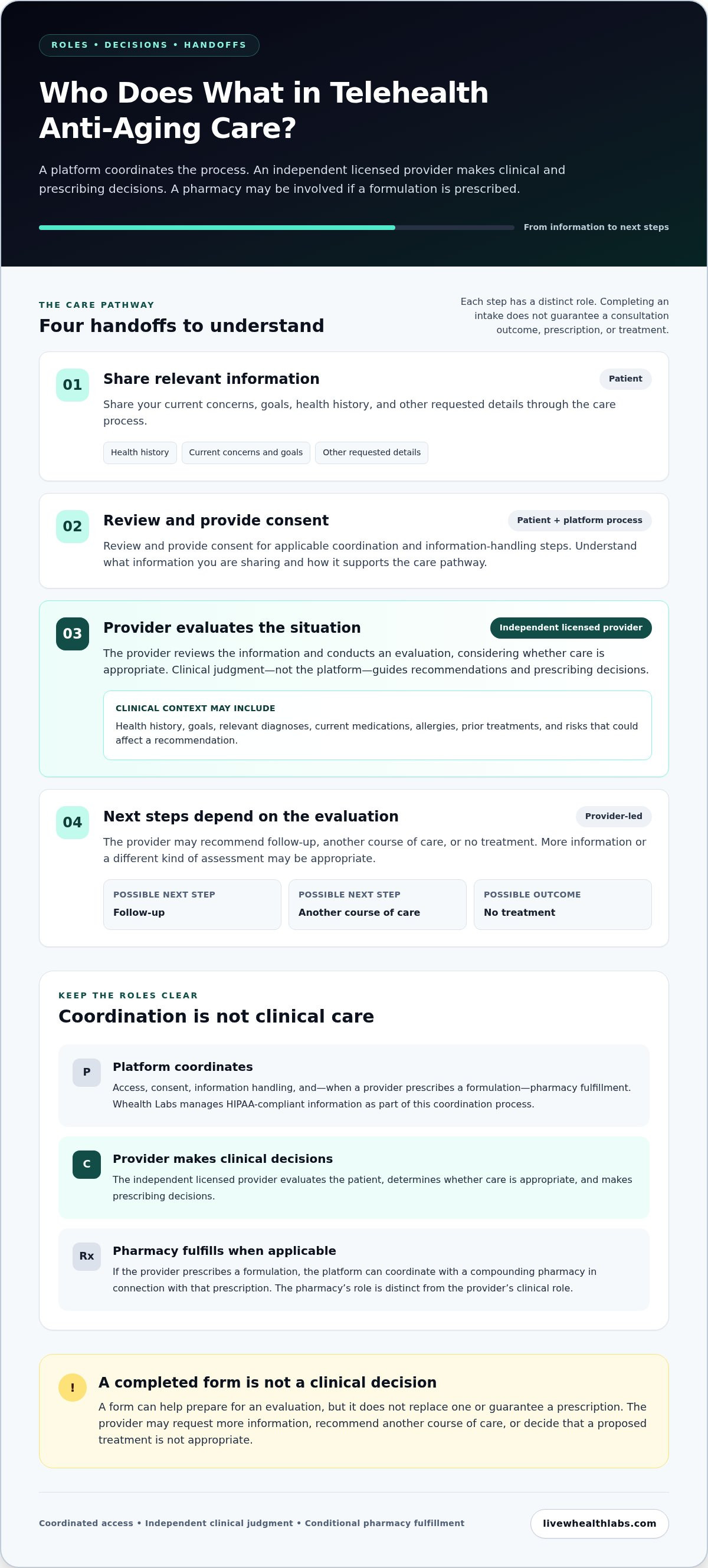
Telehealth for anti-aging involves distinct roles, even when the process feels like one connected service. The platform organizes access and administrative steps. An independent licensed provider evaluates the patient and makes clinical decisions. A pharmacy may become involved if the provider prescribes a formulation. Understanding these handoffs helps set realistic expectations from the first form through any next steps.
- Information: The patient shares relevant health history, current concerns, goals, and other requested details through the care process.
- Consent: The patient reviews and provides consent for applicable coordination and information-handling steps.
- Provider evaluation: An independent licensed provider reviews the information and conducts an evaluation, considering whether care is appropriate.
- Next steps: The provider may recommend follow-up, another course of care, or no treatment. Pharmacy coordination can follow if a formulation is prescribed.
The platform coordinates access and process, while the independent licensed provider makes clinical and prescribing decisions. Submitting information or completing an online intake doesn’t guarantee a consultation outcome, prescription, or treatment.
What does the independent provider decide?
The provider considers the full clinical context, not just an interest in anti-aging care. That may include health history, goals, relevant diagnoses, current medications, allergies, prior treatments, and risks that could affect a recommendation. If information is incomplete or a concern needs a different kind of assessment, the provider may request more information or recommend another course of care.
An evaluation can lead to different conclusions. The provider may decide a proposed treatment isn’t appropriate, suggest a different approach, or determine that no treatment is indicated. These are clinical judgments, not platform decisions. A form can help prepare for an evaluation, but it doesn’t replace one or guarantee a prescription.
Where do coordination and fulfillment fit?
A coordination platform connects the patient with an independent provider and supports administrative steps such as access, consent, and information handling. Whealth Labs manages HIPAA-compliant information as part of this coordination process. Before proceeding, understand what information you’re sharing and how it supports the care pathway.
Pharmacy fulfillment comes later, when applicable. If an independent provider prescribes a formulation, the platform can coordinate with a compounding pharmacy in connection with that prescription. The pharmacy’s role is distinct from the provider’s evaluation and prescribing decision. A platform doesn’t prescribe or determine whether a formulation is suitable.
For patients seeking a structured connection among access, independent provider evaluation, and prescription fulfillment coordination, Whealth Labs’ care coordination keeps these roles distinct.
How to compare telehealth options for anti-aging care
Compare the care structure, not just the treatment menu. A polished website or fast intake process won’t tell you who evaluates your history, how decisions are made, or what happens after a visit. Models can overlap, and details vary. Use the comparison to identify where clinical judgment sits and how each handoff is explained.
| Comparison point | Clinic-led model | General telehealth service | Coordination platform |
|---|---|---|---|
| Provider independence | Care is organized around a clinic and its clinical team. | Connects patients with clinicians for virtual care; the service structure varies. | Connects patients with independent licensed providers; the platform doesn’t make clinical decisions. |
| Assessment | May combine clinician evaluation with testing or other clinic services. | May focus on a particular concern through a virtual appointment or intake. | Facilitates access and information flow for the provider’s evaluation. |
| Privacy | Review how information is collected, used, and shared. | Review the service’s consent and information-handling practices. | Understand what information is handled for coordination and how consent is managed. |
| Pharmacy role | May be organized within the clinic’s care process. | May vary by service and by the provider’s decision. | Can coordinate with a pharmacy if a provider prescribes a formulation. |
| Follow-up | May be part of an ongoing clinic relationship. | May depend on the service and clinical plan. | Clarify which steps are coordination and which follow-up is determined by the provider. |
What signals responsible clinical oversight?
Look for a clear explanation of who evaluates you and who makes care decisions. Suitability depends on your health history, goals, and clinical context, so a thoughtful process allows for questions and a recommendation that may differ from what you expected. Claims of guaranteed results or automatic prescriptions deserve careful scrutiny. An intake form can inform an evaluation, but it can’t replace provider judgment.
Consider how the service describes evidence. Does it distinguish established uses from emerging or uncertain claims? Are intended benefits and limitations explained without promising to reverse aging or deliver the same result for everyone? These distinctions matter more than broad wellness language.
How should readers assess prescriptions and compounded formulations?
A compounded formulation should follow a provider’s prescription and an individualized clinical rationale. It isn’t an over-the-counter product, and being compounded doesn’t establish that it has the same approval status or evidence as an FDA-approved drug. Don’t treat these categories as interchangeable. For decisions about a specific formulation, discuss its purpose, alternatives, and uncertainties with the prescribing provider. FDA guidance can change, so check current FDA information for regulatory or safety details rather than inferring them from marketing.
When comparing telehealth for anti-aging, keep access, clinical assessment, and coordination distinct. Look for a model that clearly explains these roles and the next steps, without assuming one approach is right for everyone.
How to prepare for an anti-aging telehealth consultation
Preparation can make a virtual consultation more focused. You don’t need to arrive with a diagnosis or a preferred treatment. Give the independent provider a clear account of what you’re noticing, what you hope to address, and the health context that may affect an evaluation. Keep notes nearby so you can listen and ask questions without relying on memory.
What information should you have ready?
Start with a concise, accurate summary. Include relevant diagnoses, allergies, current medications, supplements, prior treatments, and concerns about side effects or past experiences. If you don’t know a detail, say so rather than guessing. Specifics help the provider understand your circumstances; they don’t predetermine a recommendation.
- Clarify your goals: Write down the concern you want to discuss and what a meaningful, realistic change would look like to you.
- Gather your health history: Note relevant conditions, when symptoms or concerns began, and any changes over time.
- List medications and supplements: Include names and, if known, doses and how often you take them.
- Collect useful records: Have relevant results or treatment records available if you already have them and they relate to your concern.
Don’t order tests or assemble a large record file just because you’re pursuing telehealth for anti-aging. Let the provider’s assessment guide whether testing or additional records are useful. Information that seems unrelated to your goal may still matter, so share relevant health details openly and let the provider determine what applies.
Which questions help clarify the plan?
Prepare a short list and prioritize what matters most to you. A clear explanation should cover the reasoning behind any proposed approach, what is known about its intended benefit, and its limitations. Ask how individual health factors influence the assessment, what risks or monitoring may be relevant, and what alternatives could be considered.
- What concern is this approach intended to address, and what evidence supports that use?
- What are the known limitations, potential risks, and uncertainties?
- Would my diagnoses, medications, allergies, or supplements affect the recommendation?
- Who is responsible for clinical decisions, and which steps are administrative coordination?
- How will follow-up and communication work if my needs or the plan change?
- Would testing or additional records help, and what specifically would they clarify?
Keep expectations open. A consultation may lead to follow-up, a different recommendation, or no prescription. The provider bases that decision on the evaluation, not on the completion of an intake form or an expectation of a particular outcome.
For organized access and administrative coordination before an independent provider consultation, review coordinated provider access.
Whealth Labs’ role in coordinated telehealth for anti-aging
Whealth Labs supports a coordinated process for people exploring telehealth for anti-aging. Its role is administrative and educational: connecting patients with independent licensed providers and coordinating relevant steps among the patient, provider, and pharmacy. Whealth Labs isn’t a medical practice or prescribing clinician. The platform organizes access, while clinical care remains with the independent provider.
What does Whealth Labs coordinate?
The process can involve access to an independent provider, consent, HIPAA-compliant information handling, and, when applicable, coordination with a compounding pharmacy. These are administrative steps, not a clinical evaluation. Whealth Labs doesn’t determine whether a patient is eligible for treatment or whether a formulation is appropriate.
If a provider decides a formulation is suitable and writes a prescription, pharmacy coordination can follow. The prescription and clinical rationale belong to the provider. The pharmacy fulfills the prescribed formulation through the coordinated process. No prescription or treatment is guaranteed.
In practical terms, responsibilities remain distinct:
- Patient: Shares relevant information and provides consent for applicable coordination steps.
- Independent provider: Evaluates the patient and makes clinical and prescribing decisions.
- Whealth Labs: Facilitates access and administrative coordination, including pharmacy fulfillment coordination when a provider has prescribed a formulation.
- Pharmacy: Handles fulfillment of a prescribed formulation as part of the applicable process.
What is the next step if you are exploring care?
Before proceeding, review how the coordination process works and note questions about consent, information handling, provider evaluation, or what happens after a consultation. Consider whether you can clearly explain your goals and share relevant health history. Preparation can make the conversation more focused, but it doesn’t determine what the provider will recommend.
An independent licensed provider, not the platform, decides whether care is appropriate and whether to prescribe. The evaluation may result in a prescription, another recommendation, a request for additional information, or no treatment. Each outcome depends on the provider’s clinical judgment and your individual circumstances.
To understand the coordination pathway before deciding whether to proceed, Explore Whealth Labs. Review the process at your own pace, with the roles of platform and provider clearly distinguished.
Take a considered next step
Start by deciding what you want a clinical conversation to clarify, rather than choosing a treatment in advance. Bring your questions, health history, and priorities into the process with an open mind. An evaluation may support a particular recommendation, lead to another course of care, or indicate that treatment isn’t appropriate. A careful decision is more valuable than a predetermined outcome.
For telehealth for anti-aging, clarity about roles can make that decision easier. Whealth Labs coordinates access to independent licensed providers, handles HIPAA-compliant information as part of the coordination process, and can coordinate with compounding pharmacies when a provider prescribes a formulation. The provider remains responsible for clinical evaluation and prescribing decisions.
To understand how the coordinated process works before choosing your next step, explore Whealth Labs’ coordinated care process. Review the process, prepare your questions, and decide whether to proceed.
Frequently Asked Questions
Is telehealth effective for anti-aging care?
Telehealth can make it easier to discuss health goals with a clinician, but the format itself doesn’t prove that a therapy is effective. For telehealth for anti-aging, ask what specific concern an approach is meant to address and how its benefits would be assessed. You might discuss a practical measure, such as whether a symptom changes over time, while recognizing that an individual response doesn’t establish a general anti-aging effect.
Can an online provider prescribe anti-aging medication?
A licensed provider may prescribe medication if an evaluation supports it and applicable requirements are met. An intake form alone doesn’t guarantee a prescription. If medication is discussed, clarify which clinician is responsible for the prescription and how it would be fulfilled. A platform may coordinate administrative steps, but it doesn’t replace the provider’s clinical judgment or the pharmacy’s role.
What happens during an anti-aging telehealth consultation?
A provider may ask about your goals, health history, medications, and the concern that prompted the visit, then use your answers to guide the discussion. For example, if you’re asking about a change in energy, be ready to describe when it began and whether anything else changed around that time. The provider may ask for more information or recommend a next step rather than a treatment.
Is compounded medication the same as an FDA-approved medication?
No. Compounded medications are prepared by a pharmacy for an individual prescription and aren’t FDA-approved in the same way as FDA-approved drugs. Don’t assume the two categories have equivalent evidence, approval status, or effects. If a compounded formulation is proposed, ask the prescribing clinician why it may be appropriate for your circumstances and what alternatives exist. Check current FDA guidance for up-to-date information.
Can anti-aging telehealth guarantee results?
No. A virtual consultation, prescription, or wellness formulation can’t responsibly promise to reverse aging or deliver a particular outcome. Before starting a proposed therapy, ask what change it is intended to address and how you and the provider would evaluate progress. Discuss potential risks and what to do if you experience an unwanted effect. A clear monitoring plan is more useful than a guaranteed-result claim.
How is my health information handled during telehealth?
Before sharing sensitive details, review the platform’s privacy information and consent process. Pay attention to what information is collected, who may receive it, and whether it could be shared with a provider or pharmacy as part of coordination. Whealth Labs handles information in a HIPAA-compliant manner as part of its coordination role. No online process should be understood as a promise of absolute security.
Do I need an in-person exam before pursuing anti-aging telehealth?
Not necessarily, but the clinician may decide a virtual assessment isn’t sufficient for a particular concern. A new symptom, a complex history, or information that can’t be assessed remotely may affect what the provider recommends next. If an in-person assessment is considered necessary, discuss why it would help answer the clinical question. Telehealth should not replace an examination the clinician considers appropriate. For individuals whose goals involve specialized, in-person clinical care—particularly across men’s and women’s health—multidisciplinary providers like Sincere Healthcare Group illustrate the value of comprehensive diagnostic and hands-on medical evaluations.